
5 Affordable Big-Block Muscle Cars Collectors Are Buying
Not everything in this world makes sense, and it often leaves us open-mouthed with a blank stare, wondering what the actual heck, or possibly a stronger word, is going on. This is especially true in Golden Age collectible muscle cars as a 1970 Chevy Chevelle SS 454 LS has a Concours condition value of $263,000, while a 1970 Buick GS 455 Stage 1 is only worth $104,000 in the same shape. Both are GM A-body cars with nearly identical bodies, and the Buick can outrun the Chevy in the quarter-mile, yet the Chevelle is worth more than double the GS. Some may think it’s a rarity kind of thing, but there were 4,475 454 LS6 cars and just 2,465 455 Stage 1s, so the Buick is much more of a unicorn.

The Chevelle SS 454 LS6 is undeniably an impressive machine and worth every penny, as are other top-tier classic era rides like the Plymouth Hemi ‘Cuda or Pontiac GTO Ram Air IV, but there are some forgotten rides that deliver just as much performance and don’t get the same respect. That’s actually a good thing because A-list classic muscle cars are so expensive that they are out of reach for most people, while cars that have the same level of swagger and performance are definitely doable for miserly muscle car buyers. Here are some of the thrilling big-block classics that collectors are quietly buying, which register impressively on any performance scale and have an outstanding price-to-power ratio.
5
1970 Mercury Cyclone GT 429 CJ
Good Condition Value: $31,200
The fourth-gen Mercury Cyclone is so overlooked it’s as though collectors are in a coma, denying themselves the style and performance it offers. With a style that rivals GM A-bodies and is only slightly less aggressive than the Mopar B-bodies, the 1970 Cyclone GT is one of the hottest-looking rides of the Golden Age that apparently nobody noticed. It gets worse for this overlooked car because it was packing a 370-horsepower 429 Cobra Jet V8 that made it a 14.3-second car from the factory, but could be tuned in about half a minute into a 13-second machine. Usually, this level of style and performance in a classic muscle car means it’s a six-figure auction darling, but the Cyclone GT is a shockingly affordable ride.

Hagerty tells us that a good condition ’70 Mercury Cyclone GT 429 CJ is worth $31,200, which is an outstanding value. A quick note on good condition cars, because some may assume that means it’s mediocre, but the reality is, most classics are sold in this shape, and they are mechanically sound with no major defects. Concours condition cars are flawless rides that have never experienced even a bird doodie on the hood, excellent condition cars are recent frame-off restos, and good condition cars are pretty perfect in the eyes of almost everyone. That being said, Hagerty’s valuation is actually a little high because ’70 Cyclone GT 429 CJs have sold for as little as $15,750 recently, which is why this is a big-block collectors are starting to notice.
4
1971 Buick GS 455 Stage 1
Good Condition Value: $31,600

We discussed the 1970 Buick GS 455 Stage 1 in our opening and, while we still think it’s undervalued, it is actually quite expensive, and nobody is quietly buying them — buyers are loud and clear about it. The 1971 GS 455 Stage 1, however, is still flying below the radar and is a great find for collectors. There were only some small appearance changes with the ’71 model in the front bumper and grille as well as the taillight trim that only a Buick super-nerd could spot, so it was still a lean, mean street machine. The 455 Stage 1 V8 did take a bit of a hit with lower compression, rated at 345 hp and 460 lb-ft of torque, but like the 1970 version, was undoubtedly underrated. With a 6.0-second 0-60 time and 14.0-second quarter-mile, it was by no means a slug, and getting that lost power back is pretty easy.
Expect to pay around $30,000 for a good condition ’71 GS 455 Stage 1, and the prices don’t escalate all that sharply the more perfect they get, with a Concours condition value of $64,200. Mecum auctions have sold quite a few of these forgotten classics, ranging from $27,500 to $46,200, so nothing really approached the Hagerty values, and all appear to be excellent condition cars. That nearly flawless Lime Mist GS 455 Stage 1 pictured above got a frame-off restoration and only sold for $40,700 at Mecum Indy 2023. Of course, these are prices for hardtop sports coupes as the convertibles go for much more, including one that nearly broke into the six-figure realm a few years back. This remains one of the best values in Golden Age big-block muscle, and savvy collectors are grabbing them while they’re still affordable.
3
1970 Dodge Coronet 440 R/T
Good Condition Value: $32,000

The second-gen Dodge Charger is the most gorgeously styled aggressive muscle car of the classic era, but the 1970 Dodge Coronet R/T is a close second. Gaining a little more curves and that ominous “bumblebee wings” grille, the ’70 Coronet R/T was absolutely stunning, but for whatever reason has been relegated to Mopar second-class citizenship. This was the last year for the Coronet R/T, and it’s actually pretty rare with just 2,391 units built. The ’70 R/T also has some unicorn variants, with 210 440 Six-Packs built, as well as some Hemi Holy Grails that only found their way under 14 hoods that year. Despite the rarity, these classics are not all that expensive, with the Six-Packs having a good-condition value of $52,100 and the Hemis shamefully undervalued at $63,100.
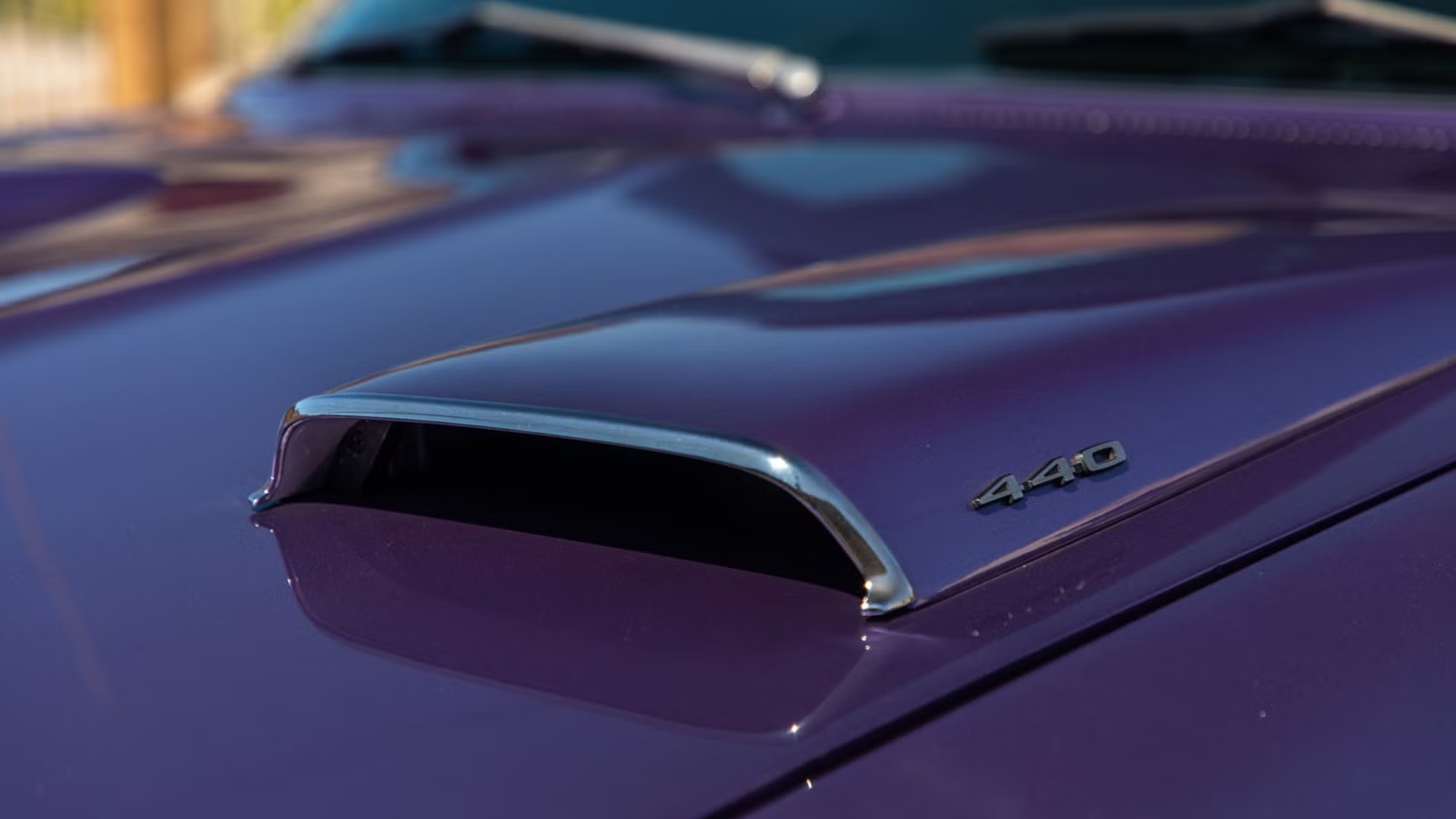
’70 Coronet Hemi R/Ts actually sell for way more, like in the $100,000 range, but they are so elusive and hardly ever come up for auction, so there’s a zero percent chance of landing one for the Hagerty value. The base R/T with the 375-hp 440 V8, however, is rather abundant, at least on auction sites, and has a $32,000 good condition value, which has smart Mopar collectors quietly snapping them up. While it may be hard to get a numbers-matching ’70 Coronet 440 R/T for the Hagerty value, Bring a Trailer sold one with a replacement engine that seemed like it was in fantastic shape for $30,000 in 2025. We understand that you probably can’t take your eyes off the Plum Crazy beauty pictured above and want some details, so we’re happy to report that it was in excellent condition and sold for $56,100, which was a tremendous score for some lucky Mopar fan.
2
1970 Dodge Super Bee 383
Good Condition Value: $34,700

The 1970 Dodge Super Bee is the same basic car as the 1970 Coronet R/T but, unlike its brother, it doesn’t suffer from severe undervalue-itis. A ’70 Hemi Super Bee has a top condition value of $175,000, which is almost $30,000 more than the R/T, and beats it easily at all condition levels. The weird thing is, the Super Bee is also way less rare with 15,506 units including 1,268 Six-Packs and 36 Hemis. We’re going to offer an unprovable theory that the name Super Bee simply sounds far cooler than Coronet, which may explain this price discrepancy. Maybe having a furious bumblebee logo on the rear quarters conveys a sense of street performance more than the letters R/T do — and ironically, those letters stand for Road and Track. Whatever the case is, they were more popular back then and that streak has continued until today, as these cars really move at auction.
Six-Pack and Hemi Super Bees are out of the question for most people of average means, but collectors are starting to realize that a base model can deliver a killer ride at an even more killer price. A ’70 Super Bee with a 335-horsepower 383ci big-block has a good condition value of $34,700, which rocks no matter how you look at it. Be warned, though, as even the 383’s price can rise dramatically, with a Concours condition value of $111,000 that surpasses any classic era base model muscle car. They really do sell for that and more, as one dropped the gavel at Mecum Harrisburg 2024 for an astounding $154,000. That was a truly exquisite rotisserie restoration and not indicative of average prices, so it’s possible to get a great ’70 Super Bee 383 for much less, like the stunning example pictured above that went for $63,250 in 2024.
1
1971 Plymouth Road Runner 383
Good Condition Value: $43,500

People were a little weirded-out by the radical “fuselage” body style of the second-gen Plymouth Road Runner at the time, but now it looks positively beautiful in a seriously badass kind of way. It’s a shame that it only got to enjoy one year with performance to match, as the 440 6BBL (Plymouth’s name for the Six-Pack) and 426 Hemi were discontinued after 1971, with the Malaise Era of detuned engines plaguing all of Detroit. Another strange tidbit about this classic muscle car is that second-gen Road Runners, like third-gen Chargers, weren’t always recognized as collectible. They sure are now and, in fact, have become the most valuable B-body cars. A 1971 Charger Hemi R/T sold for $550,000, beating any second-gen by a lot, and a 1971 Hemi Road Runner hit that same dollar amount, doubling the highest-selling first-gen.
In a quirk of the English language, fat chance and slim chance mean the exact same thing, but either way, both describe the likelihood of someone using a half-million-dollar Road Runner as a daily driver or track toy. From its introduction in 1968, the Road Runner was a bare-bones speedster that came standard with a 383 V8, and today that criminally underrated big-block offers the best way to enjoy one of these magnificent machines. The Hagerty good condition value of $43,500 for a ’71 Road Runner 383 is spot on as both Mecum and Bring a Trailer are teeming with listings around that price. Like any classic muscle car, there are going to be special ones that go for far more, and some have sold for nearly $100,000, but this really is the best performance-to-cost ratio of any big-block Golden Age vehicle.
Sources:Bring a Trailer, Hagerty, Mecum

Related posts




Latest Post


No Comments