
Why Olds, Buick And Pontiac Detuned Their Biggest V8s During The Muscle Er
The late 1960s and early 1970s were an absolutely kooky time for General Motors, and the American auto biz on the whole. Not only were the muscle car wars in full swing, but even the non-muscle stuff could be optioned with a V8 engine so large it might as well have had a gravitational pull. It didn’t matter if they got two or three gallons to the mile or put out enough smog to blind an entire city. Back then, things were simpler, as were the pleasures. Yet, over time, that zenith had to wane. Often, this is written off as being down to the 1970s oil crisis. In truth, the timeline turned out just a little bit differently.
1970: The Year Everything Changed

Okay, let’s paint the scene for you. The year is 1970, and every American OEM is in a mad dash to shove engines of ever-increasing size into ever-smaller vehicles. Except, on the part of GM, there was at least a little bit of pushback from the big wigs in Detroit. As for their much-adored A-platform intermediate cars from Chevy, Pontiac, ‘Olds, and Buick, the entire line was barred from using an engine bigger than 6.6 liters or 400 cubic inches. Now, while that might not sound like a restrictive upper limit, it did lock the A platform out of the upper echelon of great GM engines in the day.
Ostensibly, this policy was adopted in the name of some token form of corporate responsibility, safety, insurance risks, or whatever other buzzword GM’s higher-ups came up with that week. In reality, the company’s titanic presence in the American auto industry, as much as half of all cars sold in the late ’60s, meant the legal hammer was bound to fall harder on GM than on its competitors should federal regulators decide to crack down on performance. Surely, it was a move conjured up by GM’s lawyers and executives, not its engineers.
The 400-cubic-inch cap stayed with GM through the late 1960s. As a result, the firm didn’t have much of an answer to Ford and Chrysler’s mid-size street beasts, complete with 440s and 428s of ever increasing power. By 1970, the lack of a hard counter to the 440 Six-Pack Charger and Road Runner, or the 428/29 Ford Cobra Jets, was something GM’s bean counters couldn’t ignore any longer. That same year, General Motors formally lifted the cubic inch hard limit on its intermediate cars. With that, Pontiac, Buick, and Oldsmobile were all free to go nuts with it.

455 Cubic Inches: A Magic Number for General Motors

Shoutout to Chevrolet and their 454-cubic-inch big block V8, its inclusion in Chevelles, Monte Carlos, and El Caminos of all stripes made for some real fun in the first muscle car revolution. Still, that one extra cubic inch afforded to three other GM brands seemed to really increase curb appeal. The fearsome trio of ‘Olds, Buick, and Pontiac were hard at work developing and adapting 455-cubic-inch V8s for their mid-size platforms as soon as the restrictions were lifted.
The first of the fold to field a car in this configuration was Oldsmobile, which once briefly worked around the ban in 1968 by outsourcing the problem to Demmer Engineering, resulting in the Rocket 455-powered Hurst/Olds project. Its first legit OEM mid-size 455 offering was the 1970 4-4-2, supplanting the standard 400-cubic-inch Rocket V8 with the larger 455 as the line’s new flagship. From there, other offerings like the Delta 88, the Ninety-Eight, and the Cutlass Supreme were free to use the 370-hp, 500 lb-ft Rocket 455 as well. Not far behind was Buick, which promptly developed its own bespoke 455-cubic-inch motor. Complete with high-flow cylinder heads and a beefy 4.31-inch bore, the Buick 455 was a match made in heaven for the mid-size 1970 Gran Sport.
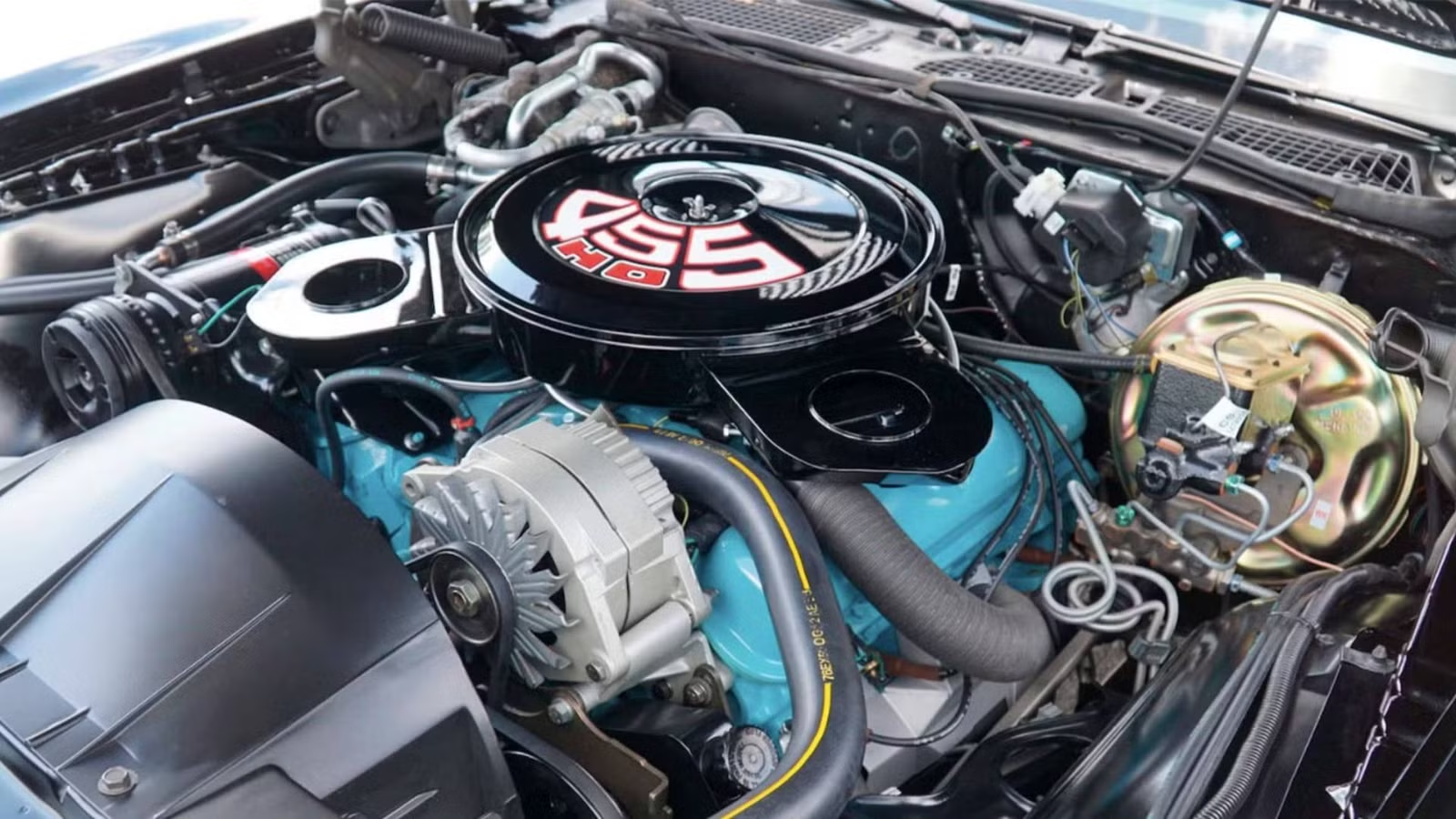
At 350 horsepower and 510 lb-ft of torque, it was every bit as potent as its corporate brothers, and possibly slightly more so at the very low end of the power band. Meanwhile, Pontiac’s own 455 motor replaced the previous 428-cubic-inch powerplant, which left production in 1969. By 1971, the tuned High-Output (HO) variant was ready to drop into the Grand Prix, Firebird Trans Am, and the arguably original muscle car, the GTO. At 335 horsepower and 480 lb-ft of twist, all three GM 455 V8s were in the margins of each other performance-wise. At least, they were at first, and it wouldn’t stay that way for long.
The Detune Years: It’s All in the Carburetor

Take everything we just said about GM 455s and understand that those power figures came when equipped with four-barrel carburetors, usually Rochester Quadrajets paired with dealer-spec’d performance packages. One would think there’s no good reason to package a V8 7.5 liters large with anything else, but GM’s top brass had other ideas. For starters, OEMs never had to give a single thought to exhaust emissions until Richard Nixon’s EPA formed in December of 1970.That is, almost exactly at the same time GM lifted its restrictions on huge engines in mid-size cars.
Years before the OPEC nations went into a tizzy, newly minted emissions restrictions forced GM to drop engine compression across the range. Starting in 1971, no GM engine, no matter how big or small, had a compression figure larger than 8.5:1. Had forced induction been involved, that might not have been a problem. Instead, it meant the whole range of GM 455s lost between 50 and 70 gross horsepower right when they needed it the most. Of course, GM’s marketing department tried to spin the deal as a positive.
In effect, they argued that a restricted engine with a two-barrel carburetor was somehow smoother and more subdued than one equipped with a fire-breathing Rochester Quadrajet. Performance figures of the day surely conveyed as much. Don’t believe us? Just look at the 1971 Rocket 455 2-barrel optioned in a Delta 88 or Cutlass Supreme SX. On the official spec sheet you were handed at the dealer, it made around 310 to 320 gross hp at the crank. The reality was far different, as choking 7.5 liters through two small primary venturis meant that top-end power effectively ceased to exist above 3,500 RPM. The Pontiac and Buick 455s were no different, with the Pontiac engine dropping to 280 gross hp with a two-barrel, and Buick’s base 455 hitting 315 hp in a single model year.
The Downfall, and Engine Consolidation

Only in 1973 did the global oil crisis rear its ugly head, and not for any reason related to the American auto industry. By then, GM’s lineup of 455 motors was already on the ropes. With the first wave of fuel-sipping Japanese imports primed to hit the market any day, the prospect of a big, useless, neutered 7.5-liter big-block motor was suddenly as ridiculous then as it is in hindsight.
The whole line of 455s wouldn’t last much longer past then, and by 1976, the party was well and truly over. After that, GM’s offerings south of Cadillac would effectively go back to pre-1970 standards, and Chevrolet motors like the 350 small block became ubiquitous across the GM lineup. From an excitement standpoint, that was a savage blow indeed, one that heralded the end of the first great muscle car renaissance.
Source: General Motors

Related posts




Latest Post


No Comments