
The Analog Supercar With Hyundai Sonata Taillights
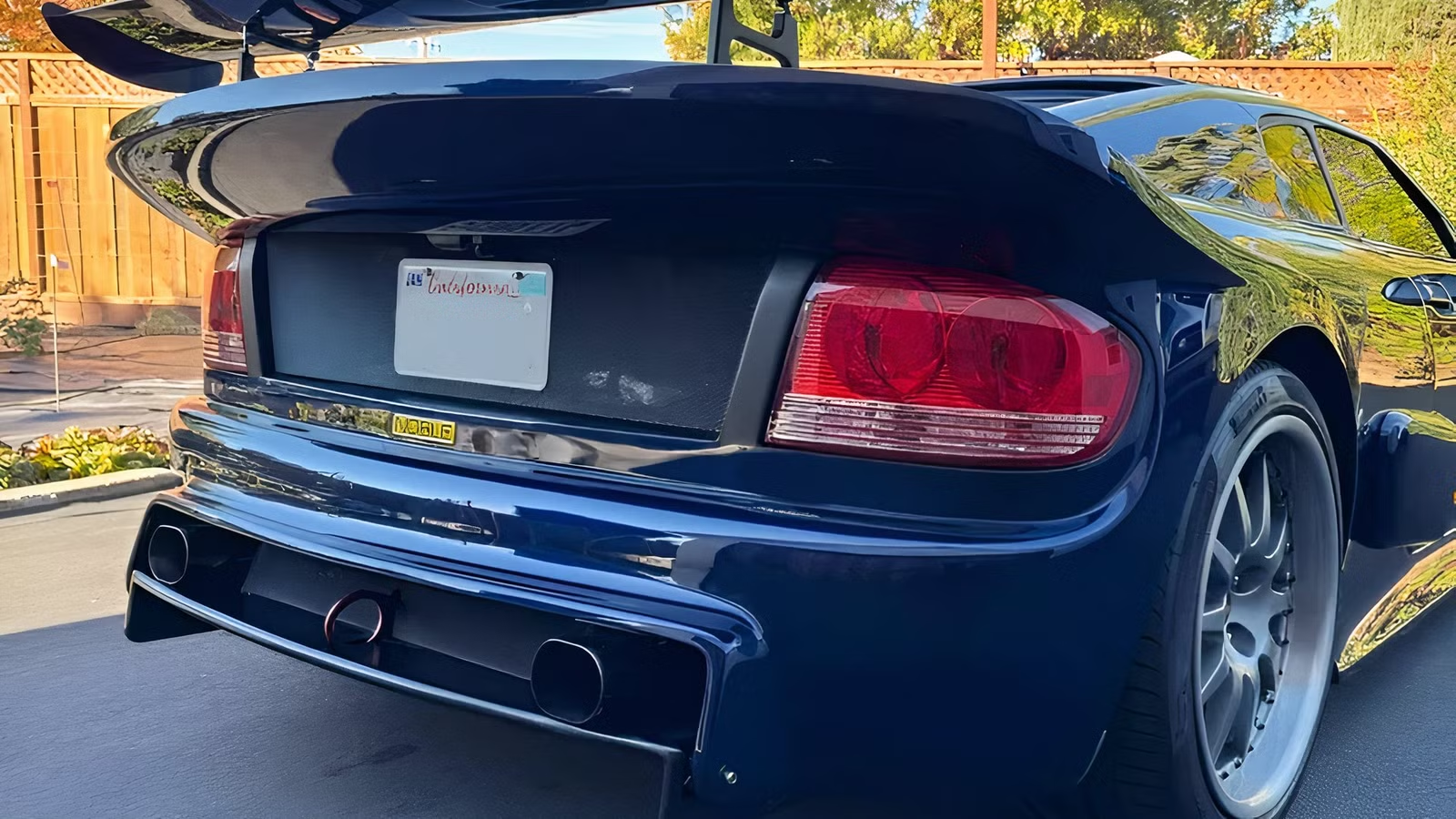
Does anyone else feel like Supercars have gotten soft lately? We’re not talking about over the last five or even ten years either. We’re talking about everything over the last quarter-century or so. When a hardcore speed machine with 600-plus horsepower and a 200-plus-mph top speed is as easy to drive as a Lexus, is it even that hardcore to begin with? Evidently, that’s what one particular English supercar maker believed, and in that regard, it was ahead of the curve on curtailing the “wussification” of the supercar.
When Supercars Got Cushy

There’s no set date and time you can point to and declare it’s when the supercar form factor went soft. Still, if you want a good rough estimate, you can track it back to when Audi/VW purchased Lamborghini back in 1998, beginning an erawhere German corporate engineering diluted the raw, unrefined Italian nature of the country’s second biggest supercar maker until it was little more than an Audi with tinsel.
Soon enough, the rest of the exotic establishment followed, for the worse and not for the better. By the mid-2000s, Ferrari was pushing its F1 automated single-clutch gearbox across the lineup when the masses wanted a third pedal. Meanwhile, Porsche was layering multi-stage stability management and active dampers onto the 911 Turbo, and McLaren’s return to the supercar business hitched off the back of a plush Mercedes GT car.
Curb weights also swelled to colossal numbers in those years, quietly creeping north of 3,000 lbs as leather-lined cabins, sound deadening, and factory AWD powertrains became nearly mandatory. Compared to the raw, unfiltered world of ‘80s and ‘90s supercars, the 2000s were a whole different ballgame. There were some exceptions, of course: the Saleen S7, the Ford GT, and the Porsche Carrera GT immediately come to mind. Still, there was one firm that bucked the trend better than anyone.

A Little Brand in England Does Supercars the Right Way

Based out of Leeds in West Yorkshire and founded in 1999, Noble Automotive looked at the trend the supercar sector at large was heading toward right when things went sideways, and decided it was a load of rubbish. Instead of chasing bragging rights or piling on luxury, founder Lee Noble focused religiously on the two metrics that actually matter on a twisting circuit, low mass and epic mechanical grip.
The brand’s first car, the M10 convertible, used a mid-mounted 2.5-liter V6 and weighed just barely over 2,100 lbs. Over the next few years, Noble refined its focus into a more true-to-form, low-slung supercoupe design language, incorporating aggressively styled bodies and twin-turbo engines in cars like the M12. The M12 lacked ABS, traction control, stability management, or just about anything the rest of the supercar market took for granted. It relied on a stiff tubular steel space frame, double-wishbone suspension, a twin-turbo Ford Duratec engine, and a six-speed manual transaxle to deliver pure mechanical feedback.

The M12 was as pure of a driving machine as existed in the early 2000s. Faster than a Lotus Elise and more hardcore than a Ferrari 360, Noble had nowhere to go but up. Of course, given the classic English “man-in-a-shed” engineering strategy Noble employed, the M12’s follow-up would need to cut a corner or two. The result was borrowing from the parts bin of none other than Hyundai. No seriously, they did.
The Noble M400: A Brilliant Supercar, With Bits Borrowed From a Hyundai

Unveiled for the 2004 model year, the Noble M400 took Lee Noble’s lightweight formula and perfected it. Its name wasn’t a reference to engine output, but rather to the 401 bhp per metric ton its Ford Mondeo ST220-sourced Duratec V6 cranked out when paired with its lightweight body. Based loosely on the chassis of the outgoing M12, the M400 swapped in forged pistons, upgraded Garrett T28 turbochargers, stiffer spring rates, and a Getrag six-speed manual transaxle to push performance up to 425 horsepower and 390 lb-ft of torque.
Zero to 60 was handled in the low-to-mid three-second range, and its immense raw grip pulled 1.2 Gs of lateral grunt on the skid pan, all without ABS or traction control. In the era of the Gallardo Superleggera and the F430 Scuderia—not exactly two timid machines—the M400 still felt like an unfiltered, feral animal. Out back sat the ultimate punchline to its giant-slaying resume: a pair of taillight clusters lifted straight off a fourth-generation Hyundai Sonata, mounted upside down and tucked cleanly into the fiberglass rear clamshell engine hatch.

It’s one of those automotive tidbits you’d only know if you were an obsessed gearhead who pauses track-test footage just to study an M400’s rear end. Yet it’s one of the most amusing and somehow one of the most down-to-earth factoids in automotive history. Safe to say, the M400 was around for a good time, not a long one, with just 209 made between 2004 and 2007: 133 for the US market, 48 for the UK, and 28 for the South African market where the car was built.
A Modern-Day Supercar Bargain

Outside of the Hyundai parts, the most fascinating fact about the M400 in 2026 is just how cheap they are to buy. While its Lamborghini and Ferrari rivals are still multi-six-figure collector’s items, you can buy an M400 online for as little as $50,000. Because US-market cars were imported as rolling component chassis through Ohio-based 1G Racing and titled individually, they also sidestepped a lot of the red tape and maintenance overhead that makes contemporary Italian exotics so intimidating to own and service.
Overall, the M400 was one of those cars that should have been overshadowed by the big boys, yet outshined them almost every time it showed its face. In the end, it had nothing at all to do with the Hyundai taillights.
Source: Bring a Trailer

Related posts



Latest Post


No Comments