
The Underrated 1971 Super Bee That Even Collectors Forget Beside The Six Pack
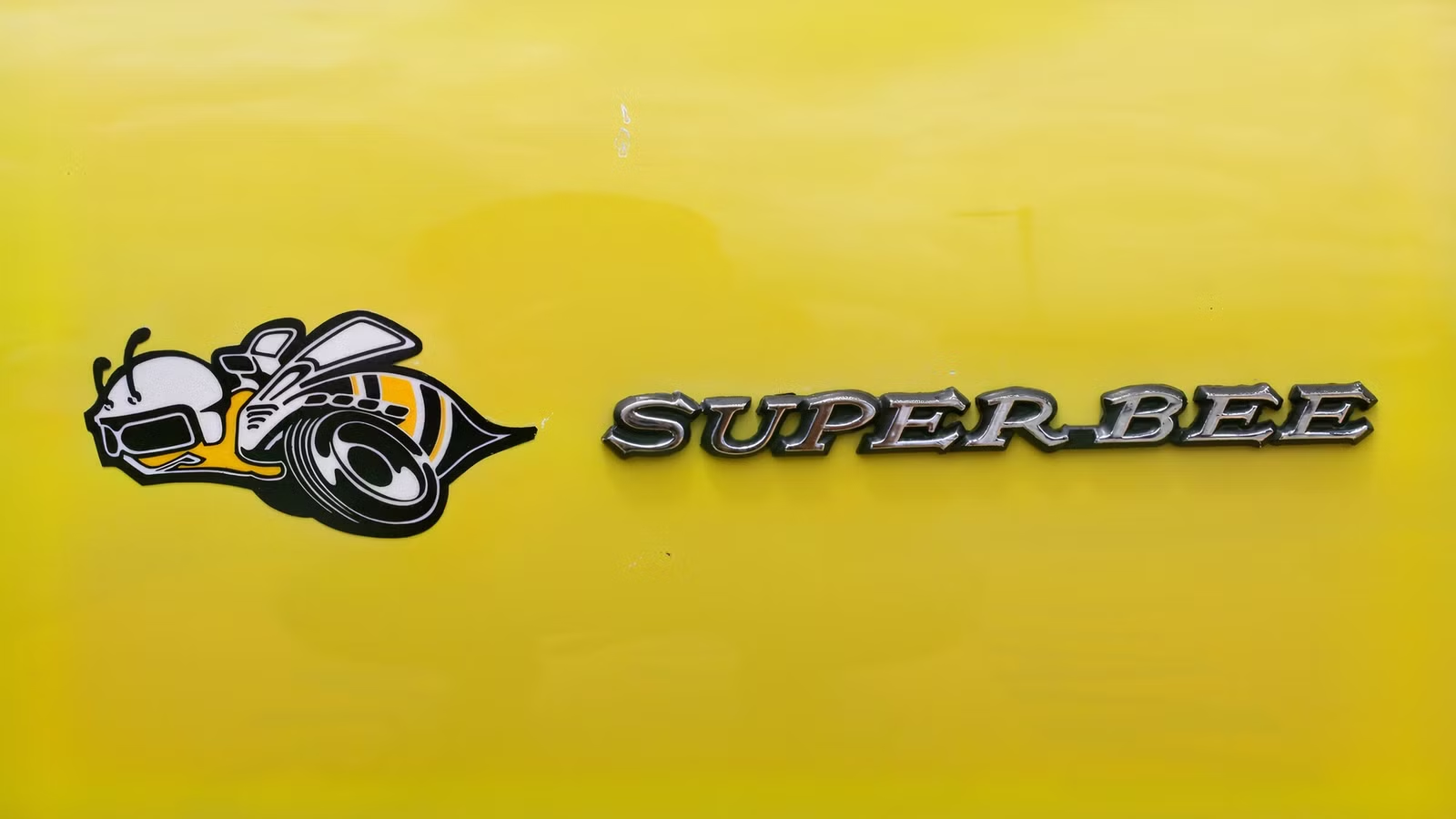
A Six Pack badge gets attention. This 1971 Super Bee needs just one character in its VIN. On a documented survivor, WM23 looks familiar enough, but the fifth character puts the car among only 26 recorded builds out of 5,054 Super Bees for 1971. That is an awfully small club for something that can look so ordinary parked beside a Six Pack.

Earlier Coronet Super Bees have their own following, but this Dodge hides its best story in the paperwork. Miss that fifth character and you could walk straight past one of 1971’s rarest Bees without realizing what you just saw.
The Super Bee Had Just One Year In The Charger Line
The Super Bee changed addresses for 1971, and Dodge wasn’t exactly gentle about the move. The Coronet was left handling sedan and wagon duty, while the Charger took over the two-door business, Super Bee included. Looking through the Dodge Coronet generations helps explain the family reshuffle, while Dodge’s 1971 fleet catalog shows Chargers on one side of the showroom and family-minded Coronets on the other. The Coronet R/T and its Hemi-powered story belonged to the earlier setup. For the original American Super Bee, 1971 was its one and only year living in the Charger line.

That matters when you’re staring at a listing and trying to work out what you’re actually looking at. A genuine 1971 Bee belongs to a different place in Dodge’s lineup than the earlier Coronet-based cars, and the later revivals don’t turn this Charger-based version into a multi-year model. Dodge changed the body and its place in the showroom, but not the basic idea: serious muscle without making buyers start with the pricier R/T. Same Bee attitude, different address.
The Super Bee’s history guide lists a $3,271 base price and a standard 300-hp 383 V8, with a bench seat standard and buckets available for extra money. But shiny wheels, fresh stripes, and a nice interior can only tell you what a car looks like today. They can’t tell you what Dodge built. The engine menu makes that especially important because 1971 was also the only year the original American Super Bee offered the 275-hp 340 small-block. So even before the really obscure big-block enters the story, this one-year Charger-based Bee is already telling collectors not to judge the lineup by the badges alone.
The Six Pack And Hemi Took The Spotlight

The Six Pack doesn’t exactly sneak into a conversation. The Super Bee optional-equipment descriptions list three two-barrel carburetors, 385 horsepower, and a V in the VIN for 1971. Then there’s the R-code 426 Hemi: 425 horsepower and two four-barrel carburetors, backed by the kind of reputation that keeps Dodge’s 426 Hemi models famous decades later. Both engines announce themselves. The Super Bee we’re looking for doesn’t have that luxury.

1971 Dodge Super Bee 440 Six Pack Engine Bay
The numbers make that easy to miss. The 440 Magnum Network’s table records 99 Six Pack Super Bees in its U.S.-shipment breakdown and 22 Hemi cars, plus one additional Hemi shipped to Canada. The forgotten configuration? Just 26 recorded builds. That makes it rarer than the Six Pack and one of the rarest 1971 Super Bees, but not the rarest. The Hemi still wins that argument.
There is one catch with those numbers. The same production source lists 5,054 Super Bees overall but 4,325 U.S. shipments, so the engine breakdown can’t be treated as a complete worldwide census. Still, the contrast is hard to ignore. The Six Pack is extremely scarce, yet everybody knows its name. This other version can disappear beside it because the important difference isn’t screaming from the air cleaner. It’s buried in the combination of model, engine, and factory identification. And that brings the whole story down to one character in the VIN.
The Forgotten Version Is The U-Code 440 Magnum

1971 Dodge Charger Super Bee
The mystery ends with one letter: U. In the fifth VIN position, it identifies the 440 Magnum with a single four-barrel carburetor, the combination behind those 26 recorded Super Bees. One documented survivor was advertised with the partial VIN WM23U1E120xxx, but a seller’s paperwork is only a starting point. The registry’s VIN decoder explains the important pieces: W identifies the Charger line, M is the Super Bee’s medium price class, 23 means two-door hardtop, U identifies the engine, and 1 marks the 1971 model year. Beside the famous Six Pack hardware, that single four-barrel can look almost ordinary. The VIN says otherwise.

That M matters almost as much as the U. A 1971 Charger R/T uses S for the Special price class, giving it a WS23 body code instead of the Super Bee’s WM23. Dodge’s R/T badge has its own story, but the distinction here is simple: a U-code R/T is not one of these 26 Super Bees. The 440 four-barrel was standard R/T equipment, so finding that engine under a Charger’s hood proves very little by itself. VIN, fender tag, available broadcast sheet, and other documentation need to agree before the rarity claim starts carrying real weight.

The survivor count needs the same caution. Seven documented examples is the reported figure, and the registry’s engine-summary table currently lists seven U-code cars. Yet a comparison line on that same page still says six of 26. That mismatch means we can’t cleanly claim exactly seven survive worldwide, especially when an unregistered car could still exist. So if a listing calls a car a factory U-code Super Bee, ask for clear photos and readable records, then have the identification checked properly. An installed 440, a Super Bee emblem, and a confident seller aren’t enough. On this car, authenticity lives in the details, and that’s what separates a rare factory combination from a good story.
The Paperwork Puzzle Is Still Part Of The Appeal

Muscle-car history would be much easier if the paperwork always agreed with itself. This one doesn’t. The specialist broadcast-sheet decoder assigns 370 horsepower to the U-code 440 four-barrel, while a separate specifications page lists 375 horsepower and 480 lb-ft of torque. Those numbers don’t explain themselves, so calling the difference a simple gross-versus-net conversion would go beyond the evidence. For now, the safest conclusion is also the least exciting one: the published references disagree.

The ordering question is just as stubborn. Production records show 26 U-code Super Bees were built, while the available Super Bee option material highlights the Six Pack and Hemi without clearly listing the four-barrel 440 as a regular engine choice. That doesn’t prove buyers couldn’t order one; it means the route remains unresolved until stronger period documentation turns up. The same goes for why only 26 exist. Insurance costs, emissions rules, Chrysler product planning, factory mistakes, and special orders all make tidy stories, but the available evidence doesn’t establish any of them as the answer. Sometimes Mopar history simply refuses to finish the sentence for us.

Broader Super Bee figures are easy to misapply to the U-code car. The specialist specifications page lists 3,945 pounds for a Six Pack test car and 4,083 for a Hemi, so neither figure tells us what every 1971 Charger Super Bee weighed. Pricing needs the same care. The 1971 Super Bee market page shows a $74,213 market benchmark for the broader model, not a median auction value and certainly not a U-code appraisal. Condition, originality, and documentation still decide what an individual car is worth. That’s part of the charm here. The single four-barrel isn’t wearing a neon sign that says “unicorn.” The correct M-and-U combination does the talking. Give the Six Pack its moment, then check the quieter car’s fifth VIN character.
Sources: 71SuperBee, HamTramCK, Dodge

Related posts



Latest Post


No Comments