
The Honda V4 Flagship Killed By A Tariff And A Rulebook Before Launch
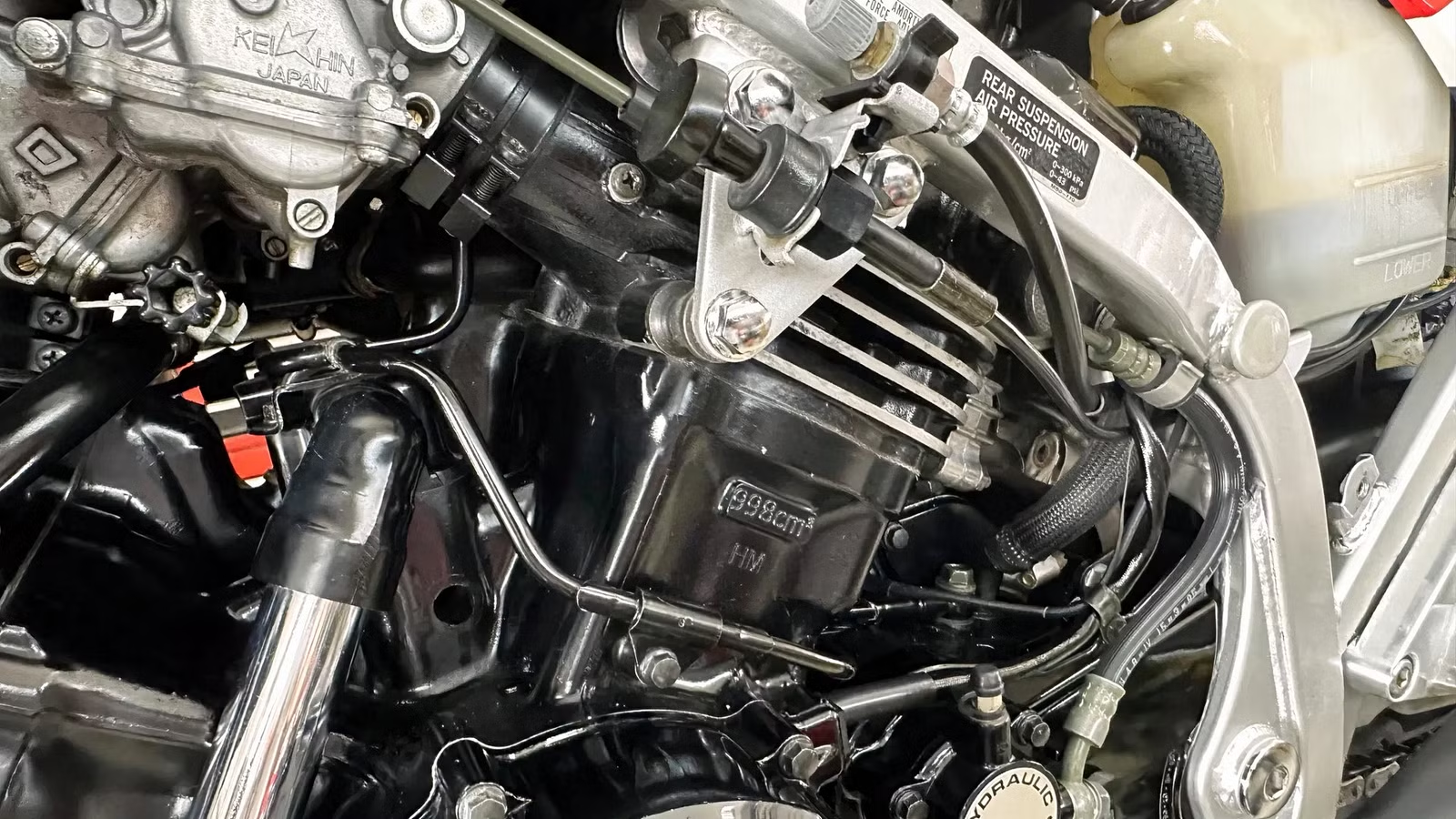
Gear-driven cam whine, genuine technological innovations, and the fastest speeds available on a road bike at the time all sound like the recipe for a genre-defining superbike. But while this Honda V4 had everything it needed to be a success, the landscape changed faster than Honda’s sketchboards could keep up with. It meant that the bike launched into a world that didn’t exist when it first picked up the pen, and it suffered because of it.
The Best Superbikes Of The 1980s Weren’t Always Defeated On The Road

The 1980s were the golden era of Japanese superbikes. Engines were increasing in size, technology was improving, and race-inspired engineering was making its way to road-going machines much more commonly, as the big four of Honda, Yamaha, Kawasaki and Suzuki all vied for road and race supremacy. Every year the benchmark was raised, as the battle for the fastest and most powerful bike hadn’t yet been curtailed by threats of government intervention as it would with 1999’s Suzuki Hayabusa. But while that battle wasn’t on the horizon yet, there were still threats from governing bodies.
Tariffs And Racing Rules Changed The Superbike Arms Race Overnight

Governments and racing organizations were rewriting rules as quickly as manufacturers could make bikes that contravened them, particularly in 1983, when the US government imposed a 45% tariff on imported motorcycles with engines larger than 700 cc. Intended to help Harley-Davidson recover from growing competition, the measure dramatically increased the cost of large-displacement Japanese motorcycles entering the US market Although the tariff was scheduled to decline each year before expiring five years later, it effectively shifted the market toward 700 cc models during its lifetime.

With the import tariff in place, Japanese superbikes like the Suzuki GS1100E and GSX1000S Katana, Kawasaki’s GPZ1100, and even Honda’s CB900F were suddenly far less economical options for those wanting performance. Brands responded by creating 700 cc superbikes like the Honda VF700F Interceptor, the Kawasaki Ninja 700R, and the Yamaha FZ700, but it was a blow to the superbike genre in the US as it placed a premium on performance.
At the same time, racing regulations were also closing in on bikes. The 1,000 cc classes that Honda in particular favored — things like TT-F1, and, in the US, the AMA Superbike Championship — were increasingly moving toward a 750 cc format, reducing the need for the big 1,000 cc homologation bikes that Honda was used to creating. This put manufacturers in a tricky spot. Should they take a considerable hit, abandoning the development work already done on the race-inspired bikes, or should they forge ahead with a project that was doomed to fail? Honda opted for the second.
Honda’s VF1000R Was Already Fighting A Battle It Couldn’t Win

When it was first introduced in 1984, the VF1000R was set to be Honda’s flagship V4. It was designed as a homologation-style machine, borrowing heavily from Honda’s endurance racing technology even though it was not built to homologate a production race bike. Still, it had the full endurance-style fairing, the clip-on handlebars, and the stiffer frame associated with a race bike, along with twin rectangular headlights up front. On the mechanical side, the bike had a five-speed gearbox, while the engine received higher compression, higher redline (10,500 rpm), and, crucially, more aggressive cam profiles.
These camshafts would be what the bike was best-known for. With the VF1000R intended to be Honda’s most technologically advanced V4, Honda did away with the usual cam chains and instead opted for gear-driven camshafts taken directly from its 1982 AMA Formula 1 Championship-winning FWS1000 works endurance racer. And this was a crucial difference.
Cam belts could stretch and wear out, so servicing and maintenance was required to ensure no power was lost, and no extra vibration was added to the engine. Honda’s gear-driven cam system addressed this by using a nine-gear train to drive its camshafts, eliminating the issues of cam belt stretch, giving the bike almost zero timing variation, and removing the need to replace a belt. It was a more expensive solution than a conventional belt, but the VF1000R wasn’t meant to be a cheap bike — it was a bike Honda was using to prove its technological might. Of course, this also gave the bike its distinctive whirring sound — the sound of a race bike at full throttle.

The bike was released in 1984, but only in Europe; Americans had to wait an extra two years to get their hands on the bike and, by the time they did, it had undergone some changes. The engine’s output was lower, for one, coming in at 117 horsepower compared to between 122 and 130 hp in Europe, the change being due to emissions regulations implemented by the EPA and the Department of Transportation. The US version also had to have a single headlight rather than the two circular ones on the European bikes, and it had different tires (Europe had Bridgestone radial tires, while the US version got Dunlop bias-ply tires), though the changes became negligible after that. By this point, though, the bike was made for a world that no longer existed.
At 582 pounds dry (over 600 pounds wet), the bike was undeniably heavy. Yamaha’s FJ1100 weighed 556 lbs wet despite offering 10% more displacement, while the Suzuki GSX-R1100 was 554 lbs wet and offered an extra ~100 cc. This was largely due to the bike’s distinctive V4 engine, as the aluminum frame and lightweight bodywork were doing their jobs. It still reviewed somewhat well and became the first bike to go faster than the Vincent Black Lightning in 35 years, but it had been born into a world that was shifting away from what the bike represented, and it answered a question that people were no longer asking. As such, while not a technical failure, it was a commercial disappointment.
The VF1000R Became Honda’s Most Important “Failure”

The VF1000R was, in some ways, ahead of its time. Its aluminum frame provided race-bike stiffness, while its gear-driven cam system would go on to be used for decades. The “mistake” of the VF1000R wasn’t in its design nor its technology, but its timing. But the bike’s commercial failure paved the way for later models to succeed.
Honda carried what it learned with the VF1000R forwards into its VFR750R RC30, which became one of the most celebrated race replicas ever produced as the race version of the bike won the first two World Superbike seasons in 1988 and 1989.
The technology also carried forward through Honda’s V4 lineup, including the VFR750F and later VFR models, while the exotic NR demonstrated Honda’s continued willingness to pursue unconventional engineering. The bike took over as Honda’s flagship V4 and created a far greater legacy for innovation than the VF1000R ever had, proving that while it didn’t work in 1984, it would work one day. And that’s the true legacy of the VF1000R. It’s not about what the bike itself achieved, but what it helped other bikes to accomplish.
Why Collectors See What Buyers Couldn’t In The 1980s

In the 1980s, the Honda VF1000R was a heavy superbike that arrived at the wrong time. But, with the benefit of hindsight, the bike has become appreciated for where it fits into Honda’s history: a gateway into its V4 lineage that would inspire the legendary RC30, with the focus on performance that Honda would become synonymous with.
Good-quality examples sell for between $6,000 and $8,000, though a 1,290-mile bike sold for $25,787 in April 2023. This might seem a high price. However, when subsequent editions like the RC30 and RC45 sell for around $51,700 and $66,500 respectively, it’s a comparative bargain for a bike that offered the performance, the reliability, and the character of a real superbike that had been legislated out of existence before it truly had a chance.
Sources: Iconic Motorbike Auctions, Honda

Related posts
Latest Post


No Comments