
The Four-Cylinder Sports Car That Delivers Supra Levels Of Fun For Less
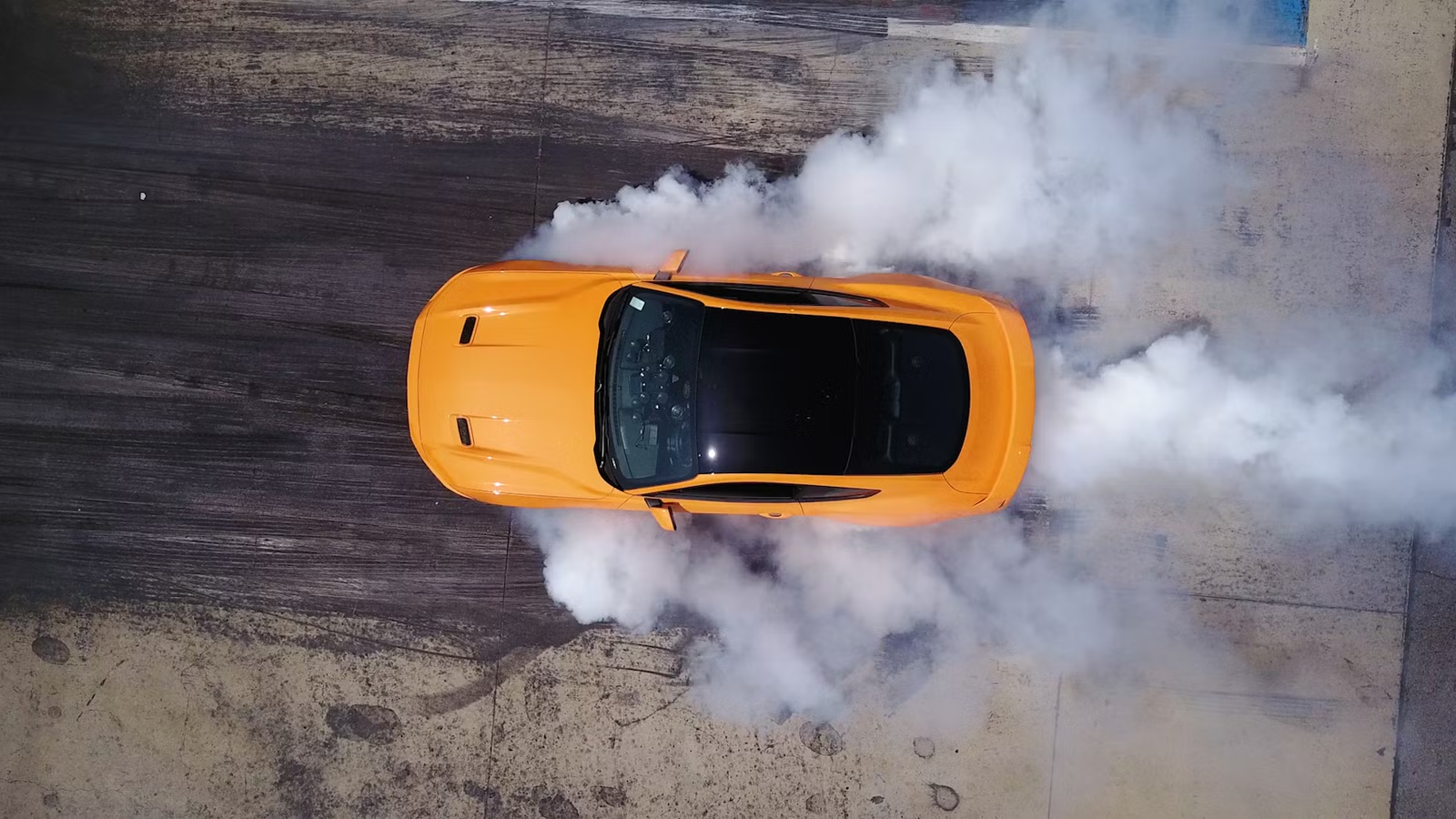
The fifth-generation Toyota GR Supra is no more in North America, and everywhere else in the world, for that matter. From the most powerful three-liter straight-six to the diminutive two-liter four-pot, the BMW-based Gen-V Supra was produced so sparingly that it still commands a premium on the used market. It’s not hard to understand why, but there are certainly cheaper, and some would argue, better alternatives. Join us as we detail which base Supra alternative we think is the best.
The 2.0 Four-Cylinder Supra: A Curious Beast in a Sea of Straight-Six Rockets

You’d be forgiven for not realizing Toyota even made an entry-level variant of the ever-controversial GR Supra. Well, that would be inaccurate, as BMW developed the car and had it built at the Magna Steyr plant in Austria. With 255 horsepower and 295 lb-ft of torque at its disposal, the four-cylinder GR Supra should have been an entry-level sports car for the ages. The kind of working-class hero car that won’t break the bank at the financing desk but still delivers all the thrills of a rear-drive sports car.
Well, that’s not what happened to the entry-level Supra at all. For one thing, only a small fraction of US GR Supra imports sported the smaller two-liter four-pot. The three-liter straight-six with a manual transmission was effectively the only variant buyers in the States cared for at all. Though sales figures from roughly 2020 to 2024 are hard to come by, estimates peg the two-liter GR Supra as accounting for just ten percent of total sales Stateside.
With such limited production, a base MSRP of $46,440 in 2024 never really went down after the GR Supra was sunset earlier this year. In its new second life as a used-market curiosity with seemingly endless resale value, it is genuinely difficult to find a decent example for under $35,000. Given the kind of performance figures we’re dealing with here, we can think of one very good, all-American approach to something similar.

Ford EcoBoost: An American Take on a Turbo GR Motor

Long before Toyota dreamed of reviving the Supra, Ford was hard at work formulating a direct-injected, turbocharged line of engines that serve the same purpose as the B48 engine in the GR Supra. On that note, the 2.3-liter variant introduced in 2015 is as direct a parallel to a Supra four-pot as Ford makes. With 10.63:1 compression and supplementary port fuel injection on top of the GDI system, this particular EcoBoost four-pot is one of the most advanced ICE motors Ford has ever built.
These strengths make it an excellent engine in non-sports car applications. In standard applications like the Ranger mid-size pickup, the Jeep-rival Bronco, and the full-size Explorer SUV, the current iteration of the 2.3 EcoBoost four-cylinder provides near-V8 levels of performance with much-improved fuel economy.
We’re talking 24 MPG combined in a rear-wheel-drive Explorer, with 300 hp and 310 lb-ft of torque. In a V6 Explorer from 20 years ago, you would be lucky to average half of that. That only makes the EcoBoost four-cylinder an even bigger achievement, but it is far from the most notable application of this engine.
2024-Present S650 Mustang EcoBoost: A 2.0 Supra’s Natural Adversary

If you put an SN95 Mustang GT from 30 years ago up against the equivalent Supra, no one who is not completely biased against JDM vehicles would pick the pony car. What a difference 30 years makes. Nowadays, at least on the entry-level side of things, a four-cylinder S650 Mustang absolutely trounces a four-cylinder GR Supra.
The Mustang has a staggering 60 hp advantage over the GR Supra, albeit tempered by an extra 350 lbs of weight compared to the Toyota. Zero to 60 is handled in between 4.7 and five seconds by the two-liter GR Supra, compared to roughly 4.5 to 4.7 seconds in the Mustang. Because of the weight differential, a quarter-mile race is sure to be neck and neck, with both averaging runs in the mid-to-high 13s. Despite the Mustang’s significant weight disadvantage, the GR Supra stops less than ten feet shorter, and it is dead even with the EcoBoost’s Performance Package equipped with four-piston front calipers.
Around corners and in hard braking situations, a 90s Mustang would coat itself with oil trying to compete with the equivalent Supra. Nowadays, things are far less one-sided. That EcoBoost Performance Package unlocks the Mustang’s MagneRide active damping system, along with Brembo brakes and a Torsen limited-slip differential. Even without those extras, a modern Mustang with fully independent suspension featuring MacPherson struts up front and multi-link geometry in the rear is well removed from the unwieldy handler it once was. Still, a GR Supra is still a Supra, and that power deficit counts for little when you can carry more speed through a tight hairpin. In that key metric of handling, the Supra is still superior. But what about the prices?
The Verdict: The Mustang is the Clear Bargain

Ford and Toyota took two opposite approaches with their entry-level rear-drive sports cars. One was a German sports coupe in a finely pressed Japanese suit, produced with scarcity in mind and sold accordingly. The other? That’s the spiritual successor to the highest-selling sports car in American history, one that relied on sure sales volume to justify its cost. Where that pays dividends more than anywhere else is on the second-hand market.
On reputable sites, two-year-old 2024 Mustangs routinely undercut equivalent four-cylinder Supras by as much as $10,000 or more. Never mind that the S650 is a brand-new platform. With the Mustang’s habit of putting the “MASS” in mass production, it outnumbers a 2.0 GR Supra by a factor of at least ten to one. Whether from large marketplaces like CarMax or Autotrader, or newer platforms like Cars&Bids, 2.0-liter GR Supras still fetch $45,000 on the low end to well into the $50s.
By most metrics, that is a significant amount of money for a pre-owned sports car of this size. At the same time, no matter where you look, you will find 2.3 EcoBoost S650 Mustangs with low miles and certified pre-owned warranties for under $30,000. Better still, parts are readily available at Ford dealerships, with no shortage of in-house technicians eager to work on them. The same cannot be said of the GR Supra. Given that many owners skip the warranty and service them at independent European performance shops because Toyota technicians are not adequately trained on the platform, it is easy to see why the Ford has an advantage.
Epilogue: Two Future Classics, for Two Different Reasons

The Mustang has always been a working-class hero, even if much of that reputation is the product of clever marketing on the part of Ford over the years. By the same token, the Supra isn’t beholden to the same set of standards. After four generations of greatness before it, Toyota’s only expectations for their greatest sports car were to push the envelope, and do the unexpected. In partnering with BMW, Toyota certainly did so, and building tens of thousands of them was never going to be a priority.
In that way, the Supra and the Mustang couldn’t be more different. If the fact that they have been compared to each other since the Supra split from the Celica in the mid-’80s says anything, it is that convergent evolution happens as much with cars as it does in nature.
Source: Classic.com, Toyota, Ford

Related posts





Latest Post



No Comments