
Suzuki’s Best Motorcycle Isn’t Its Most Popular
Suzuki occupies a strange corner of the motorcycle business. Its reputation rests on names almost every rider recognizes, including the Hayabusa, GSX-R750, DR-Z, and V-Strom. Those motorcycles earned their status by doing a particular job extremely well, but popularity doesn’t automatically identify the company’s most complete machine. Suzuki’s greatest all-rounder is considerably harder to describe, which may explain why it receives far less attention.
Suzuki’s Greatest Hits Tend To Be Highly Specialized

The Hayabusa remains Suzuki’s high-speed grand tourer, combining enormous straight-line performance with stability and long-distance ability. The GSX-R family approaches the road through a sports bike lens, while the DR-Z4S is built around lightweight dual-sport versatility. Suzuki’s V-Strom range takes another route, prioritizing upright ergonomics, range, luggage, and the ability to keep going when the pavement becomes rough.
Those motorcycles are memorable because their intentions are immediately obvious. They’re also shaped by those intentions. A focused sports bike sacrifices relaxed ergonomics, a dual-sport gives up highway refinement, and a large adventure-tourer usually trades some road precision for comfort and flexibility. Suzuki’s most familiar models have clear strengths, but none represents everything the company knows how to do in one package.
Popularity Rewards A Clear Identity

Motorcycles with simple identities are easier to understand, sell, and remember. The Hayabusa is the brutally fast one. The DR-Z is the dirt-friendly one. The GSX-R is the racing icon, while the V-Strom is the dependable adventure companion. Riders can immediately picture the type of person who buys each model and the roads that motorcycle is likely to spend its life exploring.

A premium crossover is much harder to explain. It’s part sport-tourer, part adventure-style road bike, and part upright superbike, yet it doesn’t fully belong to any of those categories. That ambiguity can make an accomplished motorcycle look less exciting than a famous specialist. It also raises an interesting possibility: Suzuki’s most capable current model may be overlooked because it refuses to fit into a neat little box.
The Best Motorcycle Has To Work Beyond Its Specialty

Calling something Suzuki’s “best” motorcycle requires a broader standard than outright speed, low price, historical importance, or off-road ability. The strongest candidate should be the model that works across the greatest number of real-world situations. It needs to handle the morning commute, a long freeway run, a passenger, full luggage, poor pavement, and a winding mountain road without seeming badly out of place in any of them.
That means combining a strong engine with comfortable ergonomics, useful weather protection, proper braking hardware, and a chassis that remains entertaining after the highway ends. Modern electronics should reduce the work involved in adjusting the bike for different conditions rather than merely adding buttons. Most importantly, the motorcycle should provide enough range and practicality that its owner doesn’t constantly need another machine for another kind of ride.
The Suzuki GSX-S1000GX+ May Not Be The Most Popular, But It’s Seriously Well-Rounded

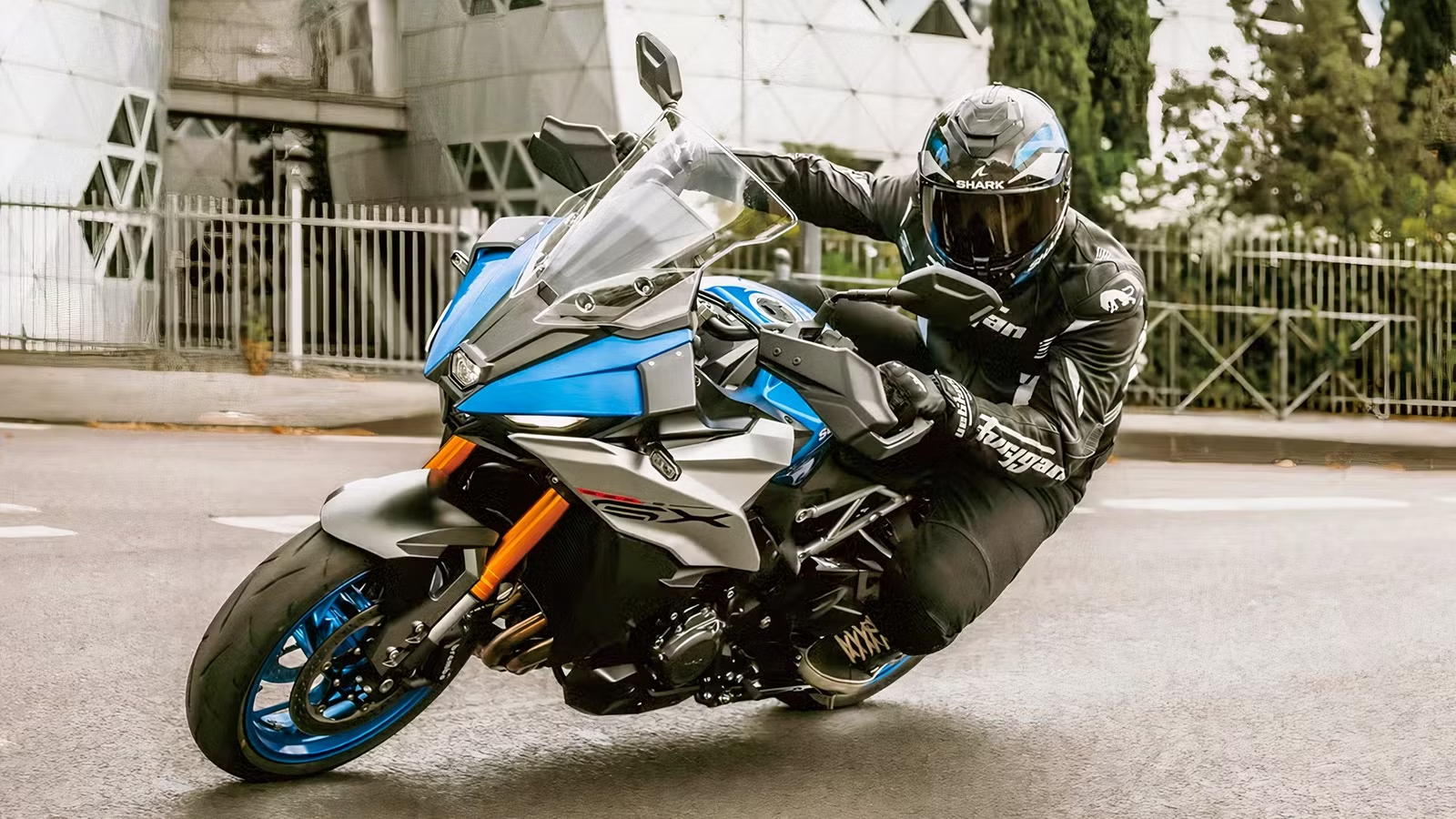
That motorcycle is the Suzuki GSX-S1000GX+, a model Suzuki describes as its flagship luxury crossover. It combines a 999cc, liquid-cooled DOHC inline-four with a six-speed transmission, chain final drive, and a twin-spar aluminum frame derived from GSX-R technology. The same basic package also borrows its upright stance and ergonomics from the V-Strom 1050 while retaining the road-focused character of Suzuki’s GSX-S sport-touring range.
The engine uses a 12.2:1 compression ratio, ride-by-wire throttle bodies, a wet multi-plate Suzuki Clutch Assist System, and a bidirectional quickshifter. Suzuki doesn’t publish official U.S. horsepower or pound-feet figures, but it emphasizes a broad torque curve and strong mid-to-high-rpm performance rather than low-rev adventure-bike grunt. A 4-2-1 exhaust, slipper function, and close-ratio gearbox complete a powertrain that remains closely connected to Suzuki’s sports bike heritage.

The GX+ starts at $18,749, which is serious money for a machine bearing the Suzuki badge, but the “plus” designation includes equipment that would otherwise add significantly to the final bill. Two removable 25.7-liter side cases, each rated to carry 11 pounds and large enough for most full-face helmets, are standard, along with a rear carrier, hand guards, and a center stand.
Comfort is supported by a three-position windscreen with 2 inches of adjustment, wide rubber-mounted aluminum handlebars, a generously padded passenger seat, and wind-tunnel-developed bodywork. For 2026, Suzuki also added winglets to the lower cowling and introduced a Pearl Brilliant White and Metallic Triton Blue color scheme with matching blue wheels. It’s visually busy, but the design serves a clear purpose by blending sports bike aerodynamics with an upright touring riding position.
This Is The Most Technologically Ambitious Suzuki Motorcycle

Justifying the price, the GX+ is the most electronically sophisticated motorcycle in Suzuki’s current lineup. Its Suzuki Advanced Electronic Suspension uses data from the six-axis inertial measurement unit, wheel-speed sensors, and suspension-stroke sensors to adjust damping. Riders can select Hard, Medium, Soft, or a customizable User setting, while electronic rear preload settings account for different combinations of rider, passenger, and luggage.
Suzuki Road Adaptive Stabilization detects uneven surfaces and coordinates the suspension, throttle response, and torque delivery to make broken pavement less disruptive. The wider Suzuki Intelligent Ride System also includes three engine modes, multi-level traction control, wheelie control, roll torque control, cornering-sensitive ABS, slope-dependent braking, cruise control, Low RPM Assist, and Easy Start. Smart Cruise Control continues operating through clutchless quickshifter gear changes.

The GSX-S1000GX+ is nothing short of a marvel of modern engineering. A 6.5-inch full-color TFT display provides access to those settings and supports Suzuki’s mySPIN smartphone system. It can display navigation, calls, contacts, music, and calendar functions when paired with a compatible phone and headset. Full LED lighting is standard, including dual mono-focus headlights, position lamps, turn signals, and twin LED taillights. Heated grips are available, though they remain an accessory rather than standard equipment.
The GX+ Avoids The Usual Crossover Compromise
Many crossover motorcycles adopt adventure-bike styling but deliver a softer, less precise road experience. The GX+ goes in the opposite direction. It uses 17-inch cast-aluminum wheels with 120/70ZR17 and 190/50ZR17 Dunlop Roadsport 2 tires. Brembo radial four-piston front calipers clamp dual 310mm discs, while a single-piston Nissin caliper works with a 240mm rear disc. Both ends are supported by lean-sensitive ABS.
The electronically controlled inverted fork and link-type rear shock each provide 5.9 inches of travel. That’s enough movement to absorb damaged pavement without giving the GX+ the vague responses associated with taller, off-road-oriented suspension. Its 57.9-inch wheelbase and road tires reinforce that focus. Suzuki isn’t pretending this is a dirt bike wearing expensive luggage. It’s a sport-tourer designed to remain composed when the pavement stops cooperating.

The engine also rewards revs more than the big twins used by many crossover rivals. Riders looking for low-speed tractor-like torque or genuine trail ability will find better choices elsewhere. Yet those limitations are part of what makes the GX+ so convincing. It concentrates on highways, city streets, imperfect back roads, and fast mountain pavement, which are exactly the places where most large adventure-style motorcycles spend nearly all their time.
Suzuki Built A Flagship Without Giving It Flagship Fame

The GSX-S1000GX+ may never become as culturally important as the Hayabusa or as familiar as the V-Strom. Its name sounds like a Wi-Fi password, its price pushes Suzuki into premium territory, and the crossover category still requires an explanation. Even its strongest traits are difficult to reduce to a single marketing slogan because its entire appeal comes from combining abilities rather than dominating one isolated test.
That combination is precisely why it may be Suzuki’s best current motorcycle. It brings together a GSX-R-derived engine and frame, V-Strom-inspired comfort, sport-touring wind protection, integrated luggage, electronic suspension, and the most comprehensive rider-aid package Suzuki offers. It can commute, travel, carry a passenger, attack corners, and deal with rough asphalt without transforming itself into a compromised imitation of a dirt bike.
Source: Suzuki Cycles

Related posts



Latest Post


No Comments