
Why Hyundai’s XRT Pro Is Chasing Honda And Subaru — But Not Really Toyota And Jeep
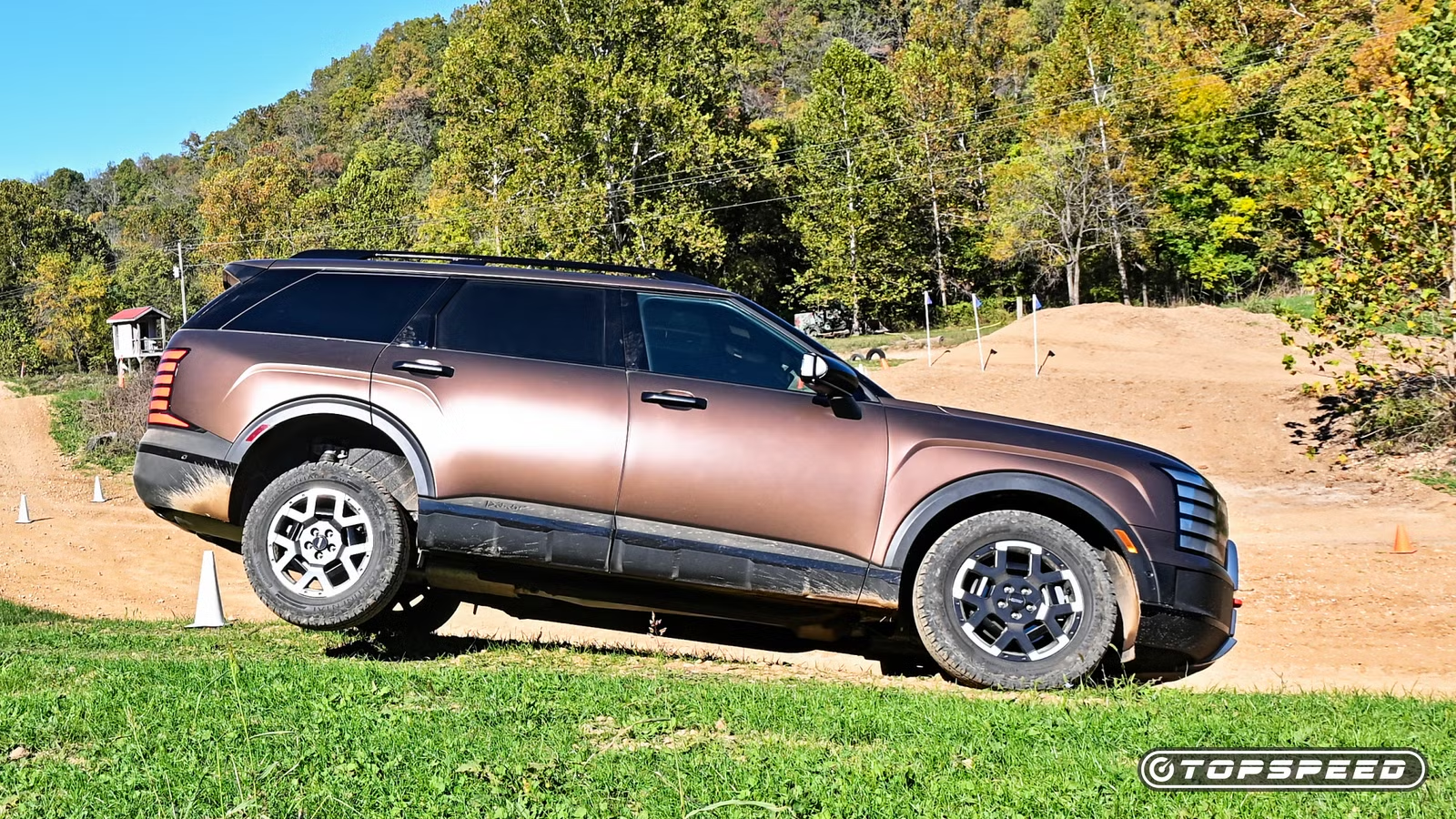
At a recent off-road drive of Hyundai’s 2027 Santa Fe XRT and 2027 Palisade XRT Pro, I drove both up and over obstacles that forced the chassis to flex, the suspension to articulate, and ultimately one tire at the front or one at the rear of both Hyundais to entirely lift into the air. I drove up and down dirt two-track that was so steep you really needed hill-descent mode, which uses the ABS brakes to automatically crab-walk down the gnarliest grit. And Hyundai’s terrain management system, with modes for snow, sand, and mud, which allows more wheel spin, was invaluable for clambering over the rockiest obstacles.

But when it comes right down to it, I don’t think Hyundai is gunning for Jeep’s most extreme Trailhawk-kitted rigs or Toyota’s TRD label. Does that matter? Here’s what I learned.
Defining XRT Pro
I’ll give Hyundai credit: they admitted that when XRT debuted a few years back, it was mostly about appearances. As the 2027 lineup debuts, it has become important for Hyundai to back rugged styling with legitimate capability.
More Capable Santa Fe


The 2027 Santa Fe XRT gets Continental all-terrain tires, a bump of 1.3 inches of ground clearance, and the aforementioned terrain modes. Towing also rises from 3,500 pounds to 4,500, and there are standard recovery hooks, too.
More Rugged Palisade

The Palisade XRT Pro adds an electronic locking rear differential, too, which is a big deal because when you’re in the toughest situation, you might need the transmission to drive the rear axle regardless of traction at either rear wheel. The Palisade XRT Pro also gains an inch of ground clearance, and more significantly, revised front and rear bumpers that improve both approach and departure angles. Both rigs also get beefier cladding. It’s not necessarily functional (say, factory rock sliders), but it’s reasonable to think Hyundai will get there eventually, and I’ll explain why in the next section.
What You Can And Can’t Do In These SUVs


Here’s the good and bad of where we stand currently with XRT Pro. Taking the Palisade first, that rear locker made much easier work of loose sand and rock than the Santa Fe. Its 20.5 front/ 22.4-degree approach and departure angles best the Santa Fe’s 19.1/ 21.8. That’s not a huge difference, but we heard considerably more scraping on the undercarriage of the Santa Fe’s front skid plate, and on the steepest climbs, saw considerably more wheel spin in the five-passenger Santa Fe than in the seven-seat Palisade. I’d guess Hyundai is studying this space, knows its deficits, and will keep adding capabilities incrementally.
More Rugged, But Not Rugged Enough?
With its 8.3 inches of ground clearance (barely trailing the 8.4 of the Palisade XRT Pro), it’s safe to argue that most of the trailheads you’ll want to get to in the Santa Fe XRT won’t tax this rig too much. But the Santa Fe’s limited by a longer rear overhang, and even a half-inch gain in ride height would help improve its off-road performance.
Where Subaru And Honda Are Ahead

The Honda Passport Trailsport slays the Santa Fe, with 9.6 inches of ground clearance and far superior, 25.4 front/ 25.3 rear approach and departure angles. The Subaru Outback Wilderness’s digits are also better: 9.5 inches of ground clearance, and 20.0/23.6 approach and departure. Even over relatively mild hummocks and chunky rocks, we were scraping the undercarriage, and the vehicle doesn’t get full underbody cladding.
Why You Still Might Be Fine With the Santa Fe

First, just how much off-roading matters to you should be part of this picture. Because the 2027 Honda Passport Trailsport will run you $51,590, while the Santa Fe XRT is about seven grand less, at $43,940. Here, you can see the all-terrain tires on the Santa Fe, which add some capability. But, notably, not much cabin noise. If you’re off-roading weekly, you’d want something even more aggressive, but remember that compromises fuel economy and makes pavement driving extra loud.
The more competitive option vs. the Santa Fe is the Subaru Outback Wilderness. At $45,540 (all prices including destination), it’s very close on price to the Santa Fe, and again, more capable off-road. All three of these family crossovers are very close on interior space, but the Santa Fe will best its peers by offering a third row of seats. That might matter a lot more than 4X4 bona fides.
The Palisade Is Also A Major Bargain

At $51,820 the XRT Pro Palisade is also nailing a value sweet spot. You could argue that its biggest rival is the Kia Telluride X-Pro, which for $55,235 offers 9.1 inches of ground clearance, an off-road-tuned suspension, and skid plating. Ditto, the $52,090 Honda Pilot Trailsport, which also gets an off-road-specific suspension. We didn’t get to drive these peers against the XRT Pro Palisade, but you get the picture. They’re getting more rugged gear and/or are lifted more for dirt-specific play.
Toyota TRD 4Runner Off-Road And Jeep Grand Cherokee Play In Their Own Sandbox

The “legit” off-road rivals to XRT and XRT Pro win this handily. For instance, the five-passenger, $51,440 Toyota TRD 4Runner Off-Road has 9.1 inches of ground clearance with substantial underbody cladding. It also has an electronically locking rear differential that the Santa Fe XRT lacks, an off-road-specific suspension, and an off-road-specific low range for the transmission.
Get The Jeep Grand Cherokee Trailhawk For Legitimate Off-Roading Capability
Jeep is never going to cede this dirt mountain, even if there are only so many customers who want a lifted, from-the-factory 4×4. So the 2027 Jeep Grand Cherokee Trailhawk will cost you $55,000. But it boasts the best approach (28.2 degrees), departure (26.0 degrees), and ground clearance (up to 11.4 inches). Its air suspension is key here, and it can lift to that higher clearance, then lower to a more civilized (and fuel-efficient) 8.4 inches. However, neither of these offers a third row of seating, and the Jeep is relatively cramped compared to the Santa Fe, with only 70 cubic feet of maximum cargo volume. You’re sacrificing interior comfort for off-road capability.
XRT’s Unique Win Will Be With Hybrids And Trucks

What’s really going on here is that Hyundai will make slow-and-steady inroads against its rivals. They’ve already announced they’ll bring a body-on-frame truck, and from there you can safely bet they can more directly target off-road capability. We’ll see them bring an extended-range hybrid (more like Scout and less like Nissan), and that will probably make its way into their body-on-frame rigs before it ever gets deployed for a vehicle like the Palisade or Santa Fe.
The Tucson Hybrid XRT Pro Comes For Toyota

This image is of the hybrid version of the forthcoming XRT Pro Tucson. It has better approach-and-departure angles than, say, the longer-overhanging Santa Fe. But also, the Tucson’s hybridization means Hyundai can directly target rivals by offering excellent fuel economy in a decently trail worthy crossover. Watch that space, particularly. Americans might like the rugged looks of a heavily clad crossover, but they detest the wallet-eroding cost of fuel. If Hyundai can go directly at Toyota with its hybrids without an especially high cost penalty, they’ll have a winner.
Sources: Hyundai

Related posts



Latest Post


No Comments