
Why Chevy Hid 425 Horsepower in a Boring Family Sedan
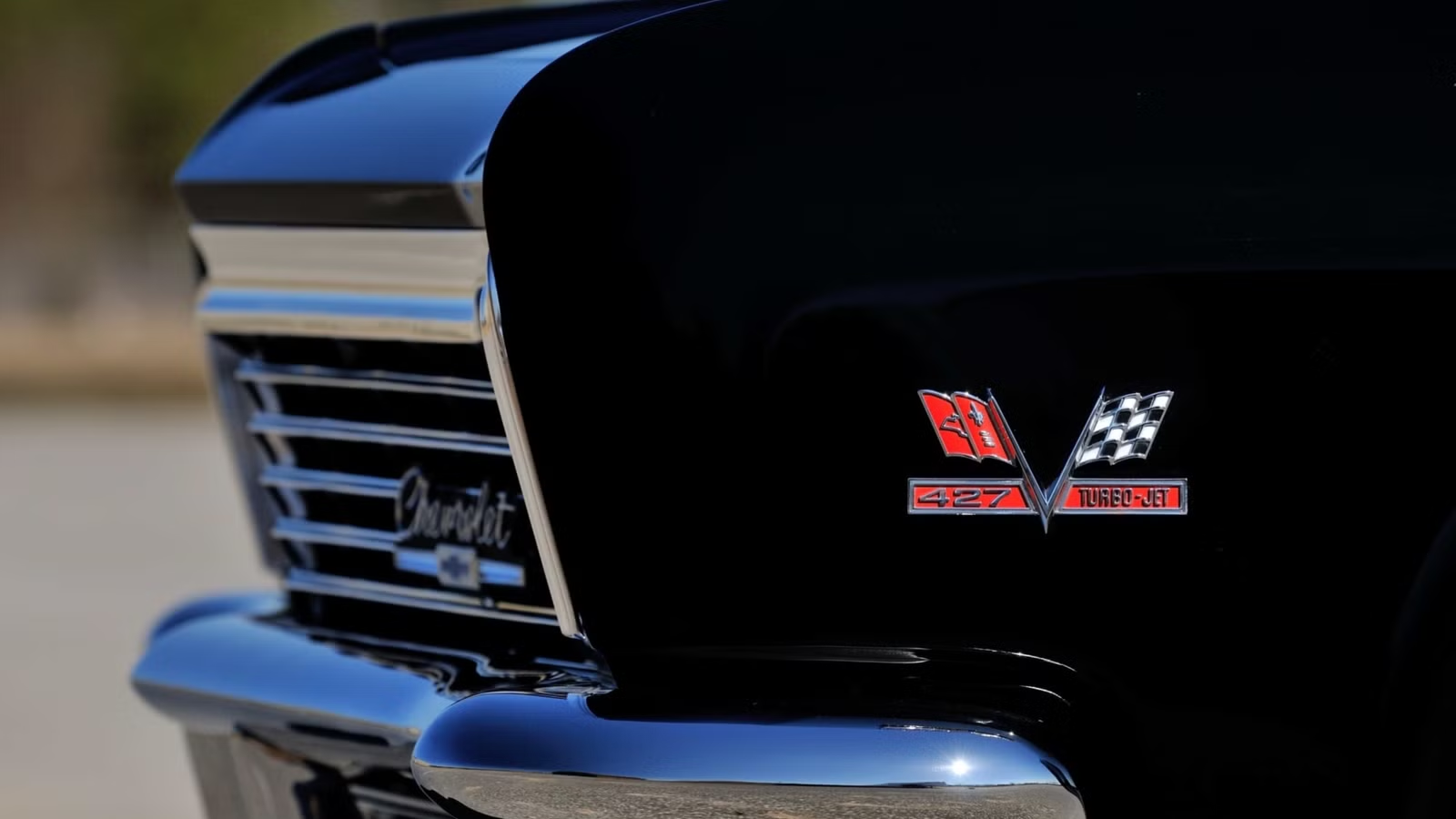
While popular 1960s full-size cars like the Chevrolet Impala and Plymouth Fury often steal the spotlight, there are other, lesser-known models that are equally worthy of attention. In 1966, Chevrolet took the idea of a sleeper car to a whole new level with its entry-level full-size car, the Biscayne. The 1966 Biscayne appeared to be a restrained family sedan, lacking the flash associated with the brand’s performance cars, but it was anything but ordinary. Beneath its unassuming looks lurked a big-block V8 with enough muscle to deliver explosive acceleration and embarrass top-of-the-line machinery. This unlikely combination of brute force and stealth makes it one of the most fascinating performance oddities Chevrolet ever built.
The Biscayne, Chevrolet’s Entry-Level Family Sedan

Chevrolet first introduced the Biscayne in 1958 as one of its more affordable models in its full-size lineup. Sitting below the better-equipped Bel Air but above the entry-level Del Ray, Chevrolet offered the Biscayne as a two-door sedan and four-door sedan with the choice of a six-cylinder engine or a small-block V8, which gave it more performance than its utilitarian image suggested. As Chevrolet dropped the Del Ray the following year, the Biscayne became the entry-level family sedan, deliberately positioned as a practical and affordable alternative to its more lavish siblings. The Biscayne’s exterior was relatively modest and understated, and just like its exterior, the cabin remained minimal with fewer standard features. By 1966, the two-door sedan particularly stood out with its simpler and lighter design when compared to heavier Chevrolet models such as the Impala. This stripped-down character ended up making the Biscayne the perfect base to build on and fit in a bigger engine.
The Engine: Meet The L72 427 Big-Block V8

Instead of adding extra weight to an already luxurious and heavily equipped full-size car, Chevrolet took its least expensive and lightest full-size model and paired it with its most potent big-block V8. Introduced in 1966, the L72 427-cubic-inch (7.0-liter) V8 was part of Chevrolet’s new Mark IV big-block family and was offered in a select group of full-size models, including the Biscayne, as well as the Corvette. Anyone could simply go up to a dealership and check a few boxes on their order sheet to get their hands on the L72, one of the most powerful naturally aspirated engines Chevrolet fitted in a production car at the time.

Officially rated at 425 hp at 5,600 rpm and 460 lb-ft of torque at 4,000 rpm, the engine featured a 4.25-inch bore and 3.76-inch stroke, along with a four-bolt-main block, forged-steel crankshaft, forged-aluminum pistons, a solid-lifter valvetrain and high-flow rectangular-port cylinder heads. Air and fuel were supplied by a 780-cfm Holley four-barrel carburetor mounted on an aluminum intake manifold. An aggressive 11.0:1 compression ratio helped the L72 deliver its impressive factory-rated output, transforming Chevrolet’s most basic full-size sedan into a genuine high-performance machine. While the standard Biscayne came with Chevrolet’s heavy-duty M13 three-speed manual, buyers could pair the L72 with the wide-ratio four-speed M-20, the close-ratio Muncie M-21, or the legendary M-22 “Rock Crusher” heavy-duty close-ratio four-speed, with the latter option famous for its highly durable, heavy-duty construction and an ideal match for the 427’s impressive torque figure.
What Made The Biscayne L72 The Ultimate Sleeper Muscle Car

While the L72 also powered the Corvette, its presence in the 1966 Biscayne was even more surprising. Unlike the top-of-the-line Impala, the Biscayne’s positioning as an entry-level full-size sedan made it look like nothing more than an ordinary family sedan. With no SS badges or hood scoops to hint at the big-block V8 lurking underneath the hood, the Biscayne was a convincing factory sleeper. The Biscayne’s simpler construction made it both lighter and more structurally rigid than the hardtop Impala, making it the perfect foundation for high-performance driving and drag racing. A two-door, 427-powered Biscayne sedan weighed 3,895 lbs according to the Automobile Manufacturers’ Association (AMA), while an Impala SS or a Caprice with the same engine weighed 4,035 lbs. Buyers looking to save even more weight could opt out of the heater option, shaving off an extra 22 pounds.
Though its performance potential suggested otherwise, the Biscayne was one of the most affordable ways to access Chevrolet’s biggest engine. Chevrolet offered the small-block V8, two-door Biscayne at a base price of $2,484, or roughly $100 less than a Bel Air and over $300 less than an Impala. Checking the L72 engine option added an additional $450 to the bill. Chevrolet never marketed the Biscayne as a drag-racing special, but pairing the lightest full-size sedan with the most potent big-block V8 turned out to be a winning formula that enthusiasts quickly recognized.
Why We Rarely Hear Of This Forgotten Big-Block Legend

Part of what makes the 1966 Biscayne L72 so desirable today is its rarity. The exact number of Biscaynes fitted with L72s has not been recorded and remains unknown to this day. However, Hemmings reports that 1,856 L72 427s were installed across Chevrolet’s full-size lineup in 1966, which included the Biscayne, the Bel Air, Impala, and Caprice. Mecum Auctions further reports estimates of roughly 200 L72 Biscaynes built in 1966, with as few as 11 units believed to have survived.
The Biscayne’s rarity today is also a consequence of how it was used, as most buyers who ordered a stripped-down sedan with a powerful big-block V8 likely spent their time at local drag strips, possibly subjecting their cars to heavy racing and crashes. Unlike highly specced Chevrolet models that were more carefully driven, few L72 Biscaynes survived, making the surviving models highly sought after by collectors, especially examples that have retained their documentation. On Bring a Trailer, an L72 Biscayne changed hands for $70,500 in early 2025, while a Marine Blue L72 with matching interior sold for $60,500 at Mecum Auctions, underscoring how Chevrolet’s understated performance legend still commands the respect it deserves.
Sources: Hemmings, Bring A Trailer, Mecum, Chevrolet

Related posts


Latest Post


No Comments