
The 454 Big-Block Won’t Die — And Restomod Builders Know Exactly Why
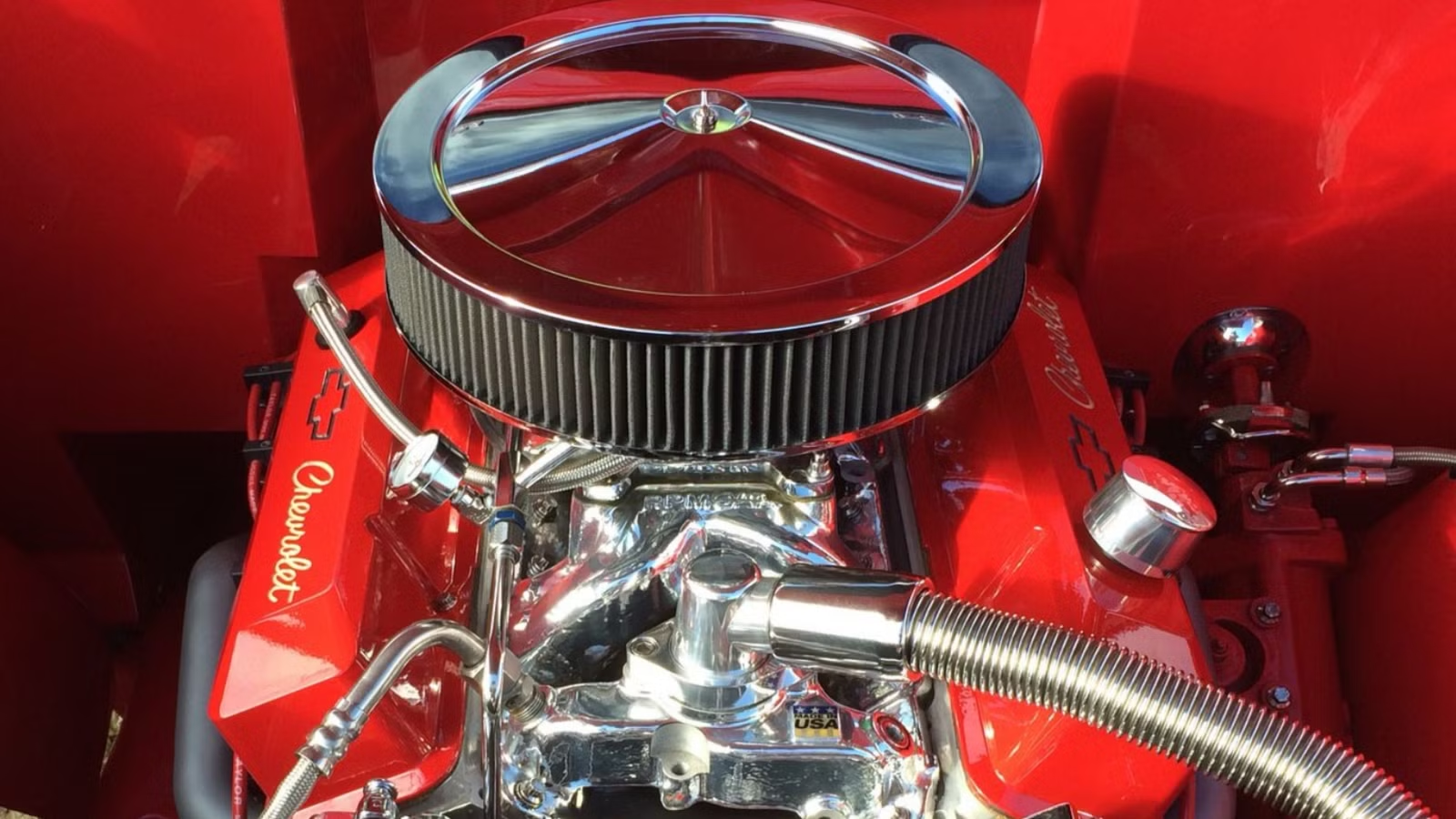
For decades, Chevrolet hot rodders had an easy choice – the Mouse went into cars that needed speed without bulk, while the Rat went into cars that needed enough torque to rearrange the pavement. Then restomods changed what “good” meant. A classic could no longer get by with a nice paint job, a four-barrel, and questionable brakes. It had to start in traffic, run cool, cruise at highway speed, and attack corners. Somewhere in that change, one Chevy legend lost its old job while the supposedly less sensible one found a reason to stay.
The Small-Block And Big-Block Were Never Just Different-Sized Chevy V8s

Calling one Chevrolet V8 a small-block and another a big-block sounds like a simple matter of cubic inches, but the truth is it never worked that way. Both traditional families use the familiar Chevrolet recipe of two valves per cylinder, a camshaft inside the block, pushrods, and rocker arms. The important split starts with the distance between the cylinders – the classic Small-Block Chevy uses 4.4-inch bore spacing, while big-engine designs stretched that figure to 4.84 inches. That 0.44-inch difference sounds tiny until eight cylinders have to fit inside one casting. It changes the block’s basic proportions before displacement, carburetors, cylinder heads, or horsepower enter the discussion.
The extra room in a big-block allows larger cylinder bores and gives engineers more freedom to chase displacement. It also demands more metal, because a wider cylinder layout needs a larger block around it, along with bigger supporting structures, and the finished engine naturally becomes longer, wider, and heavier.

Those dimensions created two personalities that enthusiasts understood long before anyone started arguing about them online. The original small-block family grew from 265 cubic inches to 400, with the 283, 327, and especially the 350 becoming hot-rodding staples along the way. Chevrolet’s larger V8 lineage produced names such as 348, 409, 396, 427, and 454, numbers that practically became their own trim badges. The Mouse won because it fit almost anywhere, weighed less, cost less to build, and still made serious power. The Rat made the opposite bargain – it accepted bulk and mass to gain displacement, airflow potential, and the kind of torque that could make a large Chevrolet feel two sizes smaller.

Restomods Changed The Rules That Made The Small-Block Chevy King

Traditional hot rodding rewarded simplicity. A builder could find a 350, add a cam, intake, four-barrel carburetor, headers, and better ignition, then spend the weekend creating horsepower instead of decoding software. Parts sat on shelves everywhere, and nearly every experienced mechanic knew the firing order. The engine fit in tight bays that could make other V8s feel like furniture being pushed through a hallway. The small-block also delivered affordable performance without forcing the rest of the car to become an engineering project. That combination turned it into one of the default engines of American hot rodding.
A serious modern restomod asks for much more, though. Strong horsepower still matters, but the engine also has to tolerate summer traffic with the air conditioning running. Owners expect electronic fuel injection, clean cold starts, smooth idle quality, overdrive transmissions, dependable charging systems, and electronics that cooperate rather than communicate through smoke signals.

Pro-touring builds add another problem: handling. Current build philosophy increasingly treats the classic body as the starting point for a car that can brake repeatedly, carry speed through corners, and behave much more like modern performance machinery. Contemporary builders describe modern drivetrains and upgraded suspension geometry as core parts of that formula, and shops such as Roadster Shop offer classic Chevrolet chassis specifically engineered around modern handling while accommodating SBC, BBC, and LS power.
That development leaves the traditional SBC in an awkward spot. Its old advantages included compact size, reasonable mass, huge parts support, and easy power. Those benefits still matter, but the engine no longer owns them. Meanwhile, the big-block appears even less suited to the new rules – an iron Chevrolet big-block can land roughly in the 650-to-750-pound neighborhood depending on heads, intake, accessories, exhaust, and what a particular weight figure includes.
The LS Stole The Small-Block’s Job, But It Couldn’t Make The 454 Irrelevant

The LS changed the argument because it became the newer answer to many of the questions that had once made the traditional small-block so attractive. Chevy started the LS era in the 1997 Corvette with an all-new architecture, while keeping the compact 90-degree pushrod layout and the familiar 4.4-inch bore spacing. That combination is important in swaps – the LS remains physically tidy for its output, works naturally with electronic fuel injection, enjoys enormous aftermarket support, and connects easily to modern engine controls and transmissions.
Engine-weight comparisons get messy because one scale may measure a bare long-block while another includes manifolds, accessories, fluids, flywheel, or exhaust hardware. A useful restomod benchmark puts a complete modern LS configuration at roughly 540 pounds, with individual combinations moving above or below that figure. The exact number matters less than the broader result, though – an LS gives builders modern power and controls without imposing the mass of a traditional iron big-block. That helps explain why LS-powered Camaros, Chevelles, Novas, Corvettes, and C10s became such familiar pro-touring recipes.

That development squeezes the traditional 350 from one side while leaving the 454 strangely protected. A period-correct build still has a strong reason to use a carbureted SBC – it looks right, sounds right, and keeps the mechanical experience intact. Once a project prioritizes EFI, modern transmissions, cooling, traffic manners, and handling, however, an LS can deliver much of the original Mouse philosophy with newer hardware.
A 700-Pound Big-Block Makes No Sense Until The Car Is Heavy Enough To Need One

Of course, none of that makes 700 pounds over the front wheels disappear. In a light Camaro meant for autocross, canyon roads, or track days, the penalty can become impossible to ignore. Compared with a roughly 540-pound modern LS combination, a traditionally dressed iron big-block can put something like 150 additional pounds near the nose. The exact difference changes with aluminum heads, accessories, intake choice, and other hardware, but the chassis still knows where the mass went.
The calculation changes in a large muscle car, street bruiser, or classic truck. A heavy Chevelle or C10 does not always need an engine that saves its best work for the top half of the tachometer. It benefits from torque immediately after the throttle opens. Large displacement lets the engine move substantial mass without depending on aggressive gearing or constant rpm. That gives a big-block car a distinctive sense of effortlessness – the driver does not need to wind the engine out to make the body move; a modest squeeze of the throttle already feels like somebody shortened the wheelbase.

The 1970 Chevelle SS 454 LS6 remains the obvious proof. Chevrolet rated its 454 at 450 horsepower at 5,600 rpm and 500 lb-ft at 3,600 rpm in the gross-rating era. Those numbers alone made the LS6 famous, but its lasting reputation came from how the engine applied them. Five hundred pound-feet arriving at only 3,600 rpm gave a sizable A-body immediate authority, and period muscle did not require an 8,000-rpm soundtrack to announce trouble. The LS6 simply leaned on its displacement and made the whole car leave.
That distinction still matters in a restomod. Removing roughly 150 pounds from the front of a canyon-focused Camaro can transform the way the car changes direction. A Chevelle, C10, Impala, or similar torque-first build can accept the extra mass because the owner wants the very thing that creates it: a physically large engine delivering large-engine response. The Rat’s weight becomes tolerable once the car has enough body around it to turn torque into the main attraction.
The Mouse Didn’t Die – Its Personality Changed Engines

The Mouse and Rat nicknames remain useful because they describe more than blocks of iron. The original Small-Block Chevy established a philosophy: compact dimensions, modest weight, easy installation, plentiful parts, and strong performance without requiring the largest engine available. The LS advanced that same basic mission with a fresh architecture, electronic management, modern transmission support, and power levels the old small-block once needed serious modifications to reach. That success pushed the traditional SBC into a narrower role. Restorations and period-flavored builds still give it a natural home.
Modern performance builds can move toward an LS. Builders chasing maximum old-school drama can move the other way and choose a 454. None of those decisions make one engine universally superior. Each one tells the rest of the car what kind of experience it needs to deliver. The LS carries the modern Mouse attitude, but the SBC remains the authentic original. The 454 stays the unapologetic Rat.
There lies the strange ending to Chevrolet’s old family feud. The small-block once looked almost impossible to replace because adaptability defined it. It fit everywhere, supported almost anything, and gave builders the performance they needed without making the whole project revolve around the engine. Those same qualities made its role easy for better technology to inherit. The 454 had no such problem – its appeal never depended on being the smartest package in the room. It stayed desirable because a heavy crank, huge cylinders, low-rpm torque, a crowded engine bay, and the rumble of a big-block all belong to one deliberately excessive experience.
The Mouse evolved. The Rat survived because excess was the feature all along.
Source: Chevrolet, Hagerty

Related posts






Latest Post


No Comments