
Why BMW’s S65 V8 Is The Last True High-Revving M Engine
Climb into a current BMW M3 Competition and the numbers are hard to argue with. Its twin-turbo inline-six makes 503 horsepower and 479 pound-feet of torque, and that torque shows up below 3,000 rpm, at engine speeds where older M engines are barely clearing their throats. It is devastatingly quick, on any road and in any weather. Then the tachometer runs out.

Somewhere along the way, the M badge stopped meaning an engine that pulls harder the longer you hold your foot down. One engine marks exactly where that line was drawn, and the people who own it tend to talk about it the way other people talk about first cars and old bands.
Why Today’s 500-Horsepower M Cars Stop Pulling Before 7,500 RPM
BMW M’s turbo era started at the top. The M5 gave up the E60’s screaming 5.0-liter V10 for a twin-turbocharged V8, and the M3 followed with the F80 generation and its S55 twin-turbo inline-six. That S55 makes its peak power between 5,500 and 7,300 rpm and runs out at 7,600 rpm.

Its replacement, the S58 that powers today’s M3 and M4, goes the other way on revs. It makes considerably more power, yet it stops at 7,200 rpm. The pattern across every generation since the switch is the same: more horsepower, much more torque, fewer revs.
Emissions Rules And Fat Torque Curves Rewrote The M Engine’s Job

None of this happened by accident. A turbocharged engine does not need to spin fast to make big power, because boost does the work that revs used to do. That makes it easier to pass tightening emissions and efficiency rules, and BMW developed the S58 with those regulations in mind, fitting it with gasoline particulate filters.
It also makes a better daily driver. Peak torque that arrives just off idle means instant passing punch without a downshift, and that is exactly what most buyers use. The turbo M cars are faster, more flexible, and easier to live with. What they gave up is the reward for chasing the redline, and the instant, linear response of an engine with nothing between your right foot and the intake.
The BMW S65 V8 Was A Race Engine Hiding In The E92 M3

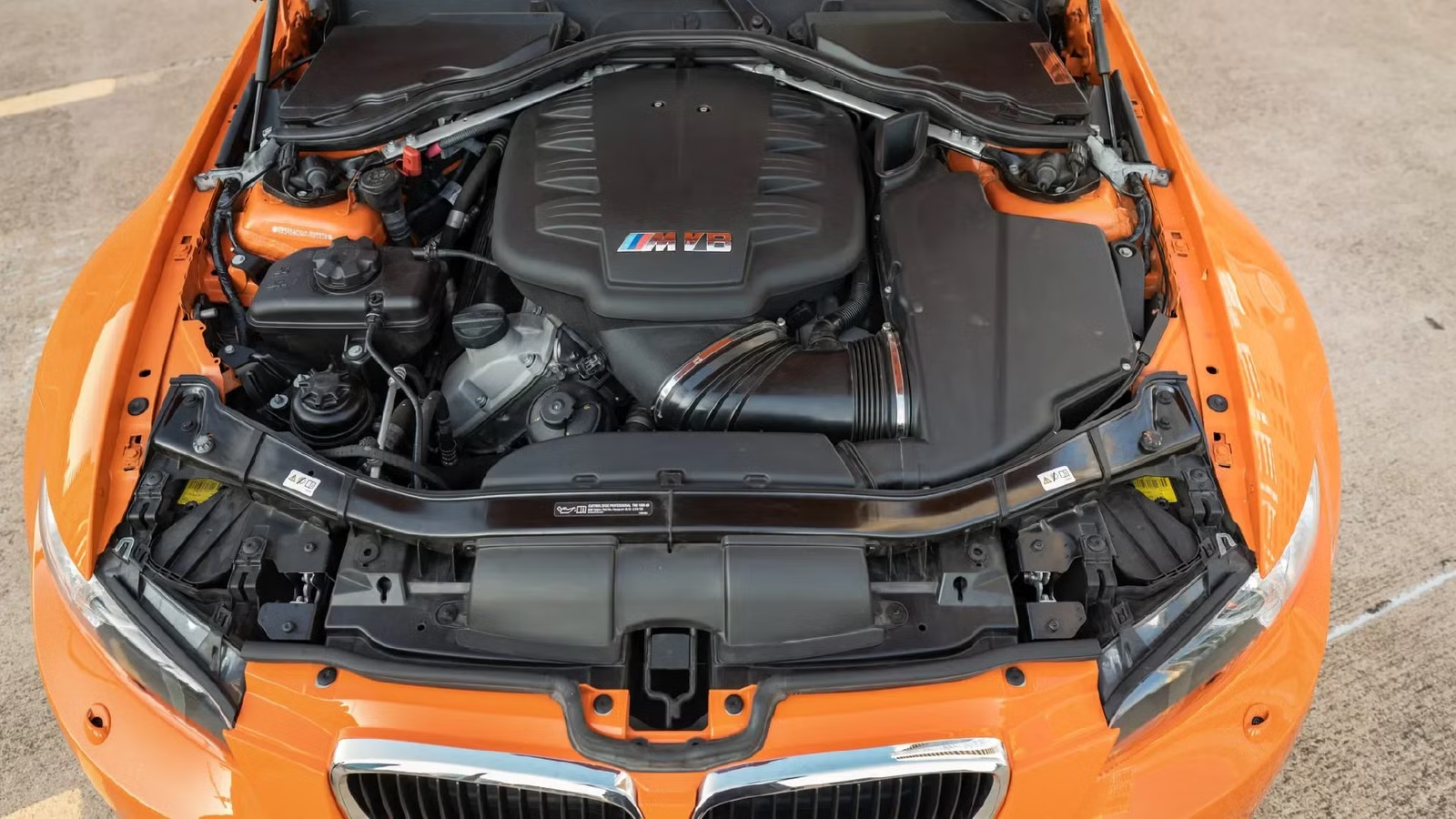
The engine is the S65, a naturally aspirated 4.0-liter V8 built for the fourth-generation BMW M3, sold as the E90 sedan, E92 coupe, and E93 convertible. It is the first and only V8 ever fitted to an M3. The last E92 coupe rolled off the line in Regensburg on July 5, 2013, and the convertible carried the S65 on until that September. After that, the M3 went turbocharged and never looked back.
Two Cylinders Short Of The E60 M5’s 8,250-RPM V10

The S65’s family tree explains its character. It is derived from the S85 V10 in the E60 M5, an engine BMW openly linked to its Formula 1 program. BMW’s own technical training material rates that V10 at 500 horsepower at 7,750 rpm, with a governed limit of 8,250 rpm.
Take two cylinders away and you have the S65. It shares the V10’s 92 mm bore and 75.2 mm stroke, a short-stroke layout built for engine speed, for a displacement of 3,999 cc. Like the S85, it has no relation to BMW’s regular production engines. It is pure M GmbH.
414 Horsepower At 8,300 RPM And An 8,400-RPM Redline

The two numbers worth knowing sit right next to each other. BMW’s 2007 press kit rates the S65 at 414 horsepower at 8,300 rpm, and BMW’s M3 technical training manual puts the engine’s limit at 8,400 rpm. Peak power arrives just 100 rpm before the cut. Short-shift this engine and you never meet it properly.
Peak torque is a modest 295 pound-feet at 3,900 rpm, but BMW says the S65 holds 85 percent of that figure across a 6,500-rpm spread. The result is an engine that feels muscular in the midrange and then gets angrier, not breathless, as the needle climbs. BMW also says the V8 weighs less than the S54 straight-six it replaced, which is no small claim for an engine with two extra cylinders.
What Happens Between 6,000 And 8,400 RPM

Every cylinder gets its own throttle butterfly, eight in total, which is why the S65 answers the throttle the instant you touch it. Variable timing on both intake and exhaust cams, BMW’s double-VANOS, runs off normal engine oil pressure, and a forged steel crankshaft anchors the bottom end.
The supporting engineering reads like a race program. BMW specified two oil pumps to keep oil supply consistent at up to 1.4 g of longitudinal and lateral acceleration, and the engine management measures ion current inside each combustion chamber to detect knock and misfire. None of it is there to make the S65 easy to live with. All of it is there so the engine can be held at 8,000-plus rpm, lap after lap.
Rod Bearings Are The Price Of Admission

Any honest account of the S65 has to include its weak spot. The engine’s connecting rod bearings run tight clearances, and premature wear is the most discussed problem in the ownership community. If a bearing wears far enough, it can spin and take the engine with it. BMW never published a rod bearing replacement interval.
The figures you see quoted come from owners, independent specialists, and parts suppliers, and they commonly land somewhere between 50,000 and 80,000 miles for preventive replacement, with some recommending earlier. Independent shops quote roughly $2,500 to $5,500 for the job, depending on parts and labor. The throttle actuators that drive those eight butterflies are another known wear item. Budget for both, and check the service history before you buy.
The BMW S65 Demands Maintenance, And Nothing Since Has Felt As Special


The case against the S65 is easy to make. It gives away 184 pound-feet of torque to a modern M3 Competition, it is slower by any stopwatch, and it asks its owners to take apart the bottom end of a healthy engine as a precaution. A turbo M car is the smarter purchase on paper, and most of the time on the road too.
But paper was never the point. The S65 is the last time an M engine asked you to chase the redline and paid you back for doing it, with throttle response no turbo can copy and a howl that builds all the way to 8,400 rpm. That claim covers BMW M’s lineup as it stands in 2026, not a promise about forever. BMW has already confirmed an electric M3 is on the way, and what M engines become after that is anyone’s guess. For now, though, nothing wearing the badge revs like this one, and that is exactly why so many E92 M3 owners refuse to let theirs go.
Sources: BMW, RepairPal

Related posts



Latest Post


No Comments