
What Honda’s Solid-State Battery Breakthrough Tells About The Future Of EV Tech
Solid-state batteries (SSBs) have been hyped for more than a decade as the next big innovation in electric vehicle (EV) performance, promising faster charging, better range, and longer lifespans. For most of that time, the technology lived almost exclusively in laboratories, research papers, and carefully worded press releases — impressive on paper, but stubbornly absent from any real production line. That changes with Honda, which has officially moved solid-state batteries off the whiteboard and into a working factory.

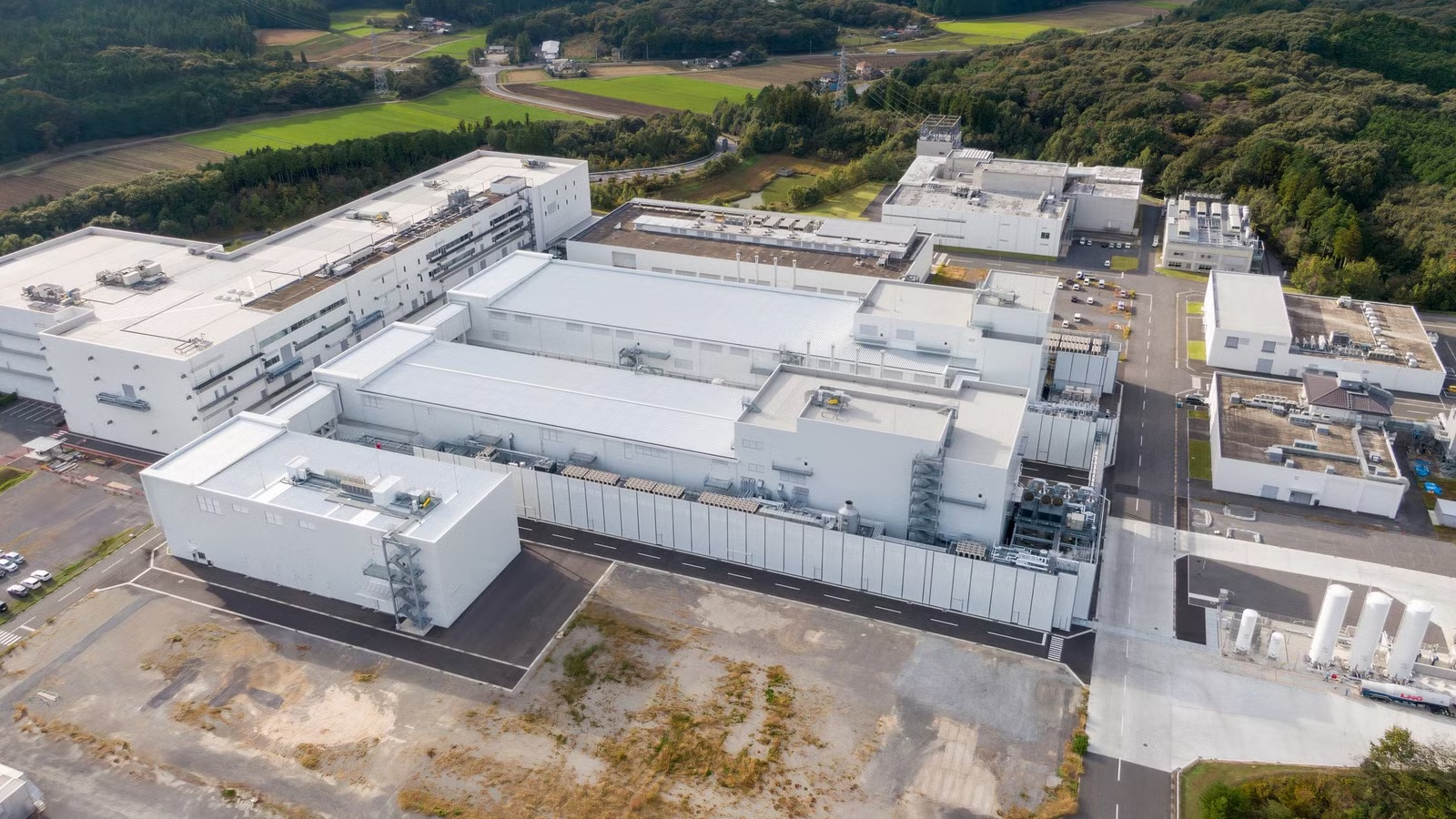
Honda’s pilot production line at its Sakura plant in Japan is now operational, turning out actual solid-state battery prototypes with the goal of scaling them for use in future EVs. This facility isn’t a glorified R&D lab — it’s a manufacturing validation site designed to stress-test the processes that will eventually underpin mass production. The investment is real, the hardware is real, and the implications for the broader EV industry could be significant.
While full commercialization is still years away, Honda’s willingness to manufacture rather than merely theorize may represent a genuine inflection point — not just for the company, but for the entire electric vehicle landscape.
Honda’s Solid-State Battery Factory Is Already Operating
The Pilot Line Is Ahead Of Schedule Compared To Rivals

In recent years, Honda has been signaling its SSB ambitions, and now the facility is fully up and running. Located at the Sakura site in Japan, it is designed to validate the key manufacturing processes that will support next-generation EV battery development. With a total investment of around 43 billion yen — approximately $287 million — this facility gives Honda a meaningful head start in proving the real-world viability of solid-state technology.
Other Automakers Are Still Stuck In The Planning Stage
While Honda is now producing physical battery cells on a pilot line, most of its competitors remain at earlier stages of development. Toyota, for example, has announced plans to introduce solid-state batteries by 2027, but its efforts remain largely experimental, focused on prototype vehicles and lab-based testing. Similarly, Ford, BMW, and Volkswagen have all entered partnerships with battery startups or research institutions, but none have matched Honda’s progress toward actual production.
The Japanese automaker is taking a notably different approach. Rather than promising breakthroughs years down the line, Honda is using the pilot line to test manufacturing methods and work through known challenges like electrolyte stability and cell durability. This positions the company to refine its process early and ensure that future mass production goes smoothly, while rivals are still evaluating theoretical performance or navigating corporate joint ventures. By keeping the entire process in-house — from engineering through to production — Honda can move at its own pace and produce functional batteries sooner than competitors relying on outside partners.
The Solid-State Hype Has Gone On For Too Long Without Results
Automakers Have Relied Too Heavily On Theoretical Test Results

For years, announcements about SSB advancements have leaned heavily on lab-based metrics like energy density figures, cycle life projections, and charging time estimates. Automakers have frequently touted promising test data — including Toyota’s claimed 745-mile range enabled by SSBs — suggesting breakthroughs were just around the corner. Translating those figures into batteries that can be produced reliably and at scale, however, has proven far more difficult than the headlines implied.
After more than a decade of bold claims, the situation has started to resemble the old “Boy Who Cried Wolf” story — consumer trust in solid-state timelines is wearing thin. Laboratory results are a necessary step in development, but they often lack the context of real-world manufacturing and actual use. Without hardware to back them up, theoretical numbers don’t bring a product any closer to market. That’s precisely where Honda’s decision to prioritize manufacturing validation over yet another performance claim represents a meaningful departure from industry norms.
Battery Startups And Partnerships Have Created More Noise Than Progress

Over the past several years, automakers have rushed to partner with startups promising next-generation battery technology. Solid Power, QuantumScape, and SES are among the names that have entered agreements with major players like BMW and VW. These partnerships generate headlines and investor interest, but the actual pace of progress has been slow. Delays in prototype delivery, challenges in scaling production, and shifting timelines have become recurring themes.
Part of the problem is an over-reliance on external partners working through their own unproven technologies. Many startups are still grappling with fundamental scientific or scaling challenges, leaving automakers without a clear path forward. Honda, by contrast, is developing its SSBs entirely in-house. This enables tighter integration between design, production, and testing — and means the company doesn’t have to wait on anyone else when navigating the complexities of an unproven technology.
Honda’s Unique Manufacturing Approach Could Solve Key SSB Challenges
Roll-Pressing Electrolytes For Better Contact And Efficiency

According to Honda, one of the biggest challenges in solid-state battery production is ensuring consistent contact between the solid electrolyte and the electrode materials. Traditional lithium-ion batteries use a liquid electrolyte that naturally fills the gaps between the anode and cathode, ensuring reliable contact throughout the cell. SSBs rely on powdered or compressed solid electrolytes, which can leave microscopic voids and uneven surfaces that interfere with conductivity. Those gaps increase internal resistance, reduce efficiency, and can accelerate degradation.
To address this, Honda is using a proprietary roll-pressing process on its pilot line to compress solid electrolyte layers with greater consistency. The goal is to improve uniform contact between materials across the cell structure, which should enhance energy transfer and reduce performance loss over time. By focusing on this aspect of manufacturing early, Honda is working to ensure its production methods will hold up at scale before committing to full commercialization.
Polymer Barriers Help Prevent Battery-Killing Dendrites
Another major concern in SSB development is the formation of lithium dendrites — microscopic, needle-like filaments that grow inside the cell and can cause internal short circuits. These structures are especially dangerous in solid-state designs, where a solid electrolyte can crack under pressure or allow dendrites to punch through cell layers. Honda is working to incorporate polymer-based separators within its solid-state cells to help mitigate this risk.
Solid-State Batteries Still Have A Long Road To Real-World Use
Semi-Solid-State Batteries Are Already In Limited Use

Despite years of excitement surrounding solid-state technology, no major automaker has yet delivered a full SSB in a production vehicle. Some EVs on the road today use what are called semi-solid-state batteries — cells that incorporate solid electrolytes alongside liquid components to improve conductivity and durability. These designs offer a middle ground between traditional lithium-ion and full solid-state chemistry, but they still fall short of the safety and performance targets that true solid-state technology promises.
Nio and Toyota have explored semi-solid options in prototype or limited-lease vehicles, but broad mass production and deployment has not materialized. These early semi-solid-state batteries help validate aspects of the chemistry and construction, but they also underscore how many hurdles remain before a fully solid-state EV is ready for the showroom floor.
Full Solid-State EVs Could Be Market-Ready By Late Decade

Honda hopes its solid-state batteries will be used in future EV models, with a goal of applying the technology to next-generation vehicles by the latter half of the 2020s. This timeline is broadly consistent with Toyota and other automakers projecting SSB use near the end of the decade. Crucially, Honda’s ability to begin pilot manufacturing now gives it more runway to refine production methods and validate real-world durability before that window arrives.

Related posts





Latest Post


No Comments