
The Middleweight ADV That Has Ténéré 700 Owners Looking Over Their Shoulders
For years, the middleweight adventure motorcycle segment in America has revolved around one name. If someone asked which bike could confidently tackle backcountry trails, interstate miles, and everything in between, the Yamaha Ténéré 700 was usually the first answer. It earned that reputation honestly.

However, the landscape has now changed. Manufacturers now understand that many adventure riders spend far more time commuting, touring, and exploring gravel roads than racing across deserts. That shift has created room for a different kind of middleweight ADV— one that balances genuine off-road capability with everyday comfort.
Why The Yamaha Ténéré 700 Has Owned The Middleweight ADV Segment
There are several things going in favor of the Ténéré 700. Its 689cc CP2 parallel-twin with a 270-degree crossplane crank is one of the most trusted engines in Yamaha’s lineup. It just keeps running, year after year, routine dealer visit after routine dealer visit. Then there’s the chassis. Yamaha leaned hard on its Dakar rally program when building the Ténéré, and it shows in the details: a slim tank you can grip with your knees while standing, a 21-inch front wheel that shrugs off rocks and ruts, and a wet weight of 452 pounds that keeps technical trail sections feeling manageable instead of terrifying.


There’s no oversized TFT dashboard begging for attention, no five-page menu of ride modes to scroll through at a trailhead. Just a bike that gets out of its own way. That kind of restraint built a cult following. Riders who’d spent years fighting with 500-plus-pound flagship ADVs on technical trails found something closer to a dirt bike that happened to be street-legal, and word spread fast. Today, however, the landscape is different. The Tenere has rivals from all over the world, be it the local Japanese names or the fancy Italians. Out of these, a fair and square attack comes from a certain Suzuki.
The Suzuki V-Strom 800DE Has Ténéré 700 Owners Looking Over Their Shoulders
Base Price: $11,799

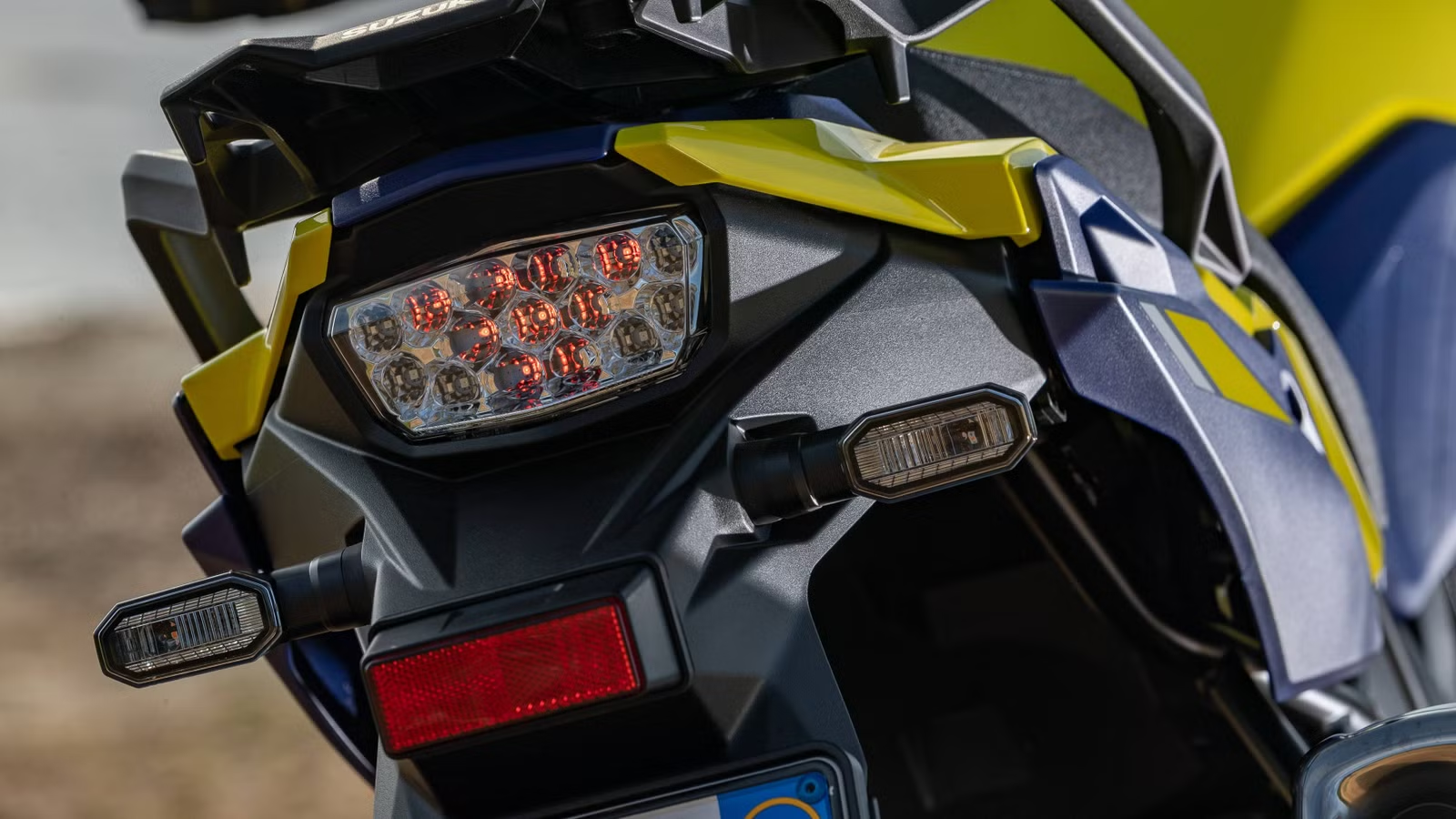
The Suzuki V-Strom 800DE, built around a clean-sheet 776cc parallel-twin platform, wasn’t designed to copy Ténéré’s playbook — it was built to attack the gaps in it. Where the Ténéré asks riders to accept a stripped-down feature set in exchange for off-road purity, the 800DE shows up with modern electronics, meaningfully more highway range, and creature comforts that solve the everyday frustrations Ténéré owners have quietly tolerated for years (for instance, a dated-feeling dash and no quickshifter).
At $11,799, the 800DE isn’t the budget option — it runs about $800 more than a standard Ténéré 700 — but it’s also not asking for the kind of premium BMW or KTM charge for their middleweights. For less than a grand over Yamaha’s benchmark, riders get a genuinely different set of trade-offs. For a growing number of buyers, those trade-offs are starting to look less like compromises and more like upgrades.
A Bigger Parallel-Twin That Doesn’t Sacrifice The Tenere’s Low-End Feel

Displacement is the most obvious difference, and it’s not a small one. The V-Strom 800DE’s engine is nearly 90cc larger than the Ténéré, producing roughly 83 horsepower at 8,500 rpm and about 57.5 lb-ft of torque at 6,800 rpm. That’s considerably more than the CP2’s 72 horsepower at 9,000 rpm and 50 lb-ft at 6,500 rpm. On paper, that’s a modest gap. Loaded with luggage and fighting a headwind, it’s the difference between a confident fifth-gear roll-on and a downshift you didn’t want to make. Suzuki also uses a 270-degree crankshaft, the same firing order Yamaha popularized with the CP2.
The Suzuki Cross Balancer System Smoothens Things

The bigger story might be what Suzuki did to smooth the engine out. The 776cc twin uses what Suzuki calls a Cross Balancer — a dual-axis primary balancer system that cancels vibration along two planes instead of relying on the single counterbalancer shaft most parallel-twins use. The practical result shows up exactly where riders feel it most: sustained highway speeds. Expect minimal buzzing unless you’re sitting at the top of the RPMs.
Off-Road Hardware That Almost Matches Ténéré’s Credentials

Suzuki clearly did its homework off-road, too. The 800DE rolls on spoked wheels — 21 inches up front, 17 inches at the rear — with 8.7 inches of suspension travel at both ends, courtesy of a Showa fork and shock developed specifically for this bike. That actually edges out the standard Ténéré 700’s 8.3 inches of front travel and 7.9 inches out back. Ground clearance lands at 8.7 inches.
The Ténéré still holds a couple of quiet advantages, though. Its 18-inch rear wheel opens up a wider range of dual-sport and knobby tire choices than the Suzuki’s 17-inch hoop, and Yamaha’s KYB suspension carries more than a decade of proven trail credibility that Suzuki’s newer Showa setup simply hasn’t had time to earn yet. Long-time Ténéré owners will also point out Yamaha’s rack of accessory suspension upgrades — from remote-reservoir shocks to longer-travel fork cartridges.
All-Day Seat Ergonomics And Aerodynamics

Where the 800DE pulls back ahead is comfort. Its seat looks broader than the Ténéré’s perch, and Suzuki gave it real wind protection straight from the factory — a proper adjustable windscreen instead of the Ténéré’s minimalist flyscreen. Seat height sits at 33.7 inches, nearly an inch lower than the Ténéré’s 34.4 inches. That should matter for shorter riders trying to get both boots down at a gas stop on loose gravel. The 800DE is considerably heavier than its Yamaha rival, though.
The Electronics And Comfort Suite Smokes The Ténéré’s Package

This is where the gap really widens. The 800DE runs Suzuki’s full S.I.R.S. electronics suite: ride-by-wire throttle, multiple selectable ride modes that adjust power delivery and traction control together, a 5-inch color TFT dash, and switchable ABS that lets riders kill rear-wheel ABS entirely for off-road work. The Ténéré, even after its 2025 update that added ride-by-wire and a 6.3-inch screen, still leans deliberately analog — two throttle maps instead of a full ride-mode suite.
The Ténéré continues with a general philosophy that leaves more decisions in the rider’s hands rather than the ECU’s. For rally veterans, that’s the whole appeal. For the much larger group of riders who commute on their ADV all week and only see dirt on weekends, the Suzuki’s extra layer of electronic assistance reads less like unnecessary complexity and more like convenience they didn’t realize they were missing.
Standard Bi-Directional Quickshifter And Gravel Mode

Suzuki also just gives away equipment that Yamaha still treats as an accessory. A bi-directional quick-shifter comes standard on every 800DE, letting riders bang off clutchless up- and downshifts, while Ténéré owners have to special-order Yamaha’s accessory quick-shifter and pay to have it installed separately. Suzuki’s Gravel mode, part of the traction control suite, recalibrates throttle response and deliberately allows more rear-wheel slip.
It’s the kind of feature that quietly does a rider’s job for them — right up until they’re skilled enough to want to do it themselves. For riders shopping this segment for the first time, that alone might be enough to settle the argument. The Ténéré 700 hasn’t lost its crown. However, for the first time in years, it has genuine reason to check its mirrors.
Source: Suzuki Cycles

Related posts





Latest Post



No Comments