
This Yamaha Is One Of Motorcycling’s Best-Kept Secrets
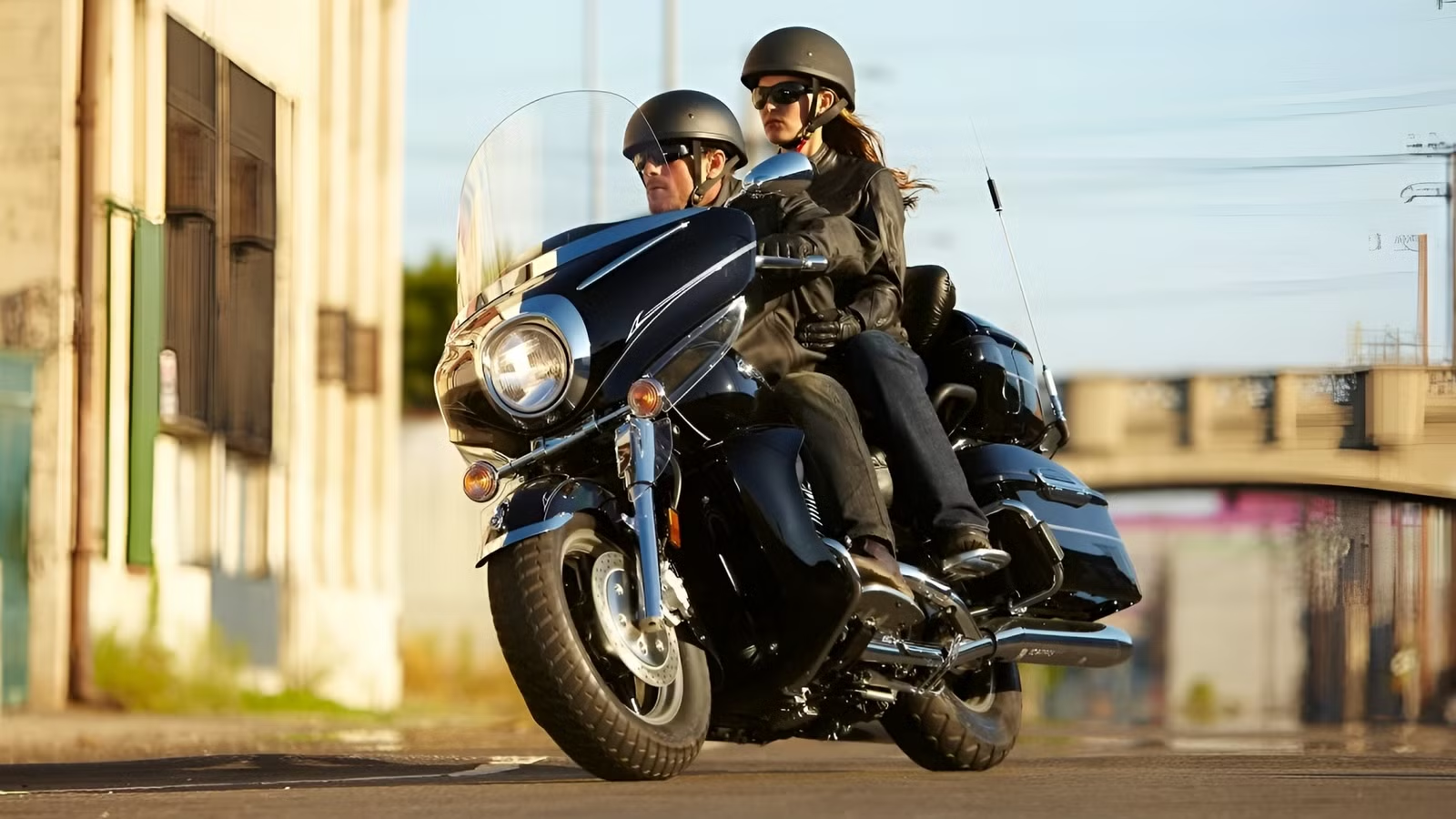
Over the years, we have had a number of underrated motorcycles. Some still linger in the shadows, while others have faded into obscurity. Among all these, if there’s one mainstream motorcycle manufacturer that has consistently produced underappreciated legends, it’s Yamaha. It seems to have mastered the art of making the right bikes at the wrong time. Here, we focus on one very special Americanized Yamaha touring bike that, if still in production, would have given iconic Harleys and Indians a serious run for money in performance, technology, comfort, convenience, and even heritage.
Yamaha Has Produced Some Segment-Defining Motorcycles

Today, Yamaha offers some brilliant motorcycles in various segments. Examples include the Tenere 700 ADV, the crossplane R1 sports bike, the neo-retro-styled XSR900 roadster, and the do-it-all Tracer 9 sport-tourer. Interestingly, this trend isn’t new for Yamaha, as the Japanese marque has quietly churned out legends for decades.

The 1970s Yamaha DT250 is widely considered the first genuine dual-sport bike. Whereas, the 1976 Yamaha XT500 strengthened its dual-sport game by winning the first two Paris-Dakar rallies. Then came the 1980s Yamaha FJ1200, which shows how a fully faired ‘sports bike’ can also be a commendable touring machine. Then came the first-gen Yamaha YZF-R1, which became an overnight success with industry-leading features like a compact stacked gearbox design.
Some Of The Best-Kept Motorcycling Secrets Wear A Yamaha Badge

Among these popular models lie some best-kept motorcycling secrets. The V-Max power cruiser is a prime example. The 1980s model had sports bike levels of power, despite being a cruiser. Then Yamaha outdid itself with the second-gen VMax. It packed a beastly V4 engine and produced a mind-boggling 200 horsepower. This motorcycle rewrote the definition of a muscle cruiser.


Then there’s the Yamaha FJR1300ES, widely considered the pinnacle of sport touring motorcycles. It packs a 1,298 cc inline-4 engine producing 142 horsepower and 102 pound-feet of torque. It looks like a sportbike but is softened with a more relaxed rider triangle, a spacious pillion seat, luggage solutions, and oodles of comfort- and convenience-focused electronics.

Both the VMax and FJR1300 are legends in their segments but don’t make as much noise as they should. Owners truly know the worth of these offerings, which is why these Yamaha bikes are hard to find on the used market. Even rarer, though, is a traditional full-dresser from Yamaha with a V4 heart. Nothing like it has graced the earth, and we doubt nothing ever will.
The Yamaha Royal Star Venture’s Legacy Remains Underappreciated
Production Years: 1983-2013

The Royal Star Venture is a luxury touring motorcycle that Yamaha built in 1983 (as the Venture Royale) to take on the big guns from Harley-Davidson and other metric rivals. Its arch-nemeses are the 1999-2013 Harley-Davidson Electra Glide/Ultra Classic, the Honda Valkyrie Interstate, and the Kawasaki Vulcan Voyager. This had a V4 engine that it lent to the first-gen Yamaha VMax as well.

Yamaha discontinued the first-generation model in 1993. Only with the 1999 revival did Yamaha lean more toward a cruiser-based touring design, with plenty of American big-twin-inspired cues and chrome. Comfort, convenience, and luxury were held in high esteem on the second-gen Royal Star Venture. This is also the one that deserves the “best-kept secret’ tag.
Used Prices Start From As Low As $3,500

Yamaha discontinued the Royal Star Venture in 2013. But finding one in used marketplaces is fairly easy. At any given time, there are an average of 12–15 listings on Cycle Trader alone. You can also find relatively low-mileage options for around $4,000. High-mileage options with over 50,000 miles can go as low as $3,500. Given Yamaha’s proven reliability quotient, these high-mileage options are safe bets too.
Powered By A Distinctive V4 Engine With Cruiser Bike Character

A 1,294 cc V4 engine powers the Yamaha Royal Star Venture. It is a four-valve, DOHC unit that produces 98 horsepower at 4,750 RPM and 90.7 pound-feet of torque at 4,750 RPM. These were class-leading numbers at the time. The early surge of torque and power is designed to maximize this Yamaha’s touring potential. This engine utilized four Mikuni 32 mm carburetors with TPS for seamless throttle response.

Each carburetor features a single 15W heater to ensure consistent fuel and air delivery across varying temperatures. A single-axis internal counterbalancer improves refinement and helps reduce engine vibration. This engine also gets automatic CAM chain tensioners that reduce maintenance and mechanical engine noise. Power is sent to the rear wheel via a wide-ratio five-speed manual transmission and a final shaft drive. The fifth gear is an overdrive that helps reduce engine RPM at highway speed for a smooth, relaxed engine character.
Complemented With Heavy-Duty Underpinnings And Comfort-Inducing Hardware

This luxury tourer sits on a high-integrity double-cradle frame with solid engine mounts. Its 29-degree caster angle supports the unmistakable traditional touring-bike stance and helps with responsive steering and elevated handling dynamics for a luxury tourer this size. Air-adjustable suspension hardware handles the ride for maximum comfort. The front gets 43 mm forks with 5.6 inches of travel, paired with a rear vertically mounted single shock with 4.1 inches of travel. Braking duties are courtesy of dual 298 mm discs coupled to four-piston calipers up front.
A Near-Perfect Replication Of American Big-Twin Visual Charm

Yamaha has left no stone unturned to make the Royal Star Venture gorgeous. It flaunts flawless paint jobs with intricate detailing, including 3D Venture fuel tank emblems and a front fender mascot. Brushed aluminum detailing shines on the engine guards, fenders, and even the handlebar switches. Its deep, balanced steel fenders add substance and perfectly complement its chunky 150-section tires at both ends, wrapped around 16-inch front and 15-inch rear alloy wheels.

The batwing fairing and huge windscreen add drama and purpose to long-distance touring. You can also find a Royal Star Venture S model that differs from the standard trim only in cosmetics. Notable differences include extensive factory chrome upgrades instead of the standard brushed or painted finishes.
Loaded With Touring Comfort And Convenience

Even the early 2000s models are loaded with cool comfort and convenience features. The rider and pillion enjoy utmost comfort, with a relaxed rider triangle and standard floorboards for both occupants. The pillion also gets added back support thanks to the integrated top-box layout. The batwing fairing, with an extra-tall windscreen and lower fairing, helps maximize wind deflection on highways. Yamaha also packs the Royal Star Venture with notable features, including remote-adjustable headlights, electronic cruise control, a Clarion AM/FM cassette stereo with automatic volume control, 18 FM presets, 6 AM presets, a covered cassette deck, and remote controllers for both rider and passenger.

This tourer flaunts four weather-resistant speakers (two up front and two at the rear) with 14 watts per channel. It also includes a handlebar-mounted 40-channel CB radio and a two-way rider-and-passenger intercom system. Its huge 57-liter top box can easily hold two full-face helmets. The color-matched hard saddlebags offer 35 liters of storage per side.
The Yamaha Royal Star Venture Deserves A Comeback

The biggest complaint about the 2026 Yamaha on-road lineup is its lack of a proper luxury touring bike. Till 2024, the FJR1300ES sport tourer somehow filled the void. But it wasn’t a true rival to the legacy hits from Harley-Davidson and Indian Motorcycle. This is why the return of the Royal Star Venture nameplate is a huge deal, as there is currently no proper traditional full-dresser rival from any of the Japanese manufacturers.
The fusion of American big-twin charm with Japanese technological innovation and mechanical refinement isn’t getting the recognition it deserves. The absence of a 2026 Yamaha Royal Star Venture proves this. Will you guys buy one if Yamaha revived it today? Chime in with your thoughts below.
Sources: Yamaha Archives via Global Yamaha and Yamaha Motorsports

Related posts

Latest Post


No Comments