
The 2026 Toyota RAV4 Plug-in Hybrid Quietly Erases The Reasons To Buy A Model Y
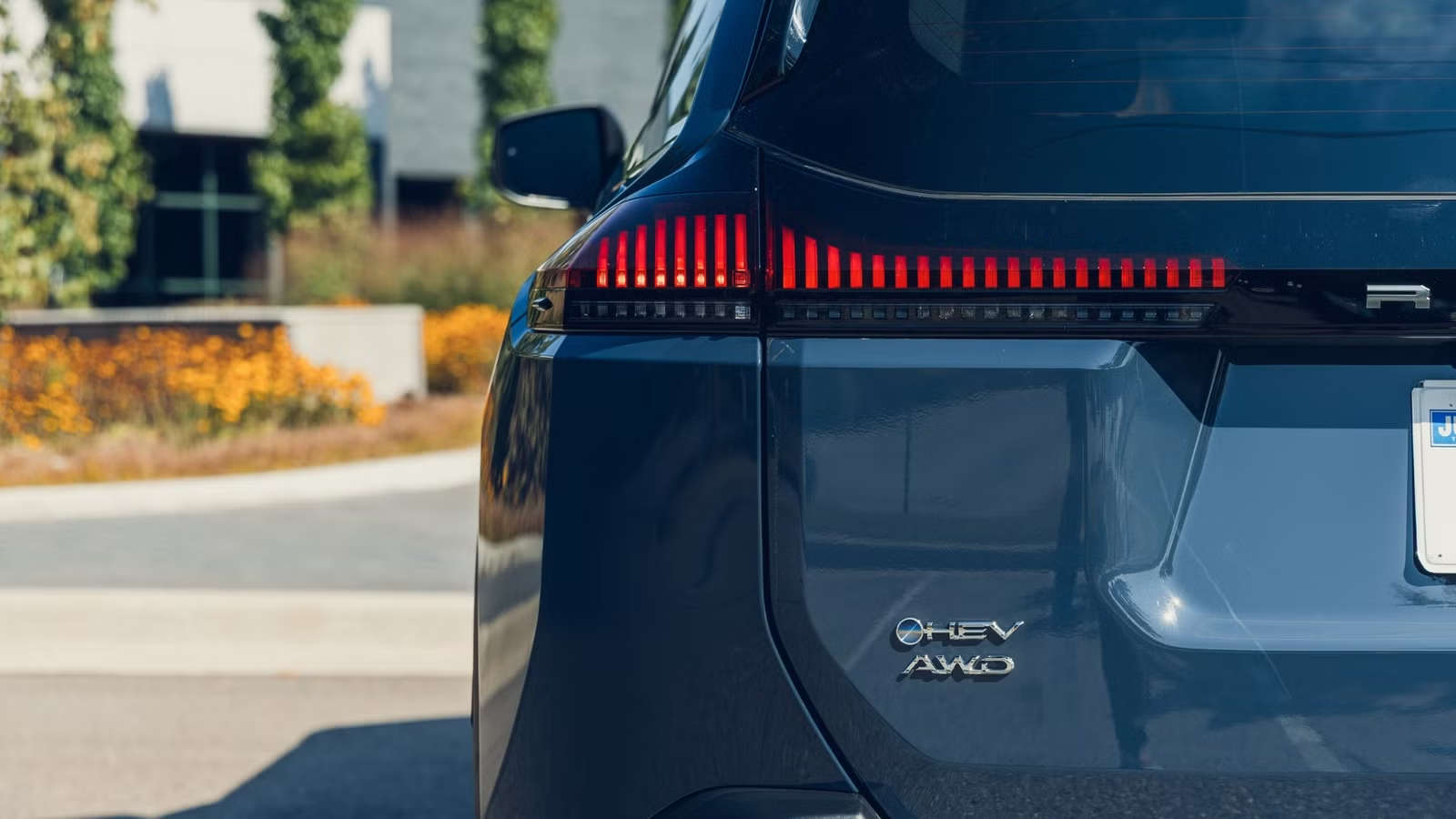
There is a reason why the Tesla Model Y is one of the best-selling EVs on the market: 300-plus miles of range, strong practicality, and a tech-forward package. Yet its appeal is changing because there is now a compact SUV that can function as an electric vehicle for 90 percent of its life while still spontaneously tackling a 500-mile road trip with class-leading efficiency. Once you consider its impressively strong acceleration, DC fast charging, and a 3,500-pound tow rating that matches the Model Y, this PHEV provides a level of flexibility that simply wasn’t possible with previous models. It’s about time a mainstream SUV finally put all the pieces together.
The Tesla Model Y Argument Has Changed

The Model Y built its reputation around a convincing formula: useful electric range, effortless home charging, strong performance, and enough practicality to replace a conventional family SUV. But an EV only needs all 300-plus miles of its battery when the journey exceeds what a much smaller plug-in battery can accomplish every day.
The Modern Standard Of Battery Range

Range anxiety used to be one of the biggest factors holding shoppers back from replacing their gas-powered vehicles with EVs, but in 2026, maximum driving range has never been better. A 2026 Tesla Model Y offers 321 miles of range in base RWD form; the Premium RWD achieves 357 miles, and even the Performance AWD manages 306 miles. Even when utilizing only about 60 percent of its total battery capacity, the Model Y is perfectly viable as a sole vehicle for the demands of most prospective owners, with the average round-trip commute ranging between 46 and 58 miles per day. Yet what happens when a PHEV battery becomes capable enough to tackle most commutes, allowing you to seldom use the gasoline engine during the regular workweek?
The Unsolved Concerns Regarding Road Trips

If you are going to take a road trip in an EV, the Tesla Model Y remains one of the easiest choices. A lot of that has to do with Tesla’s well-connected Supercharger network, which can add about 152 to 182 miles of range in roughly 15 minutes, depending on the Model Y configuration. However, everything from charger availability and weather to battery state will determine how you have to plan your trip. If you decide to tow, Tesla itself states that towing can significantly decrease the Model Y’s range, potentially adding extra charging stops and time to your journey. That is why an SUV that can provide the best of both worlds—EV operation for everyday driving and high-efficiency gasoline capability for longer-distance trips—could be the perfect compromise for the right buyer.

The New RAV4 PHEV Is The Toyota That Changes The Equation

That SUV is the redesigned Toyota RAV4 Plug-in Hybrid, the successor to the vehicle once known as the RAV4 Prime. Its bigger battery transforms it from a gasoline SUV that can occasionally behave like an EV into something much closer to an EV that happens to carry its own backup power source.
Why 54 Electric Miles Is A Perfect Amount

That’s right: the 2026 Toyota RAV4 PHEV is that versatile SUV, now offering 54 miles of EPA-estimated all-electric range in SE trim, while most other trims offer 52 miles. Toyota UK quotes 62 miles under WLTP testing, but what really matters is that crossing the 50-mile EV-range threshold provides a significant upgrade to the entire RAV4 platform.
If you have access to convenient home charging, it is likely that you could manage your entire commute and daily errands without ever starting the gasoline engine. Of course, 50 or so miles of range does not compare with the 300-plus miles offered by the Model Y, but the Toyota gives many owners enough electric range to cover their daily mileage without using gasoline. Once that electric range is exhausted on longer trips, the RAV4 still offers a class-leading 40 mpg combined without requiring owners to plan their journey around Supercharger locations.
The Advantages Of The New 22.7-kWh Battery

Part of what gives the new RAV4 PHEV this increased capability is its 22.7-kWh lithium-ion battery, a substantial increase over the previous generation. What Toyota got right with this new generation was finding the sweet spot between providing enough electric range for most consumers and avoiding unnecessary weight penalties. Shoppers often forget that increased range usually comes at the cost of increased battery weight, which can affect performance, driving dynamics, and overall efficiency. A huge battery sounds great in theory, but everything in engineering comes with a trade-off.
Now that the conventional gas-only RAV4 is a thing of the past, the entire lineup of America’s best-selling SUV revolves around electrification. The RAV4 PHEV is now the ultimate do-it-all version of Toyota’s compact SUV, becoming an aspirational model rather than an obscure trim aimed primarily at efficiency-focused shoppers.
Toyota Fixed The Two Most Common PHEV Compromises

The extra electric range alone wouldn’t make the RAV4 a genuine Model Y alternative if it remained slow to charge or noticeably slower on the road. Toyota attacked both weaknesses, although buyers need to choose the correct trim to get the full package.
324 Horsepower Provides Serious Grunt

With 324 net combined horsepower, the 2026 RAV4 PHEV is officially the most powerful and quickest RAV4 model ever produced. While its 5.4-second 0-to-60 mph time isn’t going to outrun a BMW M340i or anything like that, the fact that an SUV this versatile and efficient can accelerate this quickly is a spectacle in itself. For context, a base RWD Model Y completes the 0-to-60 mph sprint in 6.8 seconds, while the Premium RWD model matches the RAV4 PHEV’s time.
Only the Premium AWD’s 4.6-second time and the Model Y Performance’s 3.3-second time are quicker. When we consider that the RAV4 a decade ago offered a maximum of 194 horsepower and was lucky to achieve a sub-eight-second 0-to-60 mph sprint, the performance of today’s RAV4 PHEV is in an entirely different league. While the RAV4 PHEV’s powertrain may not offer the same instant torque as a pure EV, it is still remarkably quick off the line. If you really prioritize outright speed, the Model Y Performance is the clear winner.
DC Fast Charging Speeds Up Time Efficiency

Toyota focused heavily on the details that matter to EV buyers with the new RAV4 PHEV, and upgraded charging speeds were certainly a key concern. The XSE and Woodland trims specifically receive a CCS port and DC fast-charging capability, while the SE and GR Sport retain J1772 AC charging. With DC fast charging, you can charge from roughly 10 to 80 percent in 30 to 35 minutes. This alone can make a difference if you don’t have easy access to charging, since you can add meaningful electric range during a lunch or shopping trip. While the RAV4 PHEV’s 50-kW capability is nowhere near the 250-kW output available at a Tesla Supercharger, its battery, both in terms of range and charging speed, has never been better. And remember, with the PHEV, you don’t have to charge, but the option is always there.
The New RAV4 PHEV Proves Range Isn’t Everything

The Model Y still wins the pure-EV contest, but that may no longer be the comparison that matters to mainstream SUV shoppers. Once electric commuting has been covered, purchase price, towing, refueling flexibility, and ownership habits become much more important.
What You Are Getting For The $41,500 Starting Price

The 2026 Toyota RAV4 PHEV starts at $41,500 MSRP. For that price, you’re getting 324 net combined hp, a 5.4-second 0-to-60 mph time, up to 54 miles of electric range, standard AWD, and a hybrid powertrain that offers 40 mpg combined. For comparison, a 2026 Model Y RWD starts at $39,990, produces about 295 hp, offers 321 miles of electric range, has a 6.8-second 0-to-60 mph time, and can add up to 160 miles of range in about 15 minutes at a Supercharger. The RAV4 PHEV wins out by offering standard AWD, more horsepower, the versatility of both electric and gasoline power, and significantly stronger acceleration. With the PHEV model, there is no need to sacrifice performance, efficiency, or versatility to stay with a familiar SUV like the RAV4.
3,500 Pounds Of Towing Capability Is A Major Factor

Thanks to standard AWD, the SE, XSE, and Woodland trims are all capable of towing up to 3,500 pounds, matching Tesla’s advertised 3,500-pound rating for the Model Y. However, in practice, the reality is different. While the RAV4 PHEV will burn gasoline once the battery is depleted, refueling takes only a few minutes. Meanwhile, Tesla explicitly states that towing will significantly reduce driving range, meaning you may have to make more stops on your trip than you initially planned.
If you’re on a tight schedule, that can be a significant difference-maker. While a Model Y is certainly well-equipped and capable of handling a long road trip, the RAV4 PHEV’s second energy source is invaluable for the flexibility it provides, no matter how remote your adventure might be. Both the Tesla and Toyota SUVs are bestsellers in their respective segments for a reason, so as long as you know what matters most to you in terms of daily usability, you can’t really make the wrong decision with either option.
Sources: Toyota, Tesla

Related posts






Latest Post


No Comments