
This Was America’s First Production Supercharged V8 Car
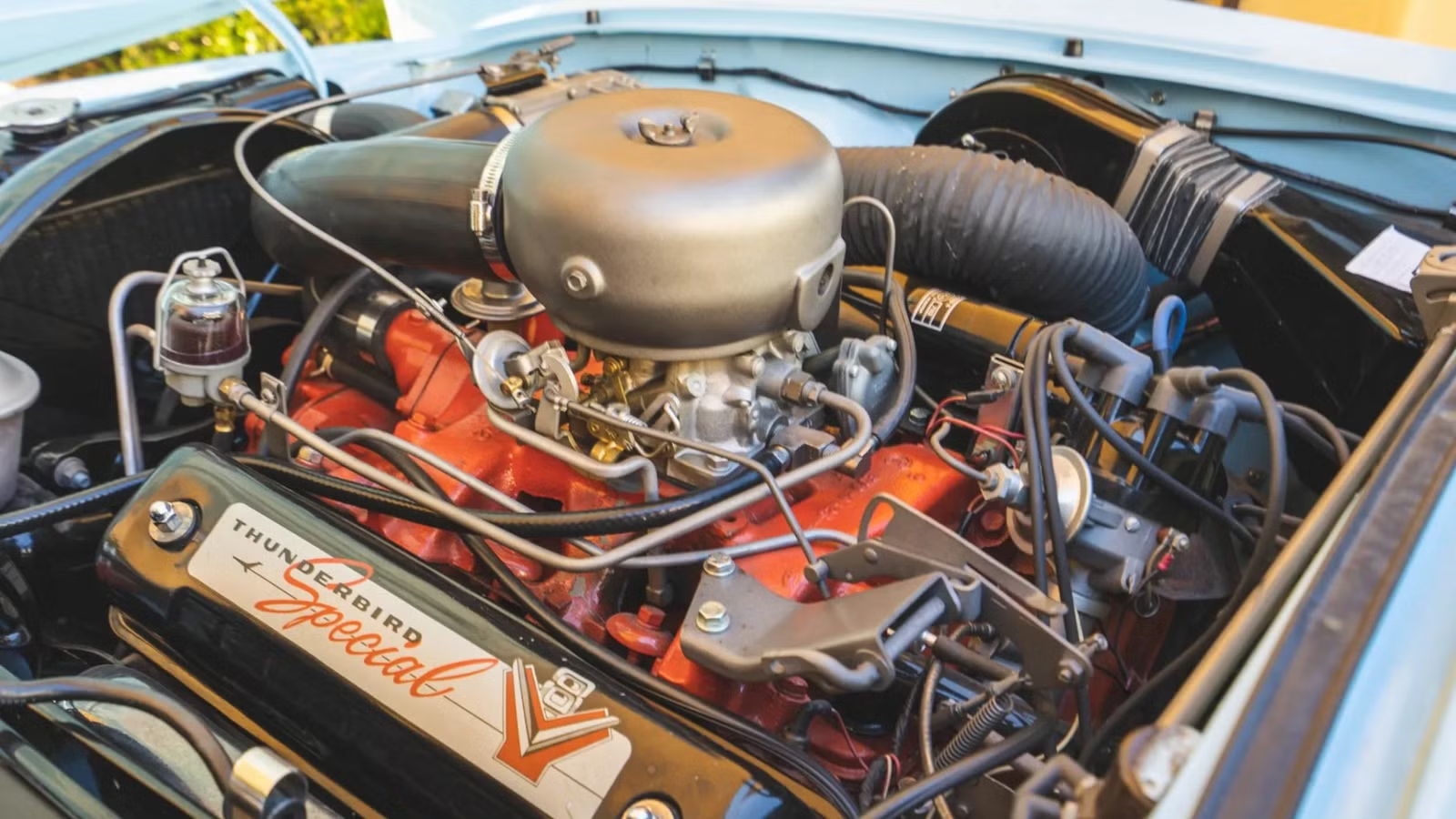
Forced induction and American iron have always been a natural pairing — but that marriage started earlier than most enthusiasts realize. Long before superchargers became a selling point on Shelby Mustangs or Dodge Hellcats, one automaker quietly slipped a blown V8 under the hood of a production car and changed the game without anyone fully noticing. The late 1950s were dominated by chrome, tailfins, and the pursuit of effortless comfort, yet right in the middle of all that excess, a single bold engineering decision rewrote what an American car could be. Before muscle cars had a name, before superchargers became showroom staples, one automaker took a calculated risk — and the result was America’s first factory-produced supercharged V8 car.

It wasn’t about volume or fame. It was about proving that refinement and raw power could share the same body. The creation of this vehicle demonstrated that sometimes the most important revolutions don’t arrive with a spotlight. They arrive with the whistle of boost and a V8 that pulls harder than it looks.
This is the story of the supercharged V8 that got to the finish line first.
The Supercharged 1957 Ford Thunderbird Went From Cruiser To Quarter-Mile Contender

When the Ford Thunderbird debuted in 1955, it wasn’t trying to be a muscle car or even a sports car. Instead, it was simply Ford’s answer to the Corvette, but with a softer edge. The first-gen T-Bird was built for style, not speed. It was low, sleek, and packed with V8 power under the hood, but its real focus was comfort, not cornering. According to Curbside Classic, Ford called it a personal car — something that looked fast but cruised like a Cadillac.
By 1957, however, things had started to shift. Chevrolet had doubled down on performance with the Corvette, introducing fuel injection and winning races. Ford couldn’t afford to hang its hat on style alone anymore. Enthusiasts were hungry for quarter-mile performance, and the T-Bird needed to prove it was more than just a pretty face. That’s where the supercharged F-Code enters the story.

According to Silodrome, Ford engineers took the T-Bird’s existing 312-cubic-inch Y-block V8 and bolted on a Paxton-McCulloch VR57 centrifugal supercharger. The result was America’s first factory-produced supercharged V8 car from a mainstream manufacturer. The addition of this forced-induction engine gave the Thunderbird real muscle to back up its looks.
The resulting 1957 Ford Thunderbird F-Code was factory rated at 300 horsepower. However, per Reddit, period tests and even Paxton Products themselves put the figure closer to 400 horsepower. According to Supercars.net, the F-Code turned in a quarter-mile time of around 17 seconds and could reach a top speed of 115 mph.
The 1957 Thunderbird also received sharper styling, revised suspension, and upgraded brakes — features that helped make it more than just a straight-line missile. The F-Code didn’t just turn heads at the country club. It was nothing like the traditional T-Birds. The F-Code was designed to hold its own on the drag strip. And while it wasn’t officially marketed as a race car, make no mistake: this was Ford’s way of throwing down the gauntlet in the growing performance war.
In just a few short years, the Thunderbird had gone from boulevard cruiser to factory hot rod. And for a brief moment in 1957, it was one of the fastest machines you could buy with a warranty.
Inside The F-Code: Ford’s First Factory Supercharged V8 Beast

At the heart of the F-Code Thunderbird sat one of the boldest engine setups Ford had ever dropped into a street-legal car. The foundation was the familiar 312-cubic-inch Y-block V8 — a solid engine in its own right. What made the F-Code special, though, was the addition of a Paxton-McCulloch VR57 centrifugal supercharger, fitted at the factory as part of a limited high-performance package.
1957 Ford Thunderbird F-Code Specs
|
Engine |
312-cubic-inch Y-block V8 |
|
Supercharger |
Paxton-McCulloch VR57 centrifugal |
|
Horsepower |
300 hp (factory-rated) ~360-400 hp (unofficial) |
|
Torque |
340 lb-ft (factory-rated) |
|
0 to 60 mph |
~8.5 seconds |
|
Quarter-mile |
~17 seconds |
|
Top Speed |
~115 mph |
This wasn’t some dealer-installed gimmick or backyard modification. It was a fully engineered system developed by Ford and Paxton to boost output and torque without sacrificing drivability. According to Hemmings, the supercharger forced air through a Holley four-barrel carburetor, helping the Y-block produce a factory-rated 300 horsepower and 340 lb-ft of torque. But as enthusiasts have long pointed out, those numbers were almost certainly conservative. Real-world output often pushed closer to 360–400 horsepower depending on setup and tuning.

The F-Code engine wasn’t just about raw numbers. It also came with upgrades engineered to handle the extra stress: a heavy-duty radiator, performance cylinder heads, reinforced internals, and special camshafts were all part of the package. Buyers could also spec the car with a 3-speed manual transmission with optional overdrive or Ford’s robust 3-speed automatic.
The 1957 F-Code was a rare blend of elegance and engineering. One moment you’re gliding to the country club in chrome-laden style; the next, you’re laying rubber across an intersection with a factory-blown V8 under your right foot. The F-Code delivered the best of both worlds in 1957 America.
Why The F-Code Still Matters In American Performance History
The F-Code Thunderbird wasn’t just fast for its day — its production was foundational for American performance as a whole. At a time when most American cars prioritized chrome and comfort over horsepower and handling, Ford quietly rolled out something radical: a factory-supercharged V8 personal luxury coupe. It was subtle, sophisticated, and brutally effective when asked to perform.
According to Sports Car Market, out of the 21,380 Thunderbirds produced in 1957, only about 212 were F-Code cars — making it one of the rarest high-performance Fords ever sold to the public.
Its original list price was around $4,815. The F-Code’s scarcity alone makes it a prized collector’s item today. According to Classic.com, clean examples routinely command six-figure prices, and matching-numbers cars with proper F-Code documentation are even more sought after.
But beyond the rarity, the F-Code was a blueprint. It marked one of the first times a major American automaker used forced induction on a V8 as part of a performance-focused production package. This supercharged setup wasn’t for a concept car or a race-only build — it was fitted to a real production vehicle that you could walk into a dealership and order.
In a way, the F-Code predicted everything that followed. Without it, there’s no GT500, no Hellcat, no ZL1. It was an early signal that American performance wasn’t just about big displacement. The F-Code proved it could be about smart engineering, too.
Before The Muscle Car Era, These Supercharged V8s Took A Shot At Glory
Ford may have been the first to bring a supercharged V8 to the mainstream, but they weren’t the only American manufacturer experimenting with forced induction in 1957. A couple of bold outliers from Packard and Studebaker were also pushing air under pressure.
Take the 1957 Studebaker Golden Hawk, for example. Per the Studebaker National Museum, under its long, low hood sat a 289-cubic-inch V8 paired with a McCulloch supercharger, producing a claimed 275 horsepower. The styling was love-it-or-leave-it, but the performance was no joke. It was one of the quickest American cars of its era, even if it didn’t look the part.
Then there was the 1957 Packard Clipper. It also featured a factory-installed McCulloch-blown 289-cubic-inch V8, shared with the Golden Hawk, and was likewise factory-rated at around 275 horsepower. However, Packard’s days were numbered, and the car largely flew under the radar.
These were the brave early adopters of forced induction — models that didn’t spark a supercharged revolution on their own, but helped lay the groundwork for one. And while the F-Code stood apart in refinement and collectible status, these forgotten boosted machines helped prove that American V8s and superchargers were always destined to find each other.
The 1957 Thunderbird F-Code didn’t sell in big numbers. It wasn’t mass-marketed, nor did it dominate any racetracks. But it didn’t need to, because it proved something much bigger. The F-Code showed that American performance could be more than just brute force — it could be beautifully engineered, delivering power through precision rather than raw displacement alone. In an era obsessed with cubic inches and tailfin styling, the F-Code quietly brought forced induction into the mainstream without ever raising its voice.
It didn’t wear stripes. It didn’t beg for attention. But under that long hood was a factory-built supercharged V8 — a clear signal of what was possible when innovation met intention.
Ford didn’t just build a faster Thunderbird. They built a blueprint: a car that looked elegant, drove smoothly, and pulled harder than anyone expected when the throttle dropped.
And even now, nearly seventy years later, that message still holds up. The F-Code wasn’t built to be loud. It was built to hint at the future. Whether you’re behind the wheel of a modern Shelby or eyeing a high-horsepower Charger, that quiet revolution from 1957 is still echoing through every boosted V8 that followed.
Sources: Classic.com, Curbside Classic, Hemmings, Over-Drive Magazine, Silodrome, Sports Car Market, Studebaker National Museum.

Related posts
Latest Post


No Comments