
Mercedes-AMG GT 63 EV: £160k hyper-saloon makes up for the V8
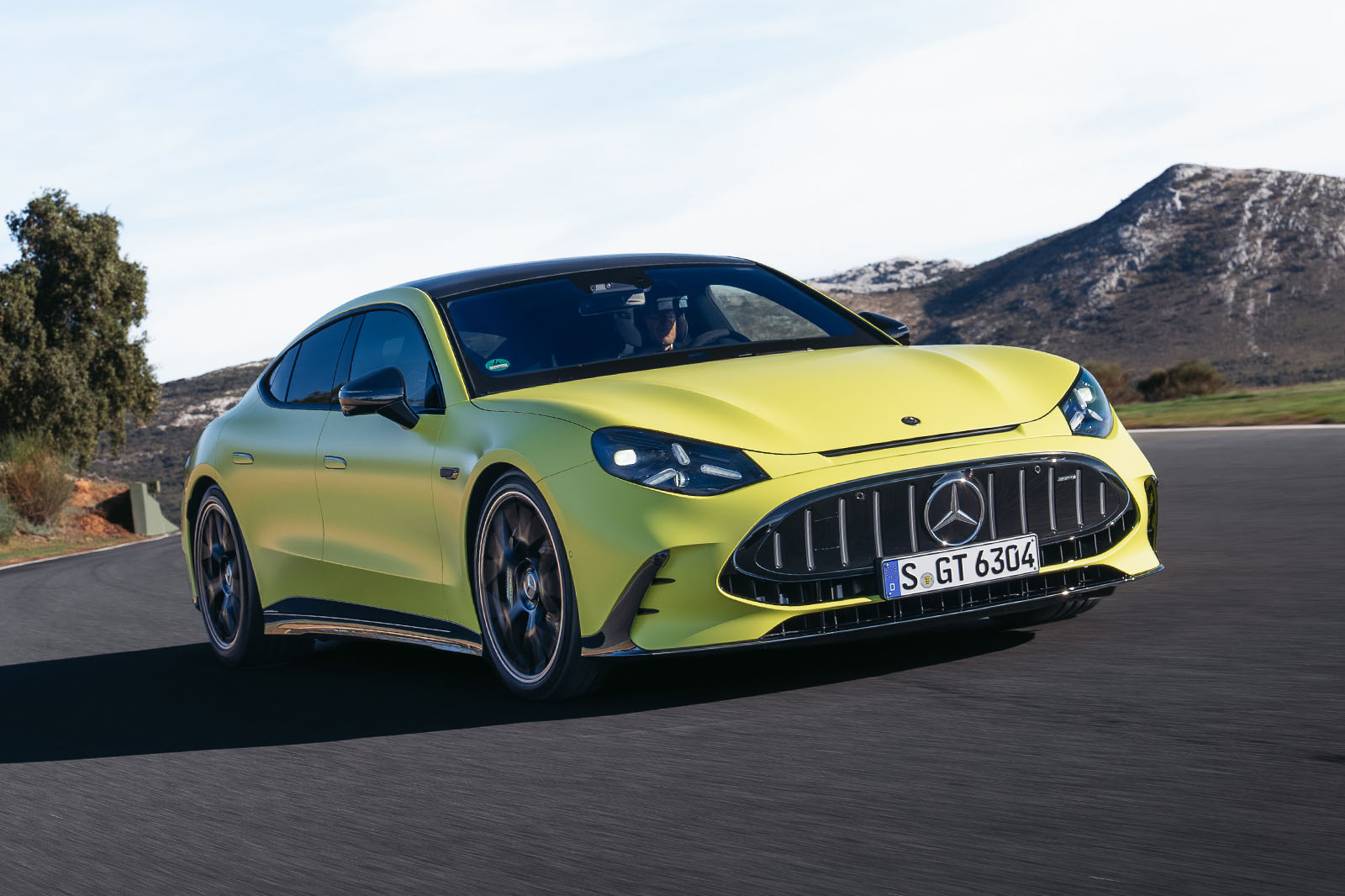
AMG’s Taycan chaser brings 1169bhp, game-changing drivetrain tech and eerily convincing ICE sensations

Somewhere between Malaga and the Ascari circuit, focused on driving a car this powerful on roads this demanding, I lost sight of the fact that the Mercedes-AMG GT 4-Door Coupe was electric.
Mostly because the driving experience just feels so alluringly familiar. For starters, it is very deliberately not silent in its more sporting driving modes: select the AMGForce option, and it sounds for all the world like a traditional combustion-engined AMG model. Loud, brutish, unapologetic. The synthetic revs rise and fall, the seat vibrates, and the paddles trigger a jolt that feels, absurdly, like a gearshift. It is a carefully orchestrated illusion, all played through a series of speakers, and for a mile or two on those Andalusian roads in the mid-range GT 55 4Matic+, it worked a treat.
This is AMG’s first dedicated electric model, built on the AMG.EA platform with an 800-volt electric architecture and axial-flux motors developed with Yasa, the Oxford firm Mercedes-Benz acquired in 2021. A GT SUV follows early next year, then a GT SUV Coupe, giving AMG three models to take on the Porsche Taycan and Cayenne Electric, plus the Lotus Emeya and Eletre.

The GT 63 4Matic+ is the flagship. Its three motors – one front, two rear – deliver up to 1169bhp and 1475lb ft in 63-second bursts (appropriately), dropping to a sustained 721bhp and 811lb ft during constant throttle running. The lower-powered 55 4Matic+ uses the same drivetrain layout, serving up 816bhp and 1328lb ft, though also settles for a milder continuous output to protect the battery and motors under sustained load. The GT 63 hits 62mph in a claimed 2.4sec and 124mph in an even more impressive 6.4sec. Top speed is limited to 186mph with the optional Driver’s Package, or 155mph as standard. The GT 55 dispatches 0-62mph in around 3.0sec, though final figures are unconfirmed.
The motors are of axial-flux rather than radial-flux construction, allowing a flatter, lighter housing than any electric motor AMG has used before. Each rear unit measures just 80mm in width and weighs 24kg.
A 106kWh battery sits low in the floor and centre tunnel, with 2660 cylindrical cells and oil cooling. AMG claims 600kW peak charging, enough to add 286 miles in ten minutes, it says. During a demonstration at Ascari, the GT 63 pulled a mind-boggling 637kW, hinting at conservative claims. The WLTP range is put at between 370 to 432 miles, depending on the model.
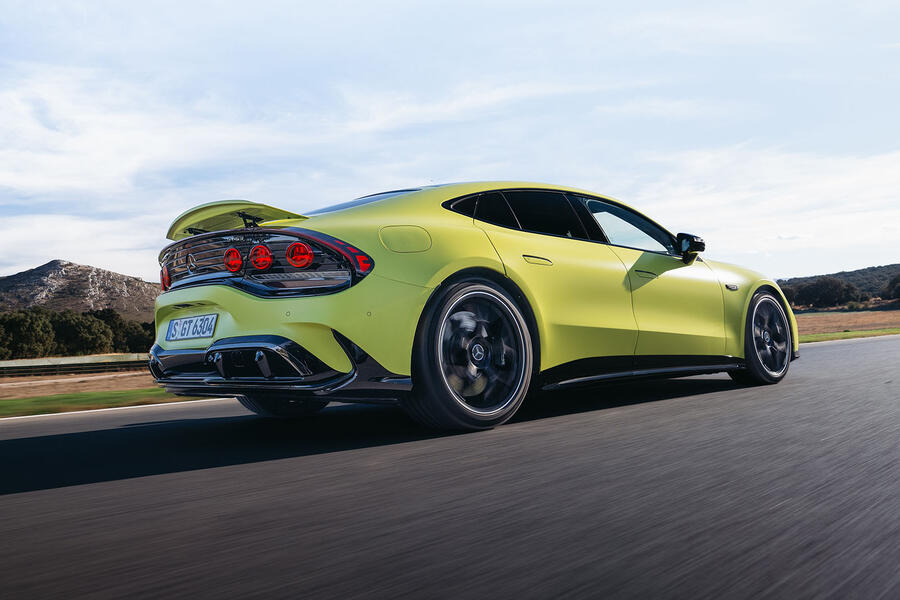
At 5094mm in length, 1959mm in width and just 1411mm in height, the GT sits 40mm lower than its V8 forebear. An adjustable rear spoiler and active diffuser contribute to aerodynamics, but the shape is cleaner and less aggressive than the figures suggest.
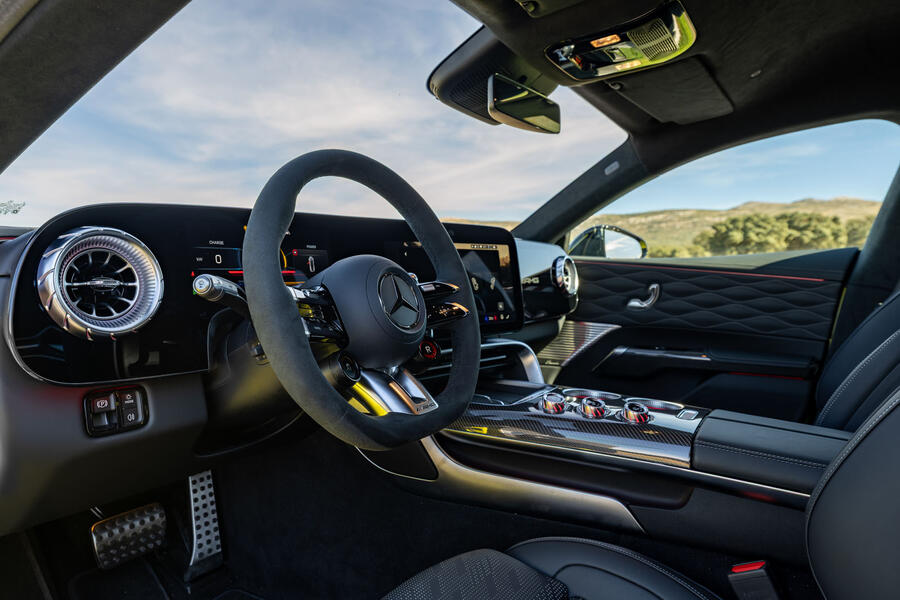
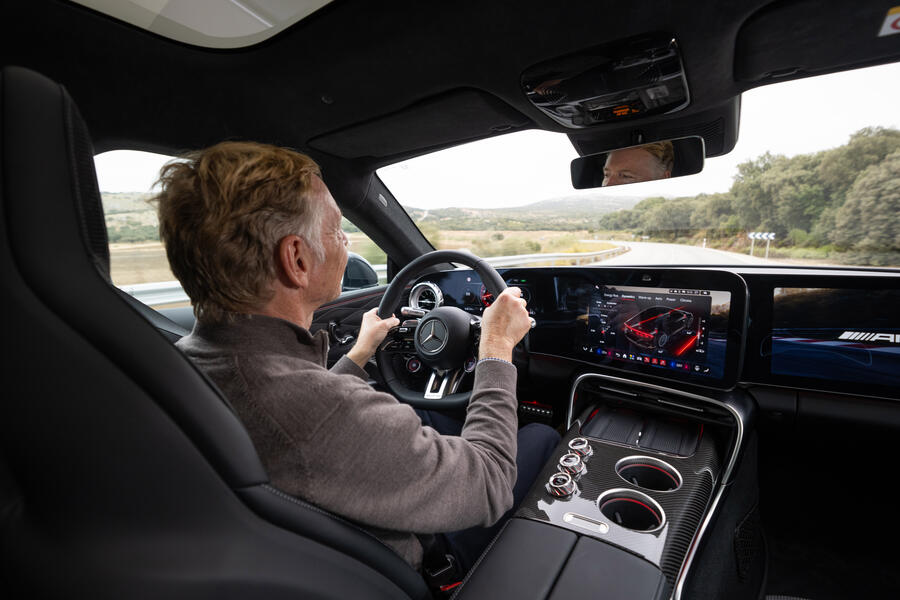
Inside, the driving position is a real strength. You sit low, not perched above the battery, with a substantial centre console separating the front seats. The seats provide excellent support, and the relationship between wheel, pedals and instruments sets up a fittingly sporting driving position.
A 10.2in instrument display and 14in central touchscreen dominate, along with an optional 14in passenger display. Crucially, AMG has retained physical controls – most enticingly the three rotary dials marked Response, Agility and Traction which form the AMG Race Engineer system, each offering nine stages of adjustment. It is a tangible, tactile interface for an ostensibly software-defined car. Boot capacity is 415 litres. There is no frunk.
On the road, the GT feels less like a Taycan rival and more like a rethinking of what a fast electric saloon can be. Around town and on secondary roads in Comfort, it is remarkably civilised. The steering is nicely weighted, the ride settled, the damping excellent – fluid, with impressive shock absorption. It breathes with the road and is superbly controlled, never floaty nor brittle.
Switch to Sport+ and the character shifts. The throttle sharpens, the ride firms up a notch or two, and the synthesised soundtrack, constructed from over 1600 audio files sampling the two-door GT R’s twin-turbocharged 4.0-litre V8, transforms the experience. It should be ridiculous. And in a way, it is. But the AMGForce also heightens the interaction between driver and car, providing clear reference points of throttle position, speed, lateral load, steering angle and braking force. Turn it off and those reference points vanish, leaving you with a car that is undeniably fast but oddly mute.
There’s more to it than synthesised noise, though. Turn into a bend, feed in power, and you feel the rear axle helping the car around. By varying torque between the rear wheels, it encourages the GT to rotate towards the apex, allowing you to open the steering earlier and accelerate away hard. It is progressive rather than abrupt, with sufficient feedback to feel natural. Adjust the agility dial and you can alter how eagerly the rear axle joins in. Keep it restrained and the GT 55 feels safe and secure. Dial it up and the rear end responds sharply, allowing you to use the power to pull the nose tighter into the line.
Out on the Ascari circuit, everything scales up. With the electronic systems relaxed, the active rear axle allows the GT 63 to adopt a remarkably adjustable attitude through tighter corners. You can lean on the chassis harder than you would on the road, and it obliges with composure that belies its mass. There is reassuring stability through faster sweepers, while huge carbon-ceramic brakes deliver strong, consistent stopping power lap after lap. What is most impressive is how approachable it all feels. The GT 63 is not a car that demands heroics. It simply asks that you trust it, and from what we have seen so far, it doesn’t disappoint.
The AMG Active Ride Control air suspension uses hydraulically linked dampers instead of conventional anti-roll bars to stiffen up in corners and softens on straight. The suspension uses forged aluminium double wishbones up front and steel and aluminium multi-links at the rear. Rear-wheel steering turns up to six degrees, adding to the sense of agility. Underbody Venturi panels also drop down at speed to suck it to the road. The low-mounted battery provides the basis for a centre of gravity that’s described as being significantly lower than the internal combustion model. Body control is excellent, the GT resists roll in a way that defies its substantial 2460kg kerb weight.
The GT 4-Door Coupe is not subtle, not restrained and certainly not cheap. But it is genuinely impressive.
The AMGForce function will divide opinion. Some will find it annoying. Others will recognise it as an acknowledgement that electric performance, however brutal, lacks the sensory richness of internal combustion. AMG has chosen to simulate it rather than ignore it, and far from feeling like a gimmick, it adds a layer of theatre that makes the car feel special.
Less potentially divisive are the undeniably impressive technical leaps this car makes: its axial-flux motors are a genuine game-changer, the charging speed lets you top it up almost as quickly as a petrol car, and the chassis is a masterclass in controlling mass without ever feeling inert.
Sales have already begun in the UK, with prices ranging from £103,275 for the twin-motor GT 53 4Matic+ to £120,095 for the GT 55 4Matic+ and £159,860 for the GT 63 4Matic+.
The concern was that pure electric drivetrains would ultimately soften the character of Mercedes-AMG models. But on the right road with AMGForce doing its thing, it proves the opposite.
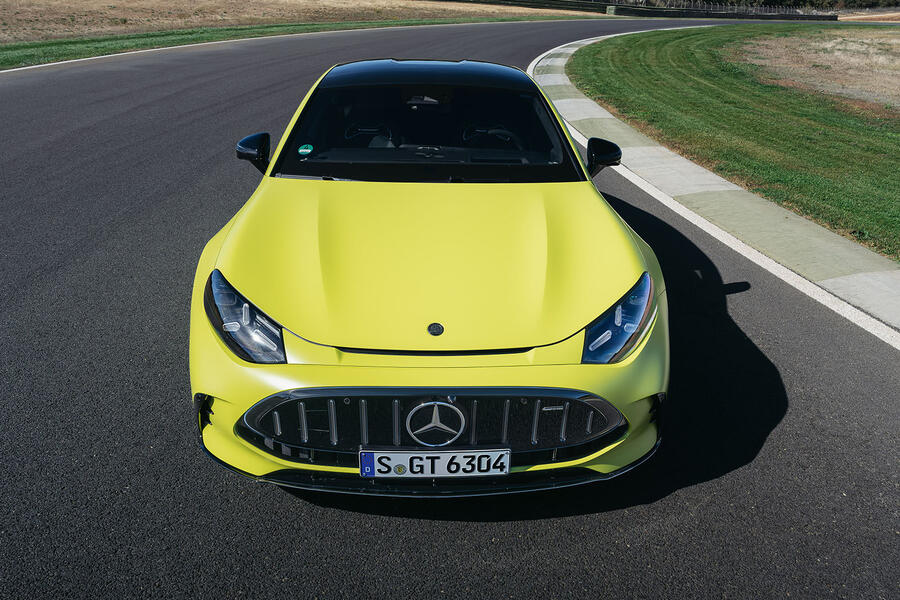
|
Mercedes-AMG GT 63 4Matic+
Fast, theatrical and surprisingly agile: AMG’s traditional road car character survives without a V8
|
|
|---|---|
| Price | £159,860 |
| Powertrain | Three electric motors, 800-volt |
| Power | 1169bhp (721 bhp continuous) |
| Torque | 1475lb ft (811 lb ft continuous) |
| Transmission | Single-speed per axle, 4WD |
| 0–62 mph | 2.4secs |
| Top Speed | 186mph (Driver’s Package); 155 mph standard |
| Range | 370–432 miles (WLTP combined) |
| Battery | 106kWh usable |
| Charging | 600kW DC peak (10–80% in 11 mins) |
| Key Rivals | Porsche Taycan Turbo GT, Lotus Emeya R |

Related posts




Latest Post


No Comments