
This Sub-$15k Kawasaki Touring Bike Will Make 500-Mile Days Feel Insufficient
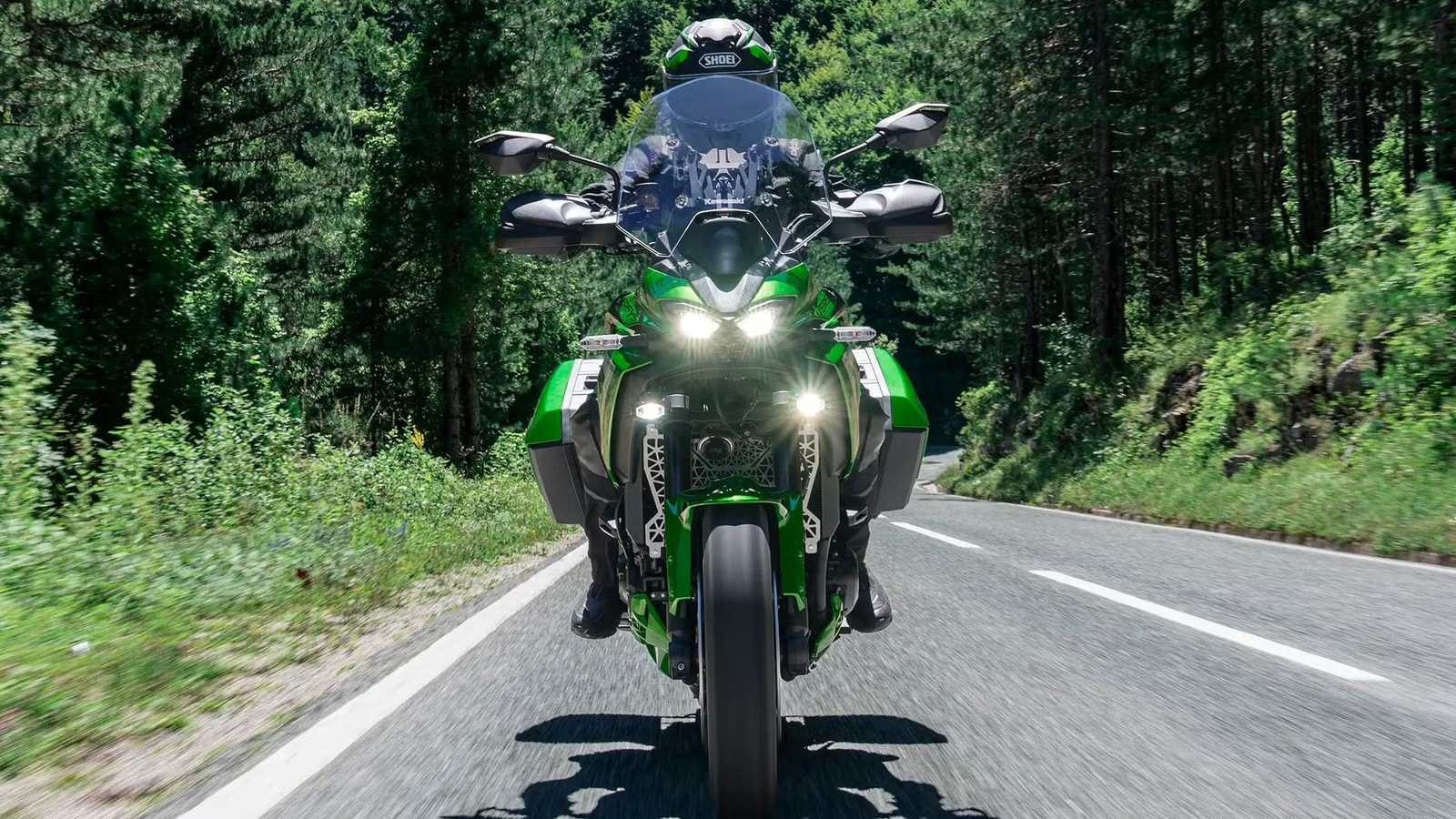
500-mile days are no easy task. They not only test the rider’s abilities, but they also amplify all the shortcomings of a touring bike. This is even more prevalent in the sub-$15,000 tourer space, as these examples can usually cut some corners in certain areas. That’s why choosing the right machine is ever so important. Every now and then, though, we see bikemakers try to set a new precedent in this segment with well-priced products loaded with high-end equipment. And the latest example comes in the form of a new-for-2027 sub-$15k inline-four Kawasaki tourer.
The Sub-$15k Touring Bike Segment Has Some Heavy Hitters

In recent years, we’ve seen competitive prices become the trend in this side of the motorcycle world. Accordingly, the sub-$15k touring bike segment has several reputed players from reputed brands–particularly Japan. Yamaha’s Tracer 9 is a prime example, which gets you saddlebags, almost 120 horsepower, and top-drawer rider aids. Similarly, the Honda NT1100, Triumph Tiger Sport 800, and BMW F 900 XR are key players.
But Kawasaki Has Been Seriously Lacking Here

One brand that’s been lacking here is Kawasaki. Team Green has only had one sub-$15k touring bike on sale for what seems like an eternity: the Versys 650 LT. While a capable machine, this is essentially an uber-dated platform that simply can’t keep up with new-age rivals. The value proposition isn’t too great, either. You pay just $2k less than the Tracer 9, while getting half the power and barely any comparable features. Finally, though, that is changing in 2027, with the launch of Kawasaki’s new inline-four midweight tourer.
The Kawasaki Versys 900 SE LT Is Your Inline-Four 500-Mile Companion On A Budget


Enter the Kawasaki Versys 900 SE LT. This is the brand’s newest touring bike, and it plugs a gaping hole in the bikemaker’s touring bike lineup. This slots between the dated but affordable Versys 650 and the near-$20k but properly loaded Versys 1100 SE LT. So Kawasaki touring bike fanatics now have an extra choice. In addition, it serves as an anomaly in the sub-$15k segment for a few reasons. Chief among them is the inline-four powerhouse, which sets it apart from parallel-twin and inline-triple rivals.
The Versys 900 SE LT Justifies Its $13,599 MSRP Well

Coming to prices, Kawasaki has priced the 900 SE LT at $13,599. That is exactly $3,000 up from the 650 but almost $6,000 less than the 1100, so it’s a good middle point. From a rival’s perspective, that price puts the new Versys exactly $1,000 above the Yamaha Tracer 9 and just $754 up from the Triumph Tiger Sport 800. Yes, that is higher than rivals, but the value proposition is quite high once you check the details. Let’s dive into them.
A Z900-Derived Inline-Four Brings Class-Leading Power

We start with the engine, and it’s class-leading. The 948cc inline-four powerhouse is derived from the Z900, but retuned for touring duties. So the output is 120 horsepower and 71.54 pound-feet, kicking in at 9,500 RPM and 8,000 RPM. Both of these are class-leading figures, while also being rather low in RPM (the power peaks lower than the Tracer and Tiger Sport). All the power reaches the wheel via a six-speed transmission. There’s no word on fuel efficiency, though.
New Chassis For 50-50 Weight Distribution
Paired up with the engine is an all-new trellis chassis. It is carved from steel, and Kawasaki says the structure takes direct inspiration from the Ninja H2 SX. This chassis uses Showa suspension for ironing out bumps. The package comprises 43 mm USD forks (with 5.9 inches of travel) and a horizontal monoshock (with 6.3 inches of travel), with rebound damping and spring preload adjustment at each end. You get a hand adjuster at the rear for less hassle during varying loads.
Topping this off is a set of 17-inch alloy wheels. That, along with the Metzeler Sportec 01 tires, confirm the tarmac-biased intentions here. These hoops house twin 310 mm semi-floating front discs (with four-piston calipers) and a 260 mm rear disc (with a single-piston caliper). What we don’t know yet is the weight and wheelbase, although Kawasaki claims the saddle height is adjustable to 32.5 or 33.3-inch settings.
Top-Drawer Electronics With Radar Assistance Boost The Value

Once aboard the saddle, you’ll realize just how loaded the Versys 900 is. In fact, it has one thing that even its elder sibling misses out on: radar assistance. Yes, you get front and rear radars here, enabling adaptive cruise control, forward collision warning, and blind-spot detection. Neither bike in this price bracket has such features in the US. Besides that, there’s the usual six-axis IMU and ride-by-wire-enabled bits you’d expect at this price. These comprise:
- Power modes
- Riding modes
- Cornering ABS
- Traction control
Finally, touring convenience has been thought of, too. The two standard saddlebags have quick-release systems, and the windscreen is adjustable, while standard fog lamps, a two-way quickshifter, and heated grips top things off. You access all these via a smartphone-connectivity-enabled five-inch TFT–the same setup we’ve seen on new-age inline-four Kawasakis.
Source: Kawasaki

Related posts



Latest Post


No Comments