
The Smallest Displacement V-6 Ever Put In A Luxury Car
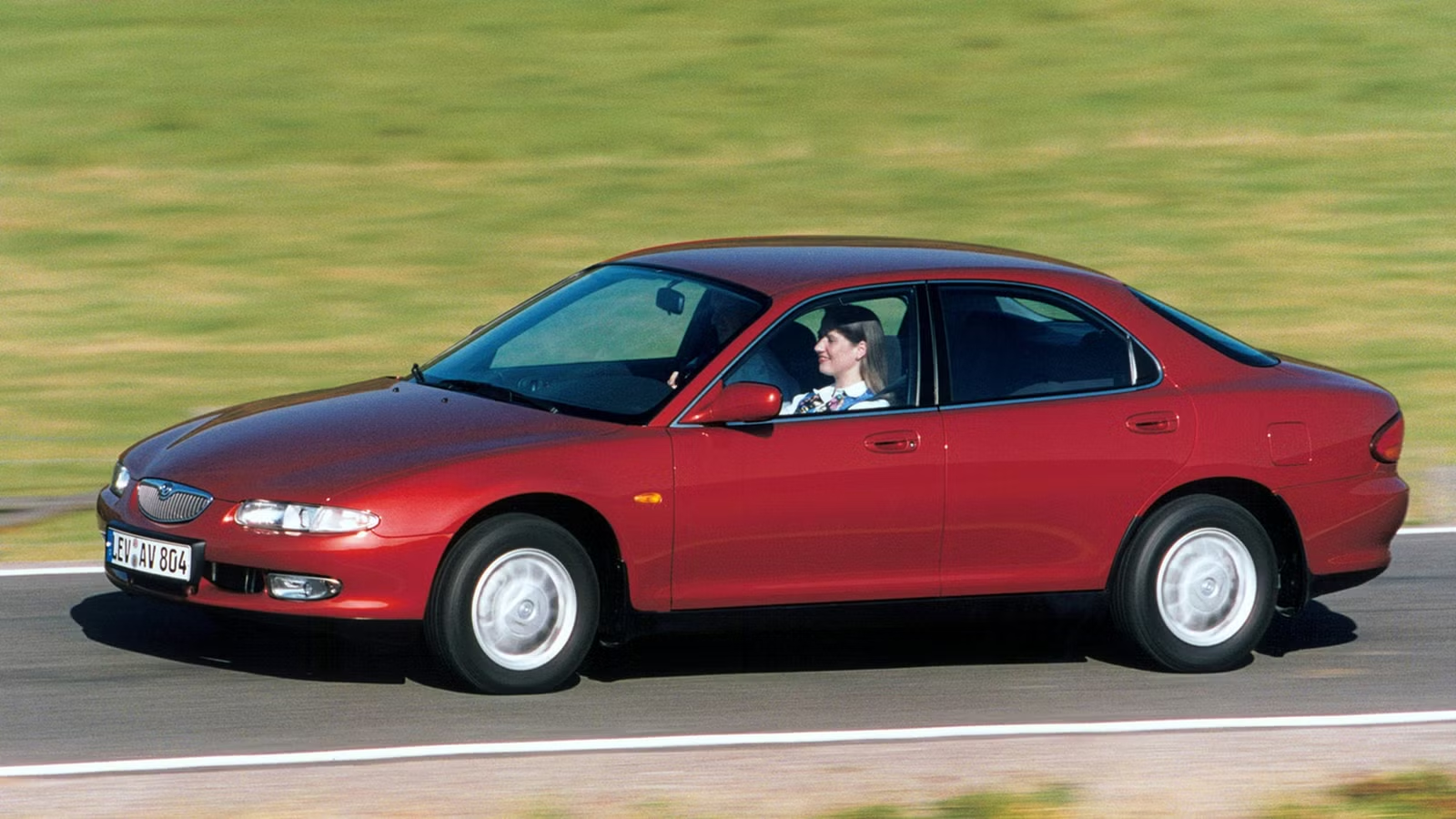
When engineers sit down to design a luxury car, the engine is rarely where they look to save space. Big V-8s and V-12s have long been the default choice for hauling around the substantial curb weight that comes with plush interiors and every conceivable comfort feature. Yet Mazda, never a brand content to follow convention, took a dramatically different path when it decided to enter the luxury segment. Rather than reaching for displacement, Mazda reached for ingenuity — and the result was one of the most fascinating engineering footnotes of the 1990s.

Mazda made a few luxury cars in the 90s that never really took off and were sold in select markets. Mazda built a new platform, created a new luxury brand, and even built a new engine for this new set of luxury cars. But instead of a powerful V-8 or an exotic V-12, they built a tiny V-6 to power their luxury car. No expense was spared to make this one of the best V-6 engines for its application.
Mazda Put The Smallest V-6 In A Luxury Car
Mazda wanted to create a luxury division in the 90s, which started with the failed Amati brand. Amati was supposed to be Mazda’s flagship luxury brand, similar to Lexus, Infiniti, and Acura. It was supposed to have some of the best luxury features available at the time. The engine was going to be a bespoke V-12 built specifically for Amati, but that project never got off the ground. Eventually, it would make other luxury cars — but with half the number of cylinders.

The Mazda K-Series

Engine Specifications
|
Engine |
NA V-6 |
|---|---|
|
Displacement |
1.8 liters |
|
Power |
135 horsepower |
|
Torque |
115 pound-feet |
|
Drivetrain |
Front-wheel drive |
|
Transmission |
Five-speed manual/Four-speed automatic |
This is not to be confused with the Honda K-series engines — Mazda’s K-series was an entirely separate family developed in-house for use across much of its model range. Displacements ranged from 1.8 to 2.5 liters, but Mazda chose the smallest variant for its luxury car: a 1.8-liter naturally aspirated V-6. This engine made its debut in the Mazda MX-3 before finding its way into the Xedos/Eunos luxury cars.
Mazda’s luxury cars were also available with a 1.6-liter inline-four making 114 horsepower, but that output was underwhelming for a vehicle of this size and weight. The V-6 was therefore engineered to deliver more power and stronger low-end torque, and it was capable of revving to 7,000 RPM. At the time, luxury cars could still be had with a manual transmission, so the Eunos/Xedos was offered with either a five-speed manual or a four-speed automatic. All powertrain configurations were front-wheel drive, reflecting Mazda’s platform capabilities at the time.
It Was Small For A Reason
Mazda could have made the V-6 bigger — and it eventually did with later versions — but there was a deliberate reason for keeping it small and compact. Japan levied a tax on large engine displacements, and any car above 2.0 liters would be taxed heavily, making it significantly more expensive for buyers. Since Mazda was just launching its luxury car, keeping displacement under two liters was a smart way to hold the price down. But a small footprint did not mean a cheap engine.
Built To Last

Mazda spared almost no expense when building this engine, since they had future plans for it. It was released just before the decline of the Japanese economy, so it had been in development for some time and was built to the highest standard. Despite a displacement of just 1.8 liters, the narrow 60-degree V-6 configuration kept it remarkably compact. The materials used to build this engine also made it robust and very reliable.
It was a very rigid engine built with high-strength materials like:
- Aluminum cylinder block
- Aluminum cylinder head
- Forged steel crankshaft
- Lightweight forged carbon steel connecting rods
These high-strength components gave the engine a free-revving character more typical of a sports car unit. But the primary motivation behind this level of construction was longevity: Mazda planned to deploy this engine across many models in its lineup, in varying displacements, states of tune, and applications. It also featured a notable innovation of the era — the Variable Resonance Induction System (VRIS) — designed to extract maximum power from the available displacement.

VRIS utilized the Helmholtz resonance principle. The intake manifold featured three chambers that opened at different RPM thresholds, controlled by the ECU. Depending on the rev range, these chambers opened sequentially to maximize air pressure and deliver the appropriate power output. The technology proved effective enough that all subsequent Mazda V-6 engines adopted it to improve efficiency. This engine was also intended to serve as the foundation for Amati’s flagship luxury car.
It Could Have Been A V-12 Engine
Amati planned to make a V-12 engine for its luxury cars, and the basis was the JK-series engine. The plan was to use the internals of the K-series engine in a new cylinder block designed for the larger configuration — a move that would have saved significant development costs, given how well-engineered the V-6 already was. The displacement was going to be much bigger at 5.0 liters and would have produced 280 horsepower. But Mazda’s promised V-12 never came to fruition, since the Amati program was scrapped.
Only Sold In Europe, Australia, And Japan

Most people in the States have never heard of the Mazda Xedos 6 or Eunos 500 because it was never sold there. In the Japanese and Australian markets, the cars were sold exclusively as the Eunos 500. They didn’t bear the Mazda name, as the company wanted it to stand as a standalone brand, though the Mazda name was retained in overseas markets.
In Europe, they were known as the Mazda Xedos 6, and the Mazda name was used deliberately. The luxury car was sold exclusively in these three regions, and a total of 72,101 Eunos and Xedos units were sold between 1992 and 1999.
The U.S. Got This Engine
Mazda never sold its luxury cars in the U.S., but the K-series V-6 did make it to American shores in another vehicle. A slightly detuned version producing five fewer horsepower was fitted to the Mazda MX-3. This was a sports coupe known in the Australian market as the Eunos 30X. It essentially shared the same 1.8-liter V-6 and drivetrain as the Xedos 6 and Eunos 500. These were the only cars to use this specific engine, as subsequent K-series variants grew in displacement fairly quickly.
The 1.8 was not the largest engine offered in the Mazda Xedos 6/Eunos 500. A 2.0-liter unit was the top option for this car, still within the Japanese road tax threshold. That engine produced 160 horsepower and 133 pound-feet of torque and was shared with several other vehicles, including the Ford Telstar. A 2.3-liter version was later offered with a supercharger, becoming the most powerful K-series variant at 217 horsepower. The largest displacement was a 2.5-liter unit making 200 horsepower in Japan, though output was reduced to 174 horsepower in other markets.
Sources: Mazda, Motortrend, and Pistonheads

Related posts



Latest Post


No Comments