
This New Plug-In Hybrid Wagon Has 630 HP And A Drift Mode
There was a time when wagons generally meant that you had settled for the easy life. Plenty of room for the family, a nice comfy ride, lazy engine up front, room for the Labrador down back. But just as anyone who actually has a family probably knows, it’s certainly not an easy life. Comfortable as your load-lugging land yacht might be, it’s not going to rid you of all the stress and strains of family vacations and weekends away with the dog. What family moms and dads really need is a bit of exciting personal time on the side, and at some point in history, carmakers realized that they could add that to the same family wagon that you use day to day. Who said you can’t have your cake and eat it . . .?
Audi Is No Stranger To Mad Wagons

In the early ’90s, Audi had a problem. At the beginning of the previous decade, the company had delivered a stroke of genius in the form of the Ur-Quattro, a rally and road car that popularized the concept of turbocharging and four-wheel drive. The Quattro was a game-changing coupe fitted with the 200 sedan’s 2.1-liter five-cylinder engine and traction at all corners, with 172 hp, a 137-mph top speed, and 60 mph in 7.3 seconds. Arriving at the Geneva Motor Show on March 4, 1980, the Quattro not only changed the shape of rallying and performance cars, it also made Audi a performance brand to be reckoned with.
By the end of the ’80s, Audi was still selling this car and wondering how to follow up on such an iconic vehicle. Enter the Audi RS2 in 1994, a joint collaboration with Porsche. The almost past-its-sell-by-date 80 Avant was fitted with 911 bits, and the 2.2-liter inline-five-cylinder turbocharged engine was tuned to 311 hp and 302 lb-ft of torque. The result was the world’s fastest wagon (it was also the first Audi to break the 155 mph barrier), with a top speed of 163 mph. It was also the beginning of the RS4 line of fast, small wagons that Audi made for the next three decades.
The RS5 Is A Hybrid — But That Doesn’t Mean It’s Boring


That leads us to the RS5 of today. Yes, internal naming conventions have effectively seen the RS2 become the RS4 and then the RS5, but essentially it is the same DNA, except for one thing. Under pressure to electrify the range, Audi Sport opted to make the RS5 its first-ever plug-in hybrid (PHEV) performance model, rather than a straight EV. But if this is putting you to sleep, like one of those late-night Toyota Prius hybrid cabs, don’t worry.
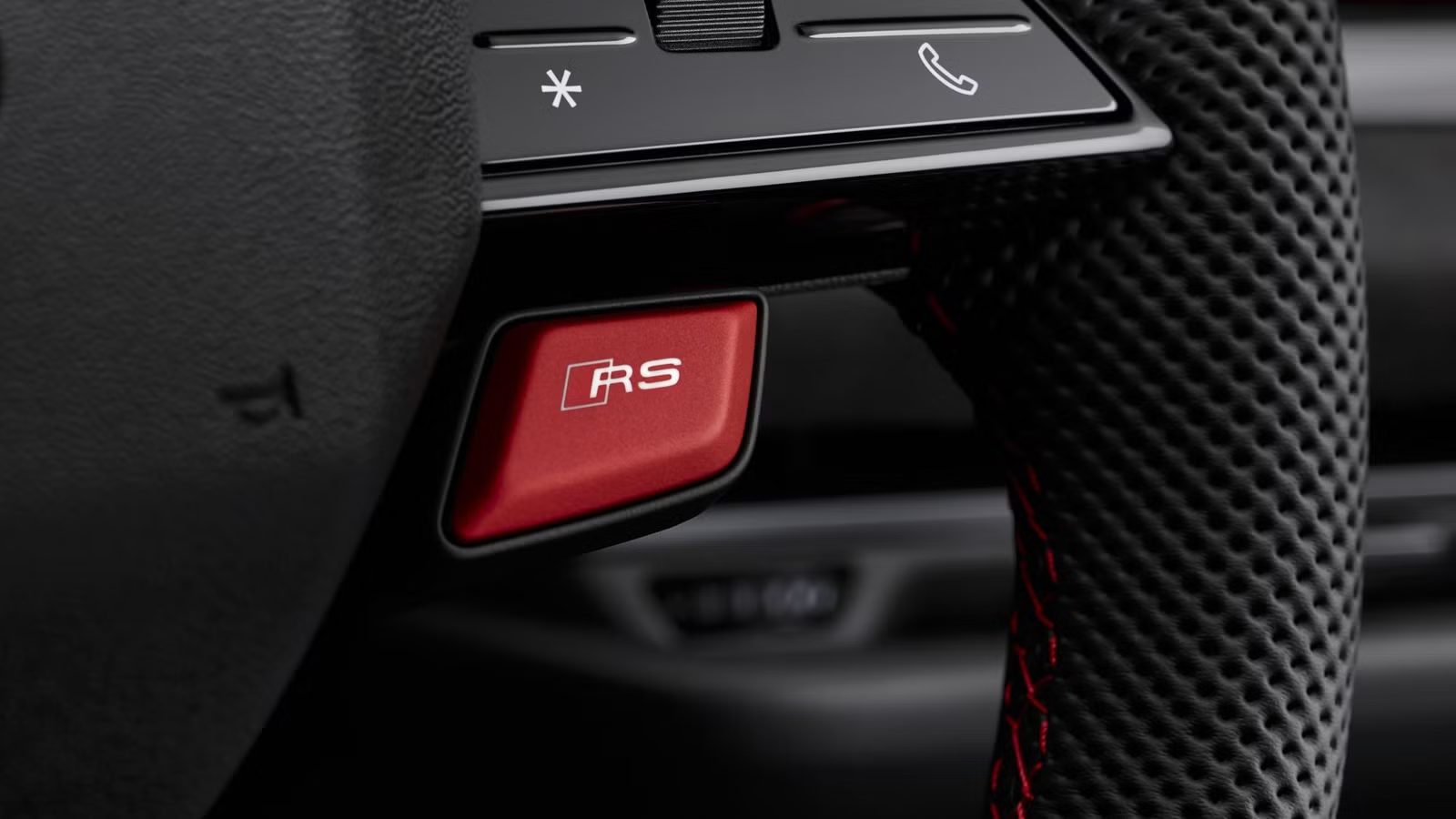
The RS5 is potentially the most potent RS wagon yet. First, when it comes to curbside presence, it doesn’t disappoint. The Audi RS5 is more than 3.5 inches wider than the base-model A5 thanks to flared fenders, and at the rear is an aerodynamic diffuser with matte oval tailpipes that look like bazookas. Under the hood is a 2.9-liter twin-turbo V6 producing 503 hp, coupled to a 130 kW electric motor that creates a combined output of 630 hp. That’s more than 100 hp over a Ferrari F50, one of the wildest hypercars of the ’90s, and more than an Audi R8 supercar.
The RS5 Is A Rocketship

As you would expect, the RS5 doesn’t hang around. Expect to hit 60 mph in 3.2 seconds, 100 mph in 7.9 seconds, and obliterate the quarter mile in 11.5 seconds. That’s quick, right? Then there is the small matter of a top speed of 177 mph. But the Audi RS5 has a trick up its sleeve. Whereas fast Audis are famed for grip and safe handling, the RS5 wants to let its hair down and party from time to time.
A Drift Mode – In A Wagon?
No one was expecting a 5,225-pound Audi wagon to go drifting, but this is exactly what it is designed to do. Well, in the right mode, that is. You’ll need to select something called RS Torque Rear mode, which configures the car for maximum rear bias and sends a high proportion of torque to the outside rear wheel, resulting in controlled drifts.
Torque can be split between the two axles depending on the driving situation, thanks to an HCP1 (High-Performance Computing Platform), and it can split power variably between 70/30 and 15/85 percent. If this wasn’t bonkers enough in a big wagon, when in Torque Rear mode, the RS5 will record and evaluate your drifting, with the drift angle recorded so that it can be analyzed later. Ultimately, this is a wagon for the Fast and Furious generation who have grown up, gotten kids and a job, and had to sell the GT-R.
The RS5 Shows There Is Life Left In ICE

These are confusing times when it comes to cars, with the arrival of the EV slowing a little, but still seemingly an inevitable replacement for ICE. Showrooms have been struggling to shift some EVs, which has prompted carmakers to slow down their immediate replacement of loved internal combustion models — likely why we have a new hybrid version of cars like the RS5. Its rival, the BMW M3, will be going down the twin model route of ICE and EV for the next generation. The trouble for some enthusiasts is that EVs haven’t captured the emotion of a wrung-out engine, but even that is being addressed by fake gearshifts and pseudo V8 noises. Whether that will be enough to win over fans remains to be seen. In the meantime, while we can, it’s worth enjoying the madness of the RS5, which retails for around $120,000 in the UK and is coming to America in 2027.
Sources: Audi

Related posts
Latest Post


No Comments