
The Weirdest Modern Motorcycle Actually Solves A Problem No One Admits
Motorcycles have long progressed from being one-size-fits-all to multi-faceted machines. Today, there’s practically a dedicated motorcycle for every use case. Specialization has taken center stage as the choices continue widening. But the compact dimensions and packaging constraints have meant that automotive technologies that help cars achieve performance, fuel economy, and electric range combined with a gasoline engine have been restricted.

Trying to make one machine cover all of these traits usually sounds weirder than it needs to be. A gasoline-electric hybrid makes the packaging problem worse. Two power sources, a traction battery, extra controls, and more weight all have to fit inside something that still needs to lean, be agile, and be easy to manage on an everyday basis. That is why the idea is odd. But it also explains why it deserves a closer look.
Hybrids Fix Different Problems On Two Wheels
Cars made hybrids mainstream because stop-and-go traffic wastes fuel, and regenerative braking can recover some of the energy normally wasted away as heat. Motorcycles already use less fuel and weigh far less, so the efficiency issue is already partly solved. Adding a battery and electric motor to a bike can easily cancel part of the advantage that a manufacturer is trying to create.

The other obstacle is packaging. A motorcycle has no trunk floor or broad underbody in which to hide a battery pack. Every component affects mass centralization, seat height, wheelbase, cooling, and rider space. That is why most electrified motorcycles have gone fully electric rather than trying to carry two complete propulsion systems. Just makes sense, right?

A hybrid starts making more sense once efficiency stops being the only narrow-focused area of improvement. Electric torque is useful at very low speeds, and an electric motor can reverse direction for parking assistance, while regenerative braking can put energy back into the battery. The combustion engine can then take over the long-distance work that’s still limited by range and charging compromises of many electric motorcycles.

This division of work is what points a weird hybrid motorcycle contraption in a direction that starts making sense. Instead of replacing the gasoline engine, the electric side can cover the moments where it does the work better. But it is a complicated answer, and even more complicated tech that Kawasaki has found an ingenious solution to.
The Result Is The Strange But Practical Kawasaki Z7 Hybrid

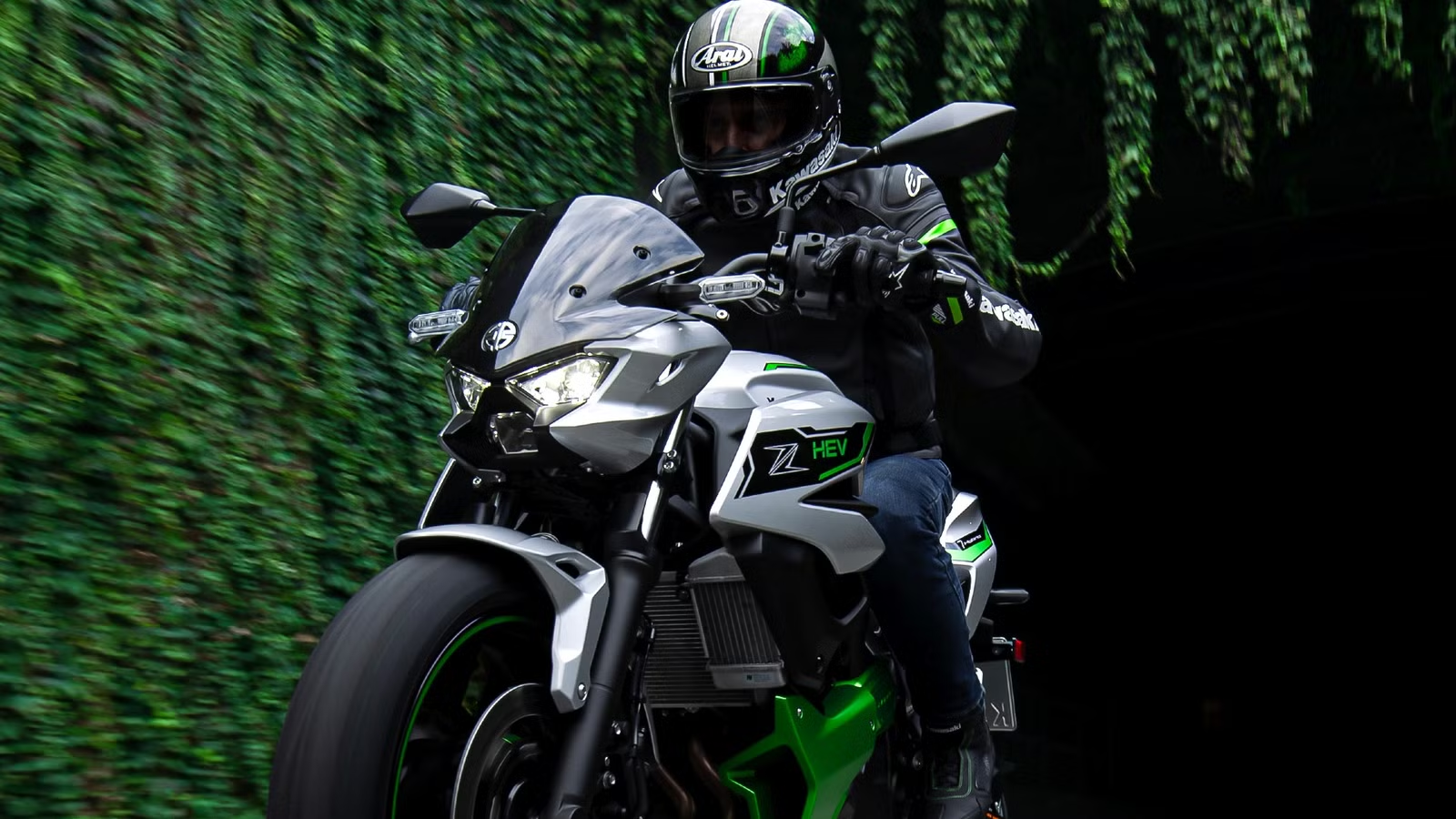
The Kawasaki Z7 Hybrid was launched in the U.S. as a 2024 naked-bike package, following the fully faired Ninja 7 Hybrid, using the same strong-hybrid architecture. Kawasaki still lists the Z7 Hybrid in the U.S. at $12,499, placing it well above conventional middleweight twins. It can run in electric-only operation at low speeds, combine both power sources, or prioritize efficiency without being a plug-in. So win-win by the sounds of it, but does it actually translate to real-world benefits?
The Hybrid System Actually Changes How The Motorcycle Works

Kawasaki’s hybrid setup pairs a 451cc parallel-twin with a liquid-cooled electric traction motor and a 48-volt lithium-ion battery. Kawasaki calls this a strong hybrid because the electric motor can propel the motorcycle independently rather than merely assisting the gasoline engine. Sport-Hybrid mode combines both systems and unlocks e-boost, while Eco-Hybrid uses electric drive when pulling away before the engine joins in at around 2,000 rpm.

At a stop, the Z7’s engine can shut down to save fuel, while EV mode allows short, low-speed electric-only running. The compact traction motor sits behind the cylinders, and the battery is positioned beneath the seat near the bike’s center of gravity. An integrated starter-generator handles starting and electric generating duties, while regenerative deceleration then feeds energy back into the battery. It all sounds too complex for a motorcycle until the numbers explain why Kawasaki did not treat the motor as a token add-on.

The combined system output is 68.5 horsepower, with maximum torque arriving at just 2,800 rpm. E-boost briefly extracts more from the traction motor for up to five seconds, and Kawasaki claims the initial standing-start acceleration can exceed that of a 1,000cc-class supersport under certain conditions. That is a carefully worded claim rather than a promise of liter-bike performance, but it shows that the electric side contributes to immediate response where the combustion engine alone would still be building revs.
The Automated Transmission Adds Real-World Convenience

The six-speed automated manual transmission eliminates the conventional clutch lever and manages clutch engagement electronically. Riders can leave shifting to the system or select gears manually using buttons on the left handlebar. Automatic Launch Position Finder can also select first gear when the motorcycle stops. Beyond convenience, the transmission coordinates the delivery of gasoline and electric power without requiring the rider to manage the transition.

Japanese bikes never fail to make daily usability a priority, so the Z7’s system is particularly useful in traffic, where frequent stops and low-speed maneuvering make clutch work tiresome. Kawasaki also includes a Walk mode that allows the motorcycle to creep forward or backward using electric power, an uncommon feature in the middleweight class, but it has a practical purpose here. At 498.3 pounds, the Z7 Hybrid is substantially heavier than a conventional motorcycle of similar engine displacement. At least Kawasaki has given riders some help managing that weight in tight parking spaces.
The Z7 Hybrid Works Because It Does Not Pretend To Be An Electric Bike

Like the Ninja 7 Hybrid, the Z7 Hybrid, too, retains the convenience of a conventional gasoline motorcycle without requiring external charging. Its 3.7-gallon fuel tank allows ordinary gas-station stops, but Kawasaki doesn’t claim MPG figures in the U.S. Kawasaki’s European WMTC fuel-consumption figure translates to approximately 64 mpg in Eco-Hybrid automatic operation. Assuming that those numbers will be equivalent this side of the Atlantic, the Z7 makes for a credible commuter, particularly for riders who regularly encounter congested urban roads.
Its appeal extends beyond fuel economy, though. Automatic shifting reduces workload, electric assistance improves acceleration, and reverse functionality makes it all the more convenient. The compromises are equally tangible, with nearly 500 pounds of curb weight, a considerably higher price than conventional middleweights, and additional mechanical complexity. Nevertheless, Kawasaki has used the hybrid hardware to address several everyday riding frustrations and full credit to the company for that.
Conventional Rivals Are Cheaper, Lighter, And Much Less Weird

The clearest problem for the Z7 Hybrid is that excellent conventional motorcycles cost far less. Honda’s 2026 CB750 Hornet E-Clutch starts at $7,999 and removes most clutch work while retaining a lighter, simpler 755cc twin-cylinder platform. If the priority is performance, Kawasaki’s own 2026 Z900 starts at $9,999 and offers 123 horsepower, cruise control, a quickshifter, and substantially more conventional speed for less money.

The Z7 Hybrid, though, stands on its own when it comes to tech and fuel economy. The Honda still depends on a gasoline engine for every mile but offers 55 MPG, and the Z900 returns 49 MPG for much more performance. The advantage over the Honda is relatively modest, particularly considering the hybrid’s substantial price premium. The Z7 Hybrid is not the rational choice if price, weight, or outright performance are the only metrics. It only makes sense because it treats hybridization as a way to broaden what a motorcycle can do without giving up fast refueling or gasoline range. Weird, certainly. Pointless, not really.
Source: Kawasaki

Related posts

Latest Post


No Comments