
This Middleweight Naked Bike Is A Wheelie Problem Disguised As Sensible Transportation
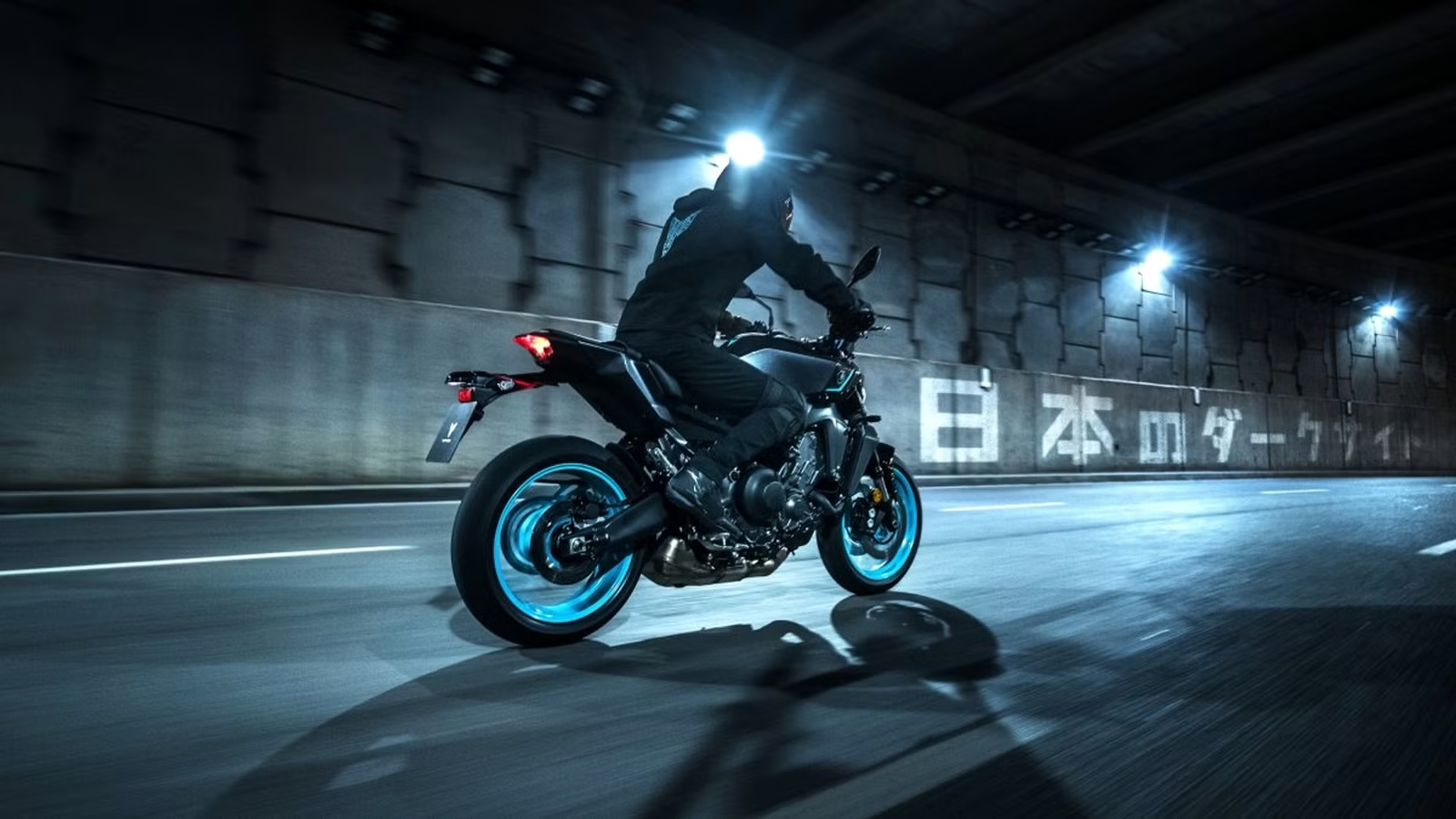
Some bikes are more than happy to live out their days faithfully taking their rider where they need to be with little fanfare. Bikes that understand their place in the world are like a workhorse that does their job reliably and often. There’s nothing wrong with that, of course, but it’s not exactly exciting. There are some bikes, though, that don’t accept this. They’re here for fun, and to let their rider experience everything they’re missing when they’re in a car. And this bike is one of them.
When Motorcycles Stopped Being Just About Going Fast

Motorcycle development used to follow a simple formula: more was better. More power, more engine, more speed. Manufacturers had to make a bike more exciting than the last one, or whatever was currently at the top of the pecking order. But as motorcycles evolved, riders began to realize that the fastest bike wasn’t necessarily the most enjoyable, and this helped to create the modern middleweight naked bike.
Born largely from riders stripping down crashed or modified sportsbikes, the streetfighter movement of the 1980s and early 1990s helped pave the way for the 1993 Ducati M900 Monster – one of the first and most influential factory-built naked bikes. A lairy 904 cc machine that wore its trellis frame for all to see, it became a huge financial success for Ducati and represented a subtle shift in what riders wanted from a bike.
Sure, a bike could still be a two-wheeled alternative for simple transportation, but riders also wanted something with character. It needed to feel alive, exciting, and like each ride was an event rather than just the bit between where you were and where you were going. Something sensible enough for Monday to Friday, with a little something extra for Saturday and Sunday.

The Hooligan Motorcycle Hiding In Plain Sight

For years, many naked bikes were seen as a compromise; often using existing or detuned engines and components to create something more practical and comfortable than a full-blown sportsbike. But as the market matured, better engines, lighter frames, stronger brakes, and sophisticated suspension started appearing. Riders no longer had to go to a large-displacement bike to get serious performance, as manufacturers could extract more power from smaller engines while keeping them affordable.
Electronics helped. Fuel injection brought more precise fueling and smoother throttle control, while increasingly sophisticated electronics allowed manufacturers to tailor throttle response, power delivery and rider aids without necessarily making bikes harder to ride. Chassis design also forged forwards, helping to make bikes more agile and forgiving without feeling cheaper. And as all these elements came together, the modern hooligan motorcycle came to be. Naked middleweight bikes were lightweight, torquey, lively, and had usable performance that didn’t need ridiculous speeds. And one bike proved it.
The Yamaha MT-09: A Sensible Bike With A Very Unsensible Engine

Introduced in Europe in 2013 for the 2014 model year, the Yamaha MT-09 looked like a somewhat reasonable offering at first blush. It wasn’t trying to be a new addition to the YZF family, like that year’s R1, and instead had an upright riding position, a lightweight chassis that contributed to a 414 lb wet weight, and some reasonably compact dimensions to make it manageable on the road. All fine so far. But then you cast your eye further down the spec sheet and spot the 847 cc, liquid-cooled, four-stroke, inline three engine that made around 117 HP and 64 lb-ft of torque. Okay, now we’re getting somewhere.
That three-cylinder was built around Yamaha’s Crossplane Concept. The concept had a 120-degree crankshaft and an uneven 270°-180°-270° firing interval. Rather than simply chasing maximum power, the design was intended to give the engine a distinctive torque character and a more direct-feeling connection between throttle input and rear-wheel response. In normal-person language: it helped make the MT-09’s engine feel more lively. It doesn’t necessarily chase a peak horsepower figure, but that’s not really what the MT-09 was about. The emphasis was on feel, of the connection between the rider’s wrist and the rear wheel, and giving the MT-09 something that didn’t fit with its roadster credentials.
The upright riding position was another layer in the MT-09’s mystique. It gave the rider a command over the bike, offering great leverage on it, while the comparative lack of weight meant it was nimble and agile. In one rider’s hands these attributes would make it a great little commuter bike, gliding easily through city streets. But in another, more daring rider’s hands, these would make it perfect for a bit of hooning.

What do you need for a wheelie? You need a bike, good control over your throttle, and ideally some torque. The MT-09 had all of that. Admittedly so do most bikes, but the MT-09 had almost indirectly been made into the perfect wheelie machine: the Crossplane Concept ensured that throttle response was crisp, the lack of weight meant there was less bike to get up, and the torquey engine gave riders the power they needed to get a bit of daylight between the road and the front tire. It was almost an inevitability that anyone who applied the throttle a little too enthusiastically would find themselves looking slightly more skywards. And that’s the real spirit of the naked bike.
Everything That Makes The MT-09 Sensible Also Makes It Fun

The key to the MT-09 wasn’t just that it had a healthy amount of power, but how that power felt. The three-cylinder engine meant it had some of the punch of a twin and some of the smoothness of a four-pot, with the focus on torque over outright speed meaning a rider didn’t need to be bouncing off the limiter to extract it.
Weight (or the lack of it) was another crucial part of the equation. It weighs roughly the same as Yamaha’s YZF-R6 despite having more displacement, while wide handlebars give the rider plenty of leverage to throw it around. Even the gearing was engineered with fun in mind, as the bike’s roughly 140 MPH top speed meant that power and throttle response was made for usable road riding rather than hitting a theoretical top speed that few riders would ever see.
It was a revelation, and one which was popular immediately. An 11,000-bike sales target was set for Europe in 2014 and, by 2017, almost 7,000 bikes were registered in the UK alone. Later versions expanded the formula, including the MT-09 SP, which added upgraded suspension and other premium equipment, and the Tracer 900, which adapted the platform for longer-distance riding. The Tracer 900 GT went further with additional touring equipment and cruise control.
The Yamaha MT-09 Changed What A Middleweight Naked Bike Could Be

The MT-09 wasn’t just another bike in Yamaha’s lineup. It was the grand arrival of the modern MT (Master of Torque) family, and a completely different way of thinking about performance motorcycles. It didn’t follow the crowd and chase a higher top speed, instead focusing on everything that happens before you get to that top speed — things like how the bike feels, its character, its agility, and its overall enjoyment. It understood that a bike isn’t a simple bragging tool, and that numbers on paper weren’t nearly as valuable as feel.
What made it different was its unusual list of contradictions. It was capable of being an everyday commuter, accessible enough for regular riders, and, at $7,990 new in 2013, not ludicrously expensive. Yet with a simple flick of the wrist, it could be persuaded to act entirely uncouth. It was everything all at once, and continues to be today.
What the MT-09 was, and still is, known for isn’t what exists in its marketing materials. The MT-09 lives in real life, on the road, and underneath the riders who want something that is very able to get you where you’re going sensibly, but which only needs the slightest provocation to show its true colors.
Sources: Statistica, Yamaha

Related posts

Latest Post


No Comments