
Used EV Prices Just Did Something Gas Cars Couldn’t Match
For years, when you would purchase a new EV like a Tesla, Porsche, or the like, the depreciation of the vehicle would be steep and almost immediate, according to InsideEVs. We’ve finally hit a point, however, where the overall value and depreciation of these vehicles are starting to stabilize. Their value resilience is gaining and holding steady with other internal combustion engine-powered vehicles that are understandably still holding steady in the market. Charging infrastructure in the U.S. has also been vastly improved, and combined with maintenance woes for ICE-powered vehicles, it’s making the market think twice about its EV biases.
Used EVs Are Wildcards

With gas prices not showing any signs of cooling off any time soon, according to marketplace.org, dealerships are paying a premium for used EVs and smaller gas-powered vehicles. At this point, it comes down to basic economics. People are demanding less gas because it is simply too expensive and, instead, are demanding electric vehicles. Where this may be a problem is that there aren’t nearly as many electric cars to choose from as there are gas-powered ones, but you could still make them work.
Increasing EV Values
Directly quoted from marketplace.org, “Wholesale prices for used electric vehicles increased 10.5 percent year-over-year in July, and used compact cars were up just over four percent.” This has inevitably created price floors for EVs that are under $30,000. Where there once was concern over trade-in values for some electric cars, that concern has now disappeared, as SUVs like the Tesla Model Y haven’t lost much of their value. According to Kelley Blue Book, a 2023 Standard Range model has a fair purchase value of $32,000 as opposed to the original MSRP of ~$45,000.
Where Gas Powered Cars Are Failing

A standard internal combustion engine-powered vehicle typically depreciates between 10 and 15 percent predictably after its first year off the lot. We are now seeing the effects of the supply chain shortage from 2021 to 2023 peter out with the depreciation curve balancing back out for ICE vehicles. Cox Automotive has shown that more fuel-efficient gas-powered vehicles have gained 9.9 percent in value with the increase in gas prices. Meanwhile, gas guzzlers are doomed to sitting on the lot.

EV Depreciation Is Slowing

You could view electric car pricing, sales and production sort of like personal computers from the early 90s and 2000s. What once was an extremely expensive, hard to keep up with device, has now turned into something that everyone can own with more of an ease-of-use factor than before. That’s a simplified explanation, but the same could be said for EVs. Where charging infrastructures used to be messy across the US, there is now uniformity. What used to be quickly degrading batteries can now be viewed as more robust and easier to deal with/replace.
Fears Around Degrading Batteries Are Dissipating

Under normal driving conditions, according to Recurrent Auto, batteries only degrade 1.5 to 2.3 percent per year. This should give customers confidence that newer EVs can go well into 100,000 miles or more with ease. There’s also a widespread fear of having to replace your EV’s battery, as the cost can amount to nearly the same percentage of the vehicle’s value itself.
Thankfully, per the same Recurrent article, only ~2.5 percent of batteries have been replaced based on a study within 250 million miles driven by EVs. There are also companies like Tesla that offer incredible warranties that typically extend to the second owner, giving you more peace of mind.
Charging Is More Convenient

Battery packs aside, probably the biggest improvement to EVs over the past year or so has been the integration of all the different types of chargers available into one cohesive infrastructure. A big missed opportunity when the bigger automakers started to follow Tesla’s lead with electric vehicles was to make the charge ports uniform.
There were CCS ports, CHAdeMO, J-1772, NACS … the options almost seemed innumerable. Now, nearly every model comes with an NACS port, which is Tesla’s charging port. This uniformity makes it easy to not have to buy an adapter and opens up the network wider, so everyone can use Tesla’s superchargers, Electrify America chargers, and the like for more widespread charging efficiency.
MVEs — Most Valuable EVs

Used EV prices, like most gas-powered vehicles, vary wildly depending on segment, mileage, year, etc. On the flip side, because these are relatively newer cars in the grand scheme of things, they might not have everything customers are looking for when it comes to charging ports or value cost as it relates to charging/battery health.
Not everybody who has a need or wants to switch to a used EV has an at-home charger. Charging publicly isn’t always as frugal as people think either. Where the real frugality lies in charging is in home chargers. Rates can vary wildly at public chargers, depending on what time of day you go. If you have an at-home charger, you are able to charge overnight at a next-to-nothing rate.
Which Ones Are Struggling?

It might not be as obvious to some, but if you’ve been in this space for a while, you know that not everybody wants to jump on the brand-new make and model bandwagon. This also applies to full-size luxury sedans. Take, for example, the Lucid Air. The first model year 2022 Pure had an original MSRP of $87,400.
Kelley Blue Book now says that the fair purchase price of the same model is around $36,600. It’s also being reported that these vehicles are unable to handle their over-the-air update, rendering the infotainment systems buggy. This also pertains to sporty variants, like the Porsche Taycan. This make and model isn’t nearly as economical, as maintenance costs can mirror those of their gas counterparts.
Which Ones Are People After?

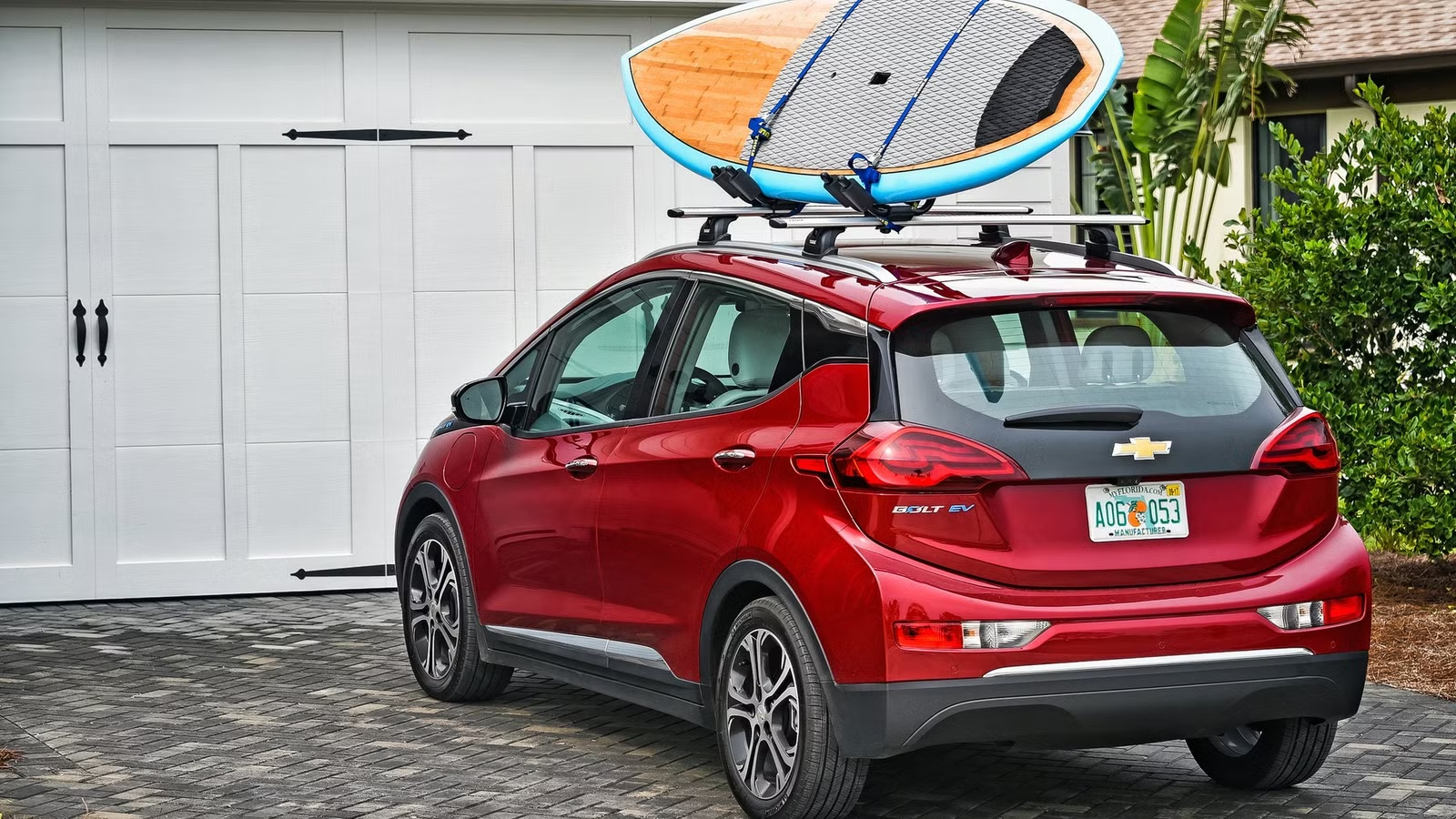
With the dissolution of the electric vehicle tax credit, people now more than ever are after the frugal versions of electric vehicles. Chevrolet brought back the Bolt EV because it moved its EVs from different platforms to one Ultium platform, but it also recognized how popular it was. Tesla also came out with a bare-bones base model for the Model Y. We mentioned both of these vehicles because their used counterparts are showing major price resilience on lots.
If You Want An EV, What This Means For You
Markets shift all the time. People were probably under the assumption that with the disbanding of the EV tax credit, EV sales would plummet. For a while, they did trend downward, but with the increase in oil costs, the market has shifted once again. Therefore, it’s crucial that used buyers stay in the know when it comes to looking for their next used vehicle.
The market in general, not just the automotive market, seems to be pretty volatile at this current moment. While we aren’t technically an economics column, it’s probably better to get in on the used electric vehicle market now more than ever.
Sources: Recurrent Auto, KBB, Cox Automotive, Inside EV

Related posts






Latest Post


No Comments