
America’s First 200 MPH Supercar That Time Forgot
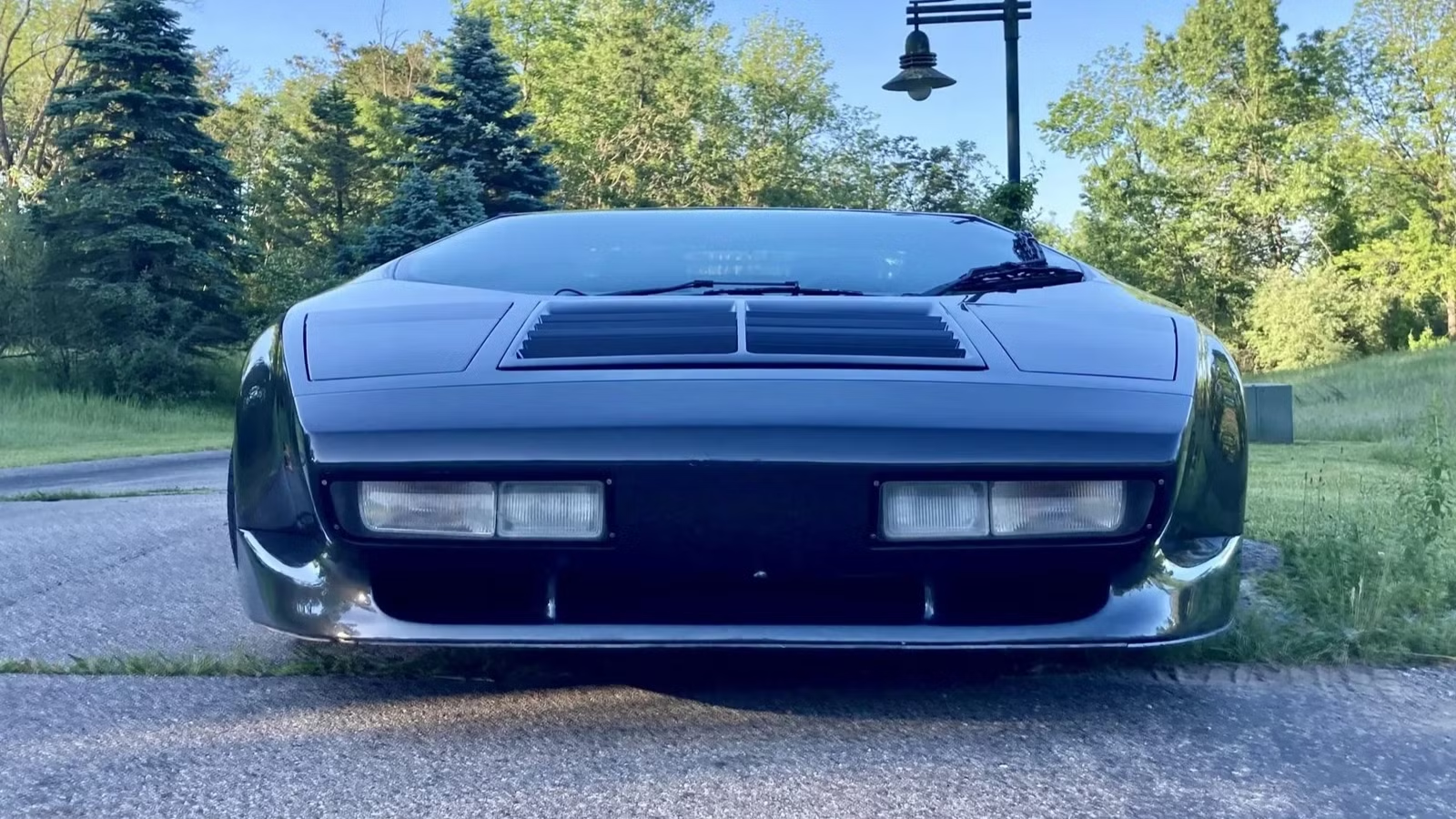
Europe has long owned the supercar conversation — Ferrari, Lamborghini, Porsche, McLaren — names that carry decades of racing pedigree and engineering mystique. The United States, for its part, built its automotive identity on thundering muscle cars, capable trucks, and plush luxury cruisers. Genuine supercars capable of trading blows with the world’s best? That was always someone else’s game. But buried in the early 1990s, one American company came startlingly close to rewriting that narrative — and almost nobody talks about it anymore.

Throughout automotive history, several U.S. companies dared to enter the supercar arena, attempting to build machines capable of standing toe-to-toe with international competitors. The majority crashed and burned. Some barely progressed beyond the concept phase. Others disappeared quickly from the market. Yet one American supercar actually succeeded. It cracked the 200 mph barrier, featured aerospace-influenced engineering, and boasted styling that seemed pulled from science fiction. Strangely enough, it’s virtually forgotten in today’s automotive conversations.
The Vector W8 Was The First American Supercar To Hit 200 MPH
|
Engine |
 69 autotech Power |
Torque |
0-60 MPH |
|---|---|---|---|
|
6.0-liter twin-turbocharged V8 |
625 hp |
649 lb-ft |
3.9 – 4.2 seconds |
Vector W8 Key Specs
The Vector W8 emerged from an audacious vision: construct a genuine world-beating supercar in the United States. Gerald Wiegert, an engineer and businessman, championed this concept. He was convinced that America could match, or surpass, Europe’s finest performance machines. In the late 1970s, he established Vector Aeromotive with a singular mission: merging aerospace innovation with blistering velocity and radical aesthetics.
The W8 officially arrived in 1989, and it looked absolutely alien. Sharp angles, substantial width, and an aggressively forward-thinking silhouette made the car look like it had rolled off a Hollywood set. Its body panels were formed from lightweight carbon fiber and Kevlar composites, and power came from a mid-mounted, twin-turbocharged 6.0-liter V8.

The Vector’s production run was minuscule — just 19 units rolled out between 1989 and 1993 (some sources cite 17). Despite the limited numbers, the impact was undeniable. Vector claimed a maximum velocity exceeding 240 mph, though independent testing pointed toward a more realistic 218 mph figure. Regardless of the exact number, it became the first American production vehicle to breach the 200 mph threshold.
Automotive journalists responded with mixed reactions. Certain publications applauded its daring approach. Others questioned its performance assertions. What remained indisputable was this: the Vector W8 represented uncharted territory for American automotive manufacturing. It was brash, blistering, geometric, and defiantly different.

The W8 didn’t revolutionize the industry. It didn’t compel Ferrari or Porsche to reconsider their strategies, and it didn’t spark a domestic supercar movement. What it did accomplish, however, was significant: proving that American engineering could produce something equally swift, equally audacious, and equally unconventional as the best European exotics. For automotive enthusiasts, that achievement still matters.
The Vector W8 Could Be The World’s First Hypercar

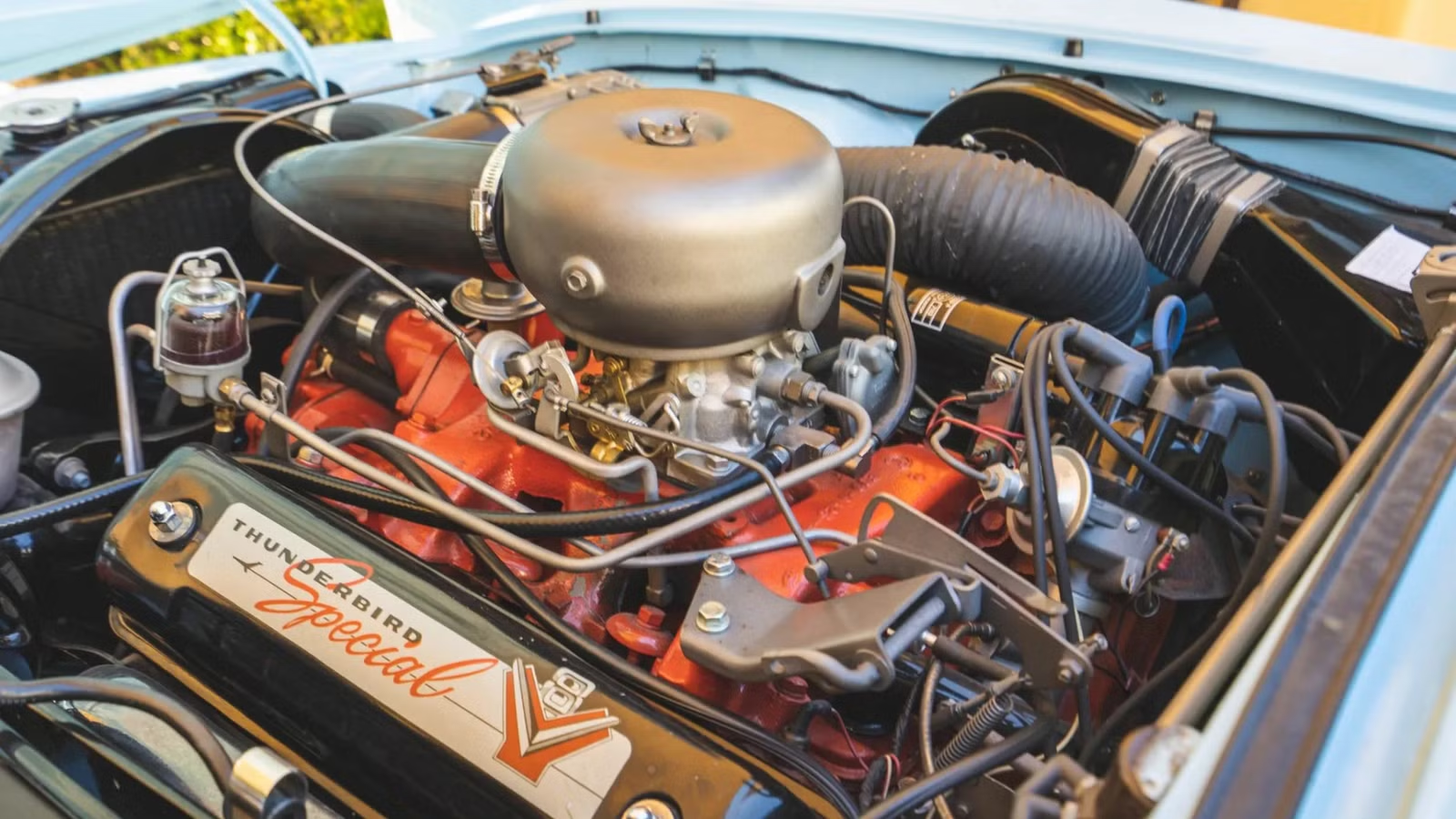
Under the hood, the Vector W8 housed a heavily modified 6.0-liter Rodeck V8 engine, boosted by twin Garrett turbochargers. It produced around 625 horsepower and 649 lb-ft of torque in standard tune. In special configurations, output could exceed 1,200 horsepower. The W8’s engine was paired with a three-speed automatic transmission — not a typical choice for a supercar, but one specially built to handle the massive torque on tap. Vector claimed a 0–60 mph time of around 3.9 seconds, placing it firmly in the upper echelon of performance cars in the early 1990s.
Produced several years before the McLaren F1 ever hit the roads, and offering similar power and performance capabilities, the Vector W8 could be considered the world’s first true hypercar. That distinction would give America the credit for birthing yet another new performance car segment.

In terms of real-world performance, independent testing by Road and Track confirmed the W8 could reach 60 mph in under 4.2 seconds and complete the quarter mile in just over 12 seconds. Top speed varied depending on tuning and test conditions, but verified runs showed it could push beyond 210 mph. For a car built in America during that era, those numbers were groundbreaking.
The chassis was a semi-monocoque aluminum honeycomb structure, similar to those used in aircraft construction. Suspension featured fully independent double wishbones at all four corners, and braking came from ventilated discs. The wheels were massive for the time: 17 inches up front, 13 inches wide at the rear.

Inside, the W8 reflected its aerospace inspiration. The dashboard was packed with digital readouts, aircraft-style switches, and custom controls. Comfort in the conventional sense wasn’t the priority — this was a cockpit, and that was entirely the point. The Vector W8 was engineered for performance above all else.
The Vector M12: The Lambo-Powered Successor

|
Engine |
Power |
Torque |
0-60 MPH |
|---|---|---|---|
|
5.7-liter Lamborghini-sourced V12 |
492 hp |
425 lb-ft |
4.8 seconds |
Vector M12 Key Specs
Following the W8’s run, Vector made another attempt. The mid-1990s brought new leadership and a fresh model: the Vector M12. This time around, the landscape had shifted considerably.
The M12 drew its power from a Lamborghini-derived 5.7-liter V12, generating 492 horsepower channeled through a five-speed manual gearbox. It managed the sprint to 60 mph in roughly 4.8 seconds and reached a top speed approaching 190 mph. The specifications were respectable, though hardly revolutionary.

Visually, the M12 shared the W8’s general language but read as more refined and considerably less daring. The aggressive, otherworldly character that made the W8 feel extraterrestrial was gone. Performance figures also fell short when stacked against the original, and the car simply couldn’t match the speed or audacity of its predecessor.
The M12’s production window proved equally brief. Between 1995 and 1999, just 17 examples emerged from the factory. Vector Aeromotive battled mounting financial pressures and legal entanglements, and the ambitious vision gradually dissolved. Despite its limitations, the M12 still occupies a chapter in American supercar lore — representing Vector’s final attempt to challenge perceptions of what a domestic manufacturer could achieve in the exotic car world.
Source: Vector Motors, Bring a Trailer.

Related posts

Latest Post


No Comments