
This Forgotten Honda V4 Sounds Better Than Most Modern Superbikes
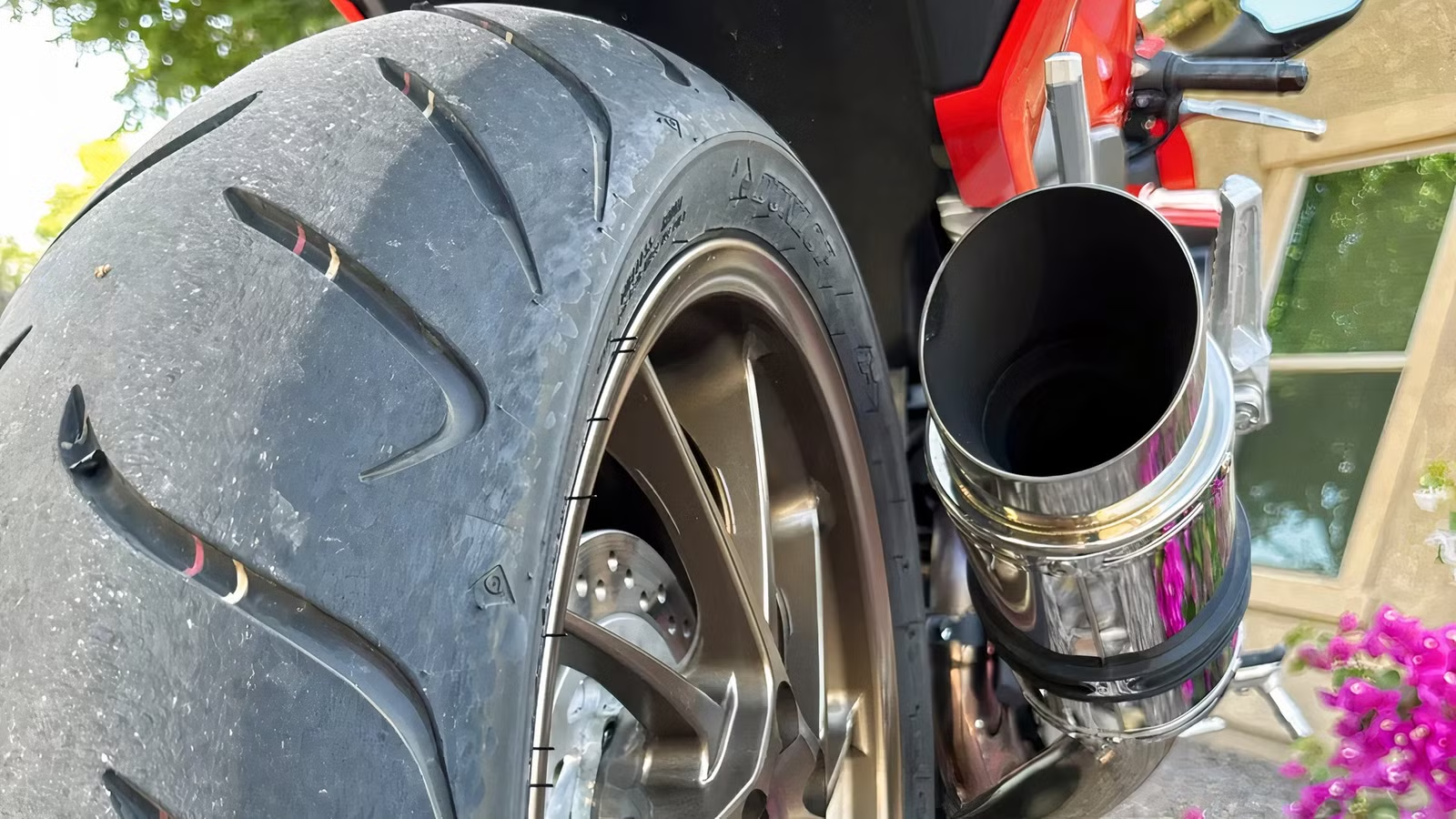
The thing with modern superbikes is that they can turn a straight road into a highly entertaining one, but gigantic horsepower numbers don’t automatically make an engine memorable, as it were. Sometimes the better motorcycle is the one you can identify with your eyes closed.

One older Japanese sport tourer mastered that trick. Its power output looks almost restrained today, yet whack the throttle to the top of the tach and it develops the sort of voice that makes another gear feel completely optional.
Horsepower Doesn’t Tell You What A Motorcycle Sounds Like
Motorcycle spec sheets have become increasingly obsessed with horsepower, acceleration, and top speed. That makes sense when modern superbikes routinely produce performance figures that would’ve sounded ridiculous not long ago. What the numbers can’t explain is why some engines make riders chase another few thousand rpm simply because the mechanical soundtrack gets better.

That was always one of the strengths of Honda’s V4 motorcycle formula. The engine could feel smooth and civilized during everyday riding, then grow increasingly urgent as the revs climbed. Roughly 100 hp was plenty for serious road performance, yet the appeal went beyond outright speed. The engine made getting to the power almost as entertaining as using it.
Keep that last line in mind because the bike in question wasn’t built as an uncompromising superbike. It came from the sport touring world, where a motorcycle had to handle highway miles without turning every long trip into an endurance test. The combination of real world usability and a boisterous V4 gave it a personality that many faster motorcycles couldn’t reproduce.
Something Special Happens When The Tach Sweeps Past 7,000 RPM

The mechanical trick behind much of that character was Honda’s VTEC system. On the 2002 version, two of the four valves in each cylinder remained closed below 7,000 rpm. Once the engine crossed that point, all four valves came into play, allowing the V4 to breathe harder as it headed toward the upper end of the tach.
That change was very apparent on the early VTEC motorcycles. The engine picked up urgency as the extra valves joined in, while the intake note became noticeably more aggressive. Instead of the power building in one perfectly smooth sweep, there was a definite moment when the motorcycle seemed to wake up and decide that the fun had just begun.
Up Top Fun

There was enough speed behind the aural drama to keep the whole thing from feeling like an acoustic party trick. The 2002-2005 examples of this machine were rated at roughly 146 mph, with a quarter-mile time of 11.62 seconds. Those figures are still pretty quick by ordinary road bike standards, even if today’s flagship superbikes have moved the performance goalposts into another county.
The original VTEC calibration also produced one, let’s say peculiar, side effect. At around 105 mph in top gear, the engine sat close to the 7,000-rpm changeover point, meaning it could hover around the transition instead of settling comfortably above or below it. Honda eventually lowered the crossover point and refined the system, but the basic idea stayed the same: everyday manners down low, considerably more awesomeness up top.
The Honda VFR800 Interceptor Made 100 HP Sound Spectacular

The legend behind that distinctive VTEC transition is the Honda VFR800 Interceptor, one of the most recognizable Japanese sport touring motorcycles of its era. Its liquid-cooled 90-degree V4 displaced 47.7 cubic inches and sent power through a six-speed transmission, giving the VFR800 a configuration that already stood apart from the inline-four engines dominating much of the sportbike market.
The 2002 redesign brought VTEC into the equation and also replaced the earlier gear-driven camshafts with silent-type chains. That change divided some longtime VFR fans, but it didn’t erase the fundamental appeal of Honda’s V4 engine. The firing character, intake sound, and way the engine built toward its upper rev range still gave the VFR800 Interceptor a voice few motorcycles could mistake for anything else.
By 2014, Honda had polished the package considerably. A rear-wheel dyno run recorded 98.3 hp at 10,000 rpm and 54 lb-ft of torque at 8,400 rpm. More than 80 percent of that torque was available from 3,400 rpm to 11,300 rpm, which meant the Honda VFR800 didn’t need to spend every mile screaming at redline to make useful power.
That broad power delivery is one reason the VFR800 still makes sense in America, where a great motorcycle may spend one day carving through mountain roads and the next crossing several states. The 2014 Honda Interceptor started at $12,499 in the U.S., while the DLX version cost $13,499 and added equipment including ABS and heated grips. It was serious sportbike money, but the VFR offered way more everyday flexibility than a pure supersport.
That Glorious V4 Sound Came With A Catch

The early Honda VTEC system had one obvious weakness: the transition could feel abrupt. You could encounter hesitation around the crossover point before the engine surged forward as all four valves per cylinder came online. Add a fairly sharp on-off throttle response, and the VFR800 could occasionally feel less polished than its sport touring mission suggested.
Honda kept working on it, though. For 2006, the VTEC transition was lowered to 6,400 rpm, making the change less intrusive during normal riding. Later revisions went further, and by the 2014 Honda VFR800 Interceptor, revised VTEC settings and cam timing made the transition much smoother than it had been on the early 2000s bikes.
Smooth Yet Manic

Thankfully, smoothing the system didn’t completely sterilize the experience. The V4 still changed character as the revs rose, and the intake note stayed one of the motorcycle’s calling cards. Honda managed to remove much of the awkwardness without turning the VFR800 into an appliance, which is harder than it sounds when engineers are trying to make a motorcycle behave itself.
The rest of the bike carried the usual sport touring compromises. Earlier VFR800 models could expose the limitations of relatively basic suspension when pushed hard, while the 2014 DLX still weighed 532 pounds wet. That’s substantial next to a modern superbike, but the VFR was designed to carry more than a rider’s ego and a tiny backpack.
The VFR800 Still Makes A Strong Case For Character Over Horsepower

The Honda VFR800 Interceptor lived on because it could do several kinds of riding without feeling badly misplaced in any of them. That’s no mean feat, and its chassis was famed for predictable handling, while the riding position was much less demanding than a full-on supersport. You could enjoy a winding road without spending the next morning discovering muscles you didn’t know could cause you soreness.
The 2014 model pushed the everyday usability further. Its seat could be set at 31.0 or 31.8 inches, while the 5.6-gallon fuel tank helped provide an estimated 255-mile range. Optional luggage made it a genuine long-distance sport-touring motorcycle, which gave the VFR800 a particularly strong case in the U.S., where a weekend ride can involve distances that Europeans would classify as a relocation.
What The Specs Won’t Tell You

And who wouldn’t want that practicality and that V4 soundtrack together? You didn’t need a racetrack or stupid speeds to enjoy the engine’s character. Rolling through the gears on a back road was enough to hear the intake note harden as the VTEC brought the full valvetrain into play.
Modern superbikes are faster, lighter, and far more sophisticated, but the Honda VFR800 Interceptor still offers something spec sheets struggle to capture. Its roughly 100 hp V4 had enough performance for real roads while giving you an unmistakable sound and sense of occasion every time the tach climbed. 200 hp may sound great on paper, but the VFR800 made half that amount sound undeniably special and usable.
Sources: Rider Magazine, Visor Down.

Related posts


Latest Post


No Comments