
Plymouth’s 1970 Rapid Transit System Explained
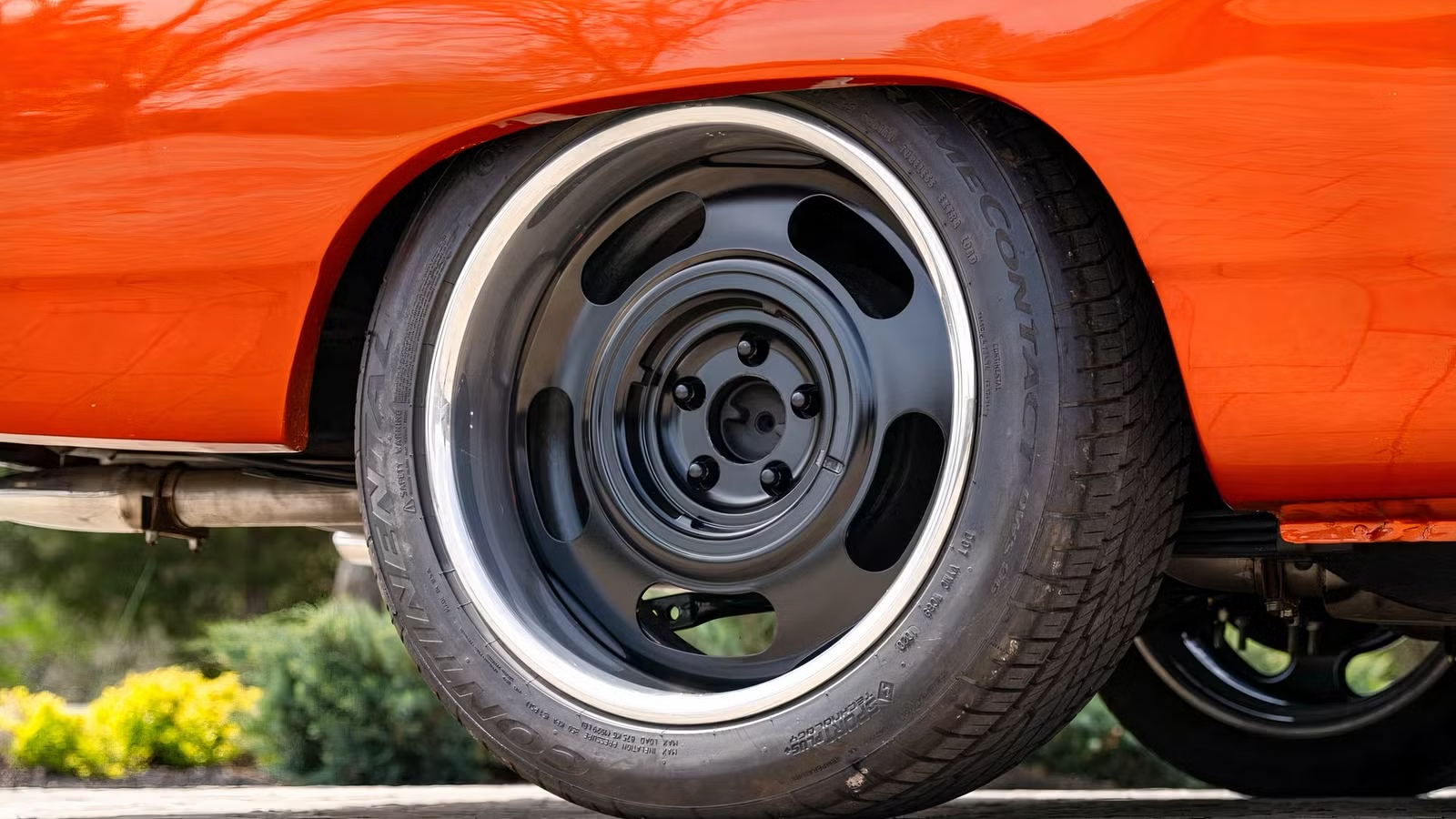
In 1970, Plymouth wanted to sell Americans something bigger than a fast car. It wanted to sell the idea that a customer could buy a performance machine and turn it into something wilder with factory-backed parts and advice from people who actually knew how to go fast. Plymouth already had the hardware and the racing credentials. What it needed was a way to connect it all. So Plymouth took the pitch on the road. The result was a traveling spectacle of customized muscle cars, racing heroes, and enough horsepower to make a modern marketing department look positively boring.
Plymouth Needed A Performance Brand That Could Match Dodge

By 1970, the muscle-car war was no longer just about who could build the biggest engine. Detroit was learning that a performance car also needed an identity, something that made a whole group of models feel like part of the same club.
Dodge had already figured this out. The Scat Pack arrived for 1968 as a common identity for Dodge’s performance models, tying together the Charger R/T, Coronet R/T, Dart GTS, and Super Bee under one famous bumblebee stripe. It gave Dodge a recognizable performance image and a sense that its muscle cars all belonged to the same family.

Plymouth had no shortage of ammunition to fight back. Its 1970 lineup included the ‘Cuda, GTX, Road Runner, and 340-powered Duster, and the brand had serious credentials in NASCAR, NHRA drag racing, and Trans Am competition. The problem wasn’t a lack of fast cars. It was that those cars hadn’t been stitched into one bigger performance story yet.

Plymouth wasn’t starting from scratch looking for a hero car. It needed an umbrella that could connect the cars it already had with the racing program, the performance parts business, and the enthusiasts buying into all of it. Dodge’s Scat Pack had shown how effective that could be. Plymouth’s answer would go a step further and let customers actually experience it.
Plymouth Took Its Performance Message Directly To The Customers

Plymouth could have done what every automaker was already doing, running aggressive advertisements and parking a few muscle cars at dealerships while the brochures did the talking. Instead, it decided to bring the spectacle to the customer.
The idea was simple. Take Plymouth’s performance message, wrap it in outrageous cars and racing hardware, add people who actually knew how to race, and haul the whole thing from dealership to dealership and event to event. That turned performance marketing from something a customer read about into something they could walk around, stare at, touch, and talk about.

The scale was considerable. The traveling display made its New York debut to a crowd of more than 73,000, and cars, performance parts, catalogs, cutaway engines, and racing material were all part of the presentation. The equipment itself was almost comically theatrical. Plymouth hauled it all in a bright yellow tractor-trailer, turning the entire operation into a rolling billboard. Contemporary accounts describe it as a mobile performance presentation, not just a collection of cars parked in a showroom.
Plymouth wasn’t only trying to convince people that its cars were fast. It was trying to convince them that performance was a system, where the customer could buy the car, choose the hardware, learn how to use it, and feel like part of the same world as Plymouth’s own racing teams and engineers. Plymouth just hadn’t given that system its name yet.
The Rapid Transit System Turned Plymouth Performance Into A Traveling Show

That name was the Rapid Transit System. Introduced for 1970, RTS brought Plymouth’s performance cars, racing activities, performance parts, and customer outreach under one identity. It wasn’t simply a trim level or an option package. It was a marketing and performance program built to make every piece of Plymouth’s performance operation feel like one big machine.
Plymouth’s own advertising summed up the philosophy in one line. “Anybody can offer a car. Only Plymouth offers a System.” The most spectacular expression of that idea was the Rapid Transit System Caravan. The original 1970 lineup included heavily customized Plymouths, a cutaway engine, performance accessories, racing films, and a flip-top replica of Don Prudhomme’s funny car. The main show cars were a 440-powered ‘Cuda, a Road Runner, and a Duster, alongside a replica of Don Prudhomme’s funny car. The following year’s tour expanded and refreshed the display, adding another Road Runner and updated versions of the carryover cars.

These weren’t ordinary dealer cars with a set of stripes slapped on them. Plymouth wanted customers to see what its performance machinery could become once the usual production-car boundaries were removed, so it brought in serious custom-car talent to make that happen. Harry Bradley, best known to enthusiasts as one of the designers behind the original Hot Wheels era, penned the looks. Customizers including Chuck Miller’s Styline Custom then turned those drawings into physical cars, all under the direction of show-car promoter Bob Larivee.
The resulting cars were gloriously excessive. The 1970 Road Runner received custom bodywork, flared rear sections, altered lighting, and brake scoops that made the factory car look almost tame by comparison. The Duster received its own custom treatment, while the ‘Cuda was transformed with a new steel nose, a split front spoiler, side pipes, wider rear tires, and even a fake parachute. The show cars were demonstrations, a way to show customers what customization and performance could look like once the imagination was allowed to run ahead of the production line. But the Caravan had another trick, one arguably more important than the wild paint jobs.
Sox & Martin Showed Customers How To Make Their Cars Faster

Plymouth didn’t stop at showing people fast cars. It brought in the people who knew how to make them fast, too. The Supercar Clinics had actually begun before RTS, with Plymouth working alongside the Sox & Martin drag racing team since 1967 as part of its NHRA promotional effort. Drivers connected to the team were trained to walk customers through Plymouth’s products, its racing program, and ways to improve their own cars. When RTS arrived in 1970, those clinics were folded into the broader program.
That was a clever move. Sox & Martin weren’t marketing hires reciting a script. They were genuine drag-racing stars, and that gave the clinics something no advertisement could buy. Real credibility. A customer could see a heavily modified Road Runner or ‘Cuda, then hear people who actually raced Plymouth machinery talk through performance parts and ways to improve their own cars. The gap between the showroom and the drag strip suddenly got a lot smaller.

The car created the desire. The racer supplied the credibility. The clinic supplied the knowledge. The parts counter supplied the hardware. Plymouth had effectively built a pipeline running from staring at an outrageous show car to figuring out how to make your own car faster.
That parts operation was already evolving. Chrysler’s performance-parts activities went through several forms during this period, including a catalog called “Hustle Stuff” in 1970 and 1971. The formal Direct Connection organization came later, with Chrysler’s own history placing its creation in 1974. RTS didn’t invent Direct Connection. But the idea behind it, putting factory hardware, technical knowledge, and racing expertise directly into a customer’s hands, was already very much alive on the Caravan.
The Rapid Transit System Previewed The Factory Performance Business

The Rapid Transit System becomes more than an entertaining footnote once you follow where it led. Plymouth had combined the production cars, the racing program, the performance parts, and a dealer network willing to sell all of it, things that normally lived in separate corners of a car company. The later Direct Connection program, formalized a few years afterward, took that same idea much further, offering factory-developed parts, technical manuals, and engineering advice to enthusiasts and racers.
The line between the two runs closer than a footnote suggests. Former Young & Rubicam advertising executive Joe Schulte, who worked on the Rapid Transit System campaign and later coined the Direct Connection name, traced some of the program’s roots back to RTS, while later Direct Connection technical seminars were modeled in part on the Sox & Martin and Dick Landy dealer clinics that had already been running for years. So the strongest claim isn’t that the 1970 Caravan single-handedly invented Direct Connection. It didn’t. The more interesting claim is that Plymouth was already building the factory-backed performance ecosystem that would become one of Chrysler’s defining enthusiast assets, years before it had that name.

The surviving RTS cars provide a spectacular footnote to that story. Steven Juliano spent years tracking down the originals, eventually reuniting three of them, the 1970 Hemi Road Runner, the 1971 Road Runner, and the 1970 Duster. At Mecum’s Indianapolis auction in 2019, the Road Runner sold for $341,000, the 1971 car brought $236,500, and the Duster sold for $264,000. Then the missing piece came back. The 1970 ‘Cuda had vanished from public view since 1976. It resurfaced in 2023, still wearing its original custom paint and metalwork, with fewer than 1,000 miles on the odometer. At Mecum’s 2023 Indianapolis auction, it sold for $2.2 million.
That’s an absurd amount of money for a customized 1970 ‘Cuda, until you remember what the car represents. It isn’t just an old muscle car with a flashy paint job. It’s a surviving piece of the moment Plymouth decided selling horsepower wasn’t enough, that it also had to show customers what to do with it. That basic idea outlived the brightly painted tractor-trailer by decades. Plymouth didn’t just take muscle cars on tour. It took the idea of factory-supported performance on tour, and that may be the real reason the RTS Caravan still matters.
Sources: Mecum, Bring A Trailer Classic.com

Related posts



Latest Post


No Comments