
This Forgotten American Adventure Bike Used A Harley V-Twin And Fuel In The Frame
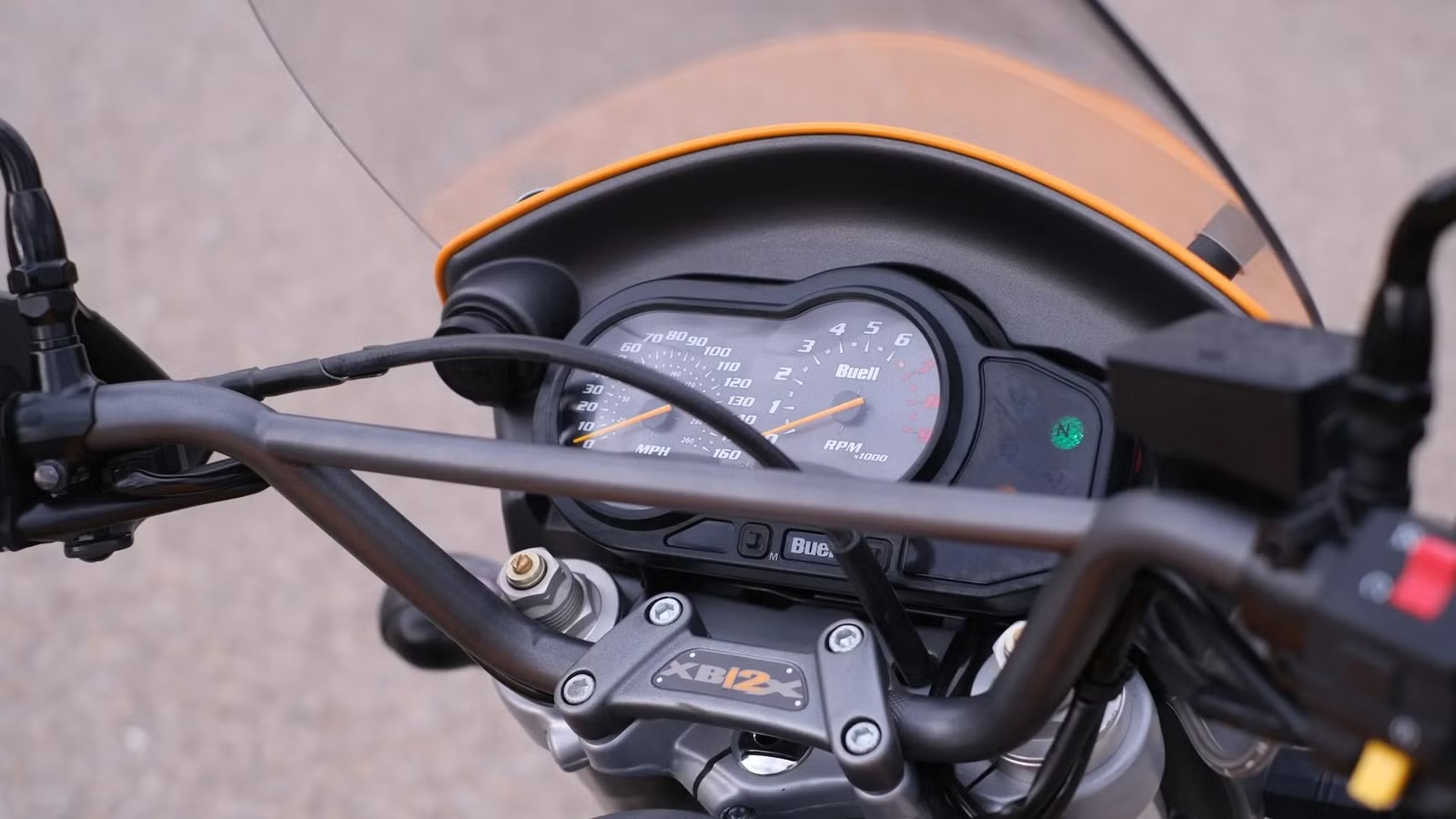
Harley-Davidson is one of the oldest motorcycle manufacturers in the world. This kind of resilience is impressive, but just like any company over a century old, they have had their fair share of ups and downs. One of the biggest downs happened back in the 70s, while under the stewardship of AMF. By the end of the decade the company was on its knees, and although the lack of product quality is often cited as the main issue, there was more to it than that.
An Alternative Approach To Innovation

AMF had expanded the range considerably, and were slapping the Harley badge on a wide range of two-stroke machines in an effort to tap into different markets. This kind of diversification is quite normal today, but back in the 70s it was harder to swallow, and Harley enthusiasts were not impressed. This kind of innovation was good in the sense that it catered to more motorcyclists, but it had the unintended consequence of watering down the brand.
The recovery process was long and painful. All the way through the 80s, Harley pretty much shut the door on innovation in an effort to get on top of product quality. Naturally, the two-strokes were unceremoniously dumped, but they eventually found a different way to innovate. Seeing what Buell were able to do with their Sportster engine, Harley initially invested in the brand in the 90s, then eventually acquired them in the 00s, but retained the Buell name. The Buell brand gave Harley-Davidson a means to offer innovative Harley-based products without putting the coveted Harley brand name on the line, and one of the most innovative models was an adventure bike that everyone seems to have forgotten.
The Buell XB12X Ulysses Was The First American Adventure Tourer
Price Range: $3,000 – $5,000


The XB12X Ulysses enjoyed a relatively short production run between 2006 and 2009, so it is pretty easy to see why most people forget the model. It was not, however, a forgettable motorcycle, and deserves way more credit than it gets. Even though the engine was relatively simple in the sense that it was just a hopped-up V-twin, the rest of the bike was incredibly innovative, as well as surprisingly light.
For now, these bikes are not collectible, which is a good thing. Prices remain low as a result, and you can even find bikes in good shape for just $5k. Back when it was new, it sold for around $12k, and was actually well and truly worth the price of admission back then, so $5k is a bargain today. Finding spares and consumables for the Harley engine won’t be much trouble, but the more exotic parts manufactured by Buell and their suppliers might be a little more tricky to find.
The Ulysses Had A Sportster Engine
Power: 103 Horsepower

Buell initially made use of XR1000 engines for their bikes built in the 80s, but those exotic twins were depleted quickly. Since then, they have made use of extensively reworked Sportster engines, with the Ulysses being equipped with the 103 horsepower 1203cc version of the lump. The more significant figure is actually the torque, just like any good Harley. It made an impressive 84 pound-feet of torque, which is around as much as a new Honda Africa Twin.
Putting The Fuel In The Frame Helped With Weight Distribution

From an engineering perspective, using a heavy Harley twin doesn’t make a lot of sense in sporty naked bikes. To make it work, Buell had to come up with all sorts of innovative weight-saving solutions, which all got carried over to the ADV. Two of the most impressive engineering solutions are to do with where the oil and fuel are stowed. The swingarm actually serves as the oil reservoir, and its twin-spar aluminum chassis (which was manufactured by Verlicchi in Italy) holds all the fuel. Not only does this help reduce the overall weight, but it also helps with mass-centralization, which became something of an obsession for Buell.
The Ulysses Was Lighter Than Its Key Competitor
Dry Weight: 425 Pounds

Most Buell motorcycles are relatively compact, but the more roomy Ulysses bucks that particular trend. It is a relatively tall motorcycle with a seat height of 35 inches. Buell claimed 33 inches, but we suspect, like Harley-Davidson, that is a laden seat height. A laden seat height actually makes far more sense, but when pretty much no other manufacturer uses it, it can be a little confusing.
With the Ulysses being a bit of a “tall boy”, it will be a little challenging for shorter folk to ride off-road. It also messes with Buell’s famous mass-centralized approach to motorcycle design, so even though the fuel resides in the frame it is still a little top-heavy thanks to how tall it is. But, the same is true for pretty much any ADV, and by shaving weight everywhere they could, the bike was lighter than the BMW R 1200 GS it was competing with.
The fact that it is so light and has such a short wheelbase (just 54 inches) made it a blast to ride. It featured fully adjustable Showa suspension, and 17-inch wheels. Buell actually went as far as marketing the bike as an “Adventure Sport Bike.” In many ways, it was more comparable to the contemporary Ducati Multistrada, which was also more of a sport tourer than an ADV. Unfortunately, it was never quite as popular as either of those models even though it had the potential to be.
A More Comfortable Sports Tourer Followed
One of the main things holding the XB12X is the fact that it was never meant to be much of an off-roader. Erik Buell called it a “touring supermotard” and that speaks volumes. The dirt-worthy facade was all in an effort to tap into the already growing adventure market. Unfortunately, the end product was just a sport tourer loosely disguised as an ADV, which isn’t necessarily a bad thing, but the more street-focused XB12XT that followed in 2008 seems like the better buy.
It offered luggage as standard, a lower seat height, added wind protection, and it addressed most of the niggles owners experienced with the original XB12X. With the same ultra-short wheelbase, relatively light weight, and more street-oriented suspension, it offered an even more dynamic riding experience. One little quirk with this model was the fact that the third position of Buell’s unique three-way tail section was limited by the addition of a top box and fixed rear rack. It still works as a seat rack and sissybar, but also serves to underscore the practical limitations of some innovations.
Sources: KBB, Bring a Trailer, and Cycle World Magazine (September 2005)

Related posts

Latest Post


No Comments