
The First Production Motorcycle To Run A 10-Second Quarter Mile
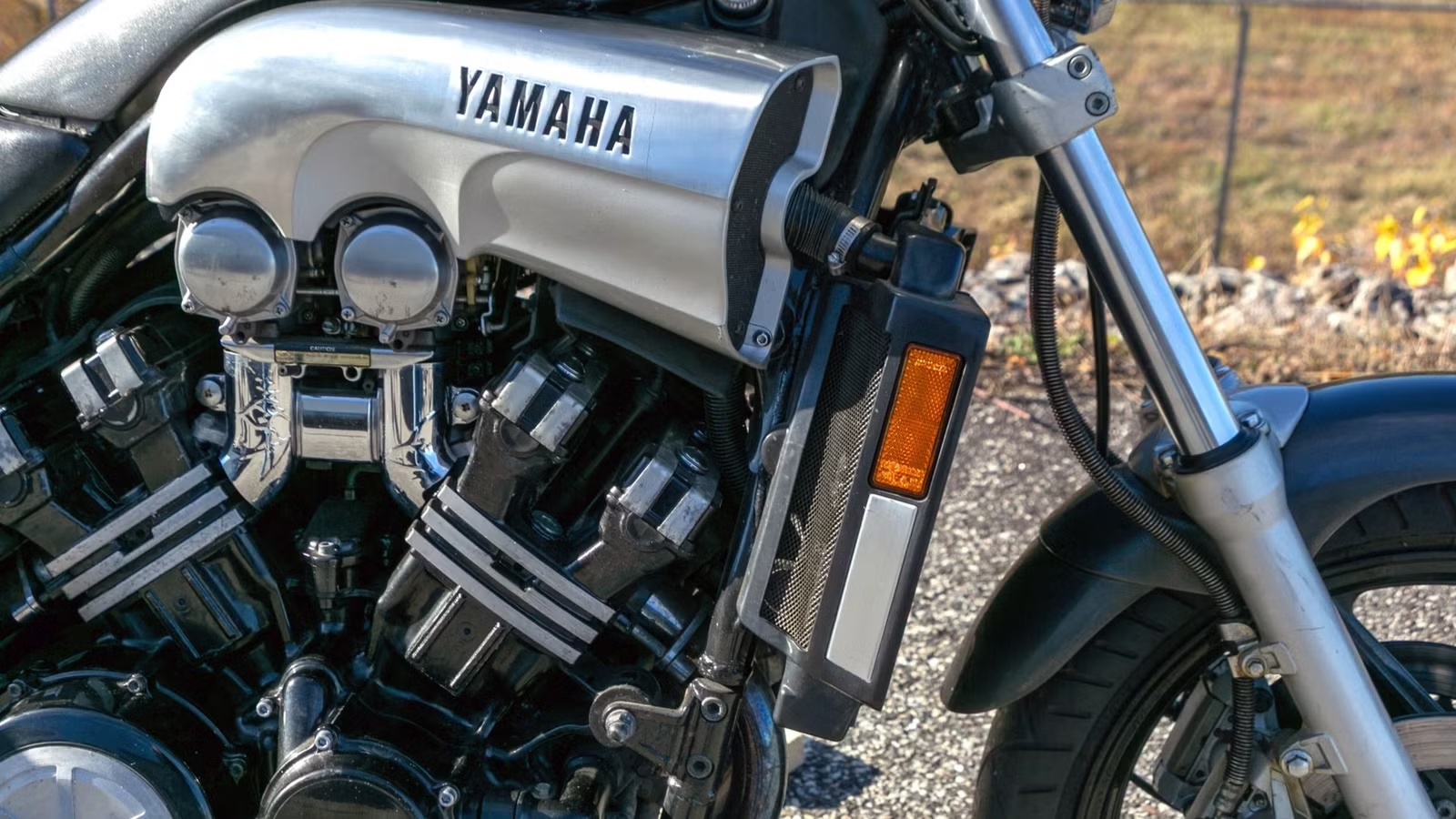
Motorcycles didn’t run 10-second quarters. That was car territory, the exclusive club of purpose-built dragsters and the occasional street machine with money poured into it that no showroom bike could match. Then a Japanese manufacturer showed up at a California drag strip with a factory prototype and a professional drag racer, and the rulebook got rewritten in a single afternoon. What happened next humbled cars costing five times as much.
A Quarter Mile Time That Embarrassed Cars Costing Twice As Much

Breaking into the 10s in the quarter mile meant something specific in the mid-1980s. It put a vehicle in the same bracket as genuinely serious performance machinery, cars built with drag racing as the whole point rather than a side benefit. A production motorcycle getting anywhere near that number wasn’t really on anyone’s radar, because motorcycles of the era simply didn’t have the combination of power, traction, and weight distribution to launch hard enough. Big engines existed. So did fast bikes. Neither had cracked the barrier that separated quick from genuinely, legitimately fast.
That gap existed for a reason. A motorcycle’s rear tire has a fraction of the contact patch a car’s does, and dumping serious horsepower through that tiny footprint usually means wheelspin, not forward motion. Engineers had spent years chasing bigger numbers on paper without solving the part that actually mattered on pavement: getting the power down cleanly enough to use it. Whoever solved that problem first wasn’t just going to build a fast bike. They were going to embarrass an entire category of car nobody expected a motorcycle to even compete with.
The Muscle Bike Era Nobody Saw Coming


By the early 1980s, Japanese manufacturers were locked in a horsepower arms race, and most of that fight played out on sportbikes built for cornering speed and top-end pull. A different, weirder idea was brewing at the same time: take a cruiser, something built for a relaxed riding position and a laid-back image, and stuff it with more engine than it had any business carrying. Nobody was quite sure the formula would work. A heavy, upright bike with drag-strip power sounded like a recipe for a wheelie contest, not a record run.
One manufacturer decided to find out anyway, building a machine explicitly marketed around straight-line violence rather than any pretense of touring comfort or cornering finesse. Early prototypes impressed testers behind closed doors, each one reportedly quicker than the last, but claims made in a boardroom don’t mean much until somebody straps on a helmet and proves it on an actual strip with a stopwatch running. That proof came at a raceway outside San Francisco, and it came from a rider who weighed barely more than a jockey.
The 1985 Yamaha V-Max Broke The 10-Second Barrier

In January 1985, Yamaha brought a prototype V-Max and professional drag racer Jay Gleason to Baylands Raceway in Fremont, California, a strip known for dense, near-sea-level air and some of the best traction on the West Coast. Gleason, all 130 pounds of him, launched the bike and ran a 10.32-second quarter mile, the fastest time period testers had ever recorded from anything built for a showroom floor. It wasn’t a fluke run either. The magazine’s own testers noted the bike shrugged off more than thirty consecutive passes at the strip without any damage to the engine or clutch.
The number itself undersold how the bike did it. This wasn’t a stripped-down race special with slicks and a straight-cut gearbox. It was a 1,198cc V4 cruiser wearing the same basic architecture Yamaha used in its touring lineup, launched off a stock rear tire that the magazine itself later called “not particularly sticky.” Getting a 599-pound motorcycle into the 10s on street rubber wasn’t supposed to be physically possible with 1985 technology. Yamaha did it anyway, and did it with a rider who could have passed for a jockey rather than a bodybuilder.
Was It Really A Production Bike, Or A Prototype?

Here’s the detail that separates a real record from a marketing stunt. Gleason’s 10.32-second run came on a pre-production prototype, and that detail drew genuine skepticism at the time from people who assumed Yamaha had quietly built a ringer. Cycle World answered that question directly a few months later by bringing an actual, off-the-showroom-floor production V-Max back to the same strip. Their own staff rider posted a best run of 10.89 seconds at 128.75 mph, on a bike anyone could walk into a dealership and buy. That’s not the 10.32 Gleason posted, but it’s comfortably inside the same 10-second bracket, on a genuinely stock machine. The barrier held up under its own scrutiny.
The Engine Trick That Made A Cruiser Run Like A Superbike

The V-Max’s secret sat between the cylinder banks rather than under a turbocharger or an oversized displacement figure. Yamaha called it V-Boost, a servo-controlled butterfly valve system that kicked in above roughly 6,000 rpm and physically connected the intake manifolds between paired cylinders, letting each one draw fuel and air from two carburetors instead of one. It was a clever workaround for a genuine engineering limitation: four separate 35mm carbs couldn’t flow enough air on their own to feed the engine’s real appetite at high rpm, so Yamaha effectively doubled up the plumbing right when the bike needed it most.
Yamaha’s own marketing claimed 143 horsepower for the production engine, a figure Cycle World repeated in its contemporary testing coverage. Later dyno testing and retrospective analysis have generally landed closer to 110 to 120 horsepower at the rear wheel, which is still a genuinely massive number for a mid-1980s cruiser, just not quite the figure on the brochure. Numbers on paper matter less than numbers on a timing light anyway, and the V-Max’s times spoke for themselves regardless of which dyno chart you trust.
How It Beat A Legendary American Muscle Car Head To Head

Cycle World didn’t stop at a solo run. The magazine arranged a direct shootout against a Shelby 427 Cobra at Carlsbad Raceway, on a day when the surface was notably slicker than the traction Gleason had enjoyed at Baylands the week before. Neither vehicle hit its optimum numbers, but the V-Max still put 1.5 seconds on the Cobra in the quarter mile, running 11.34 at 122.95 mph against the Shelby’s 12.85 at 114.64. The Cobra’s driver wasn’t done, though. He turned a 13.77-second 0-100-0 mph run that day, just a few hundredths quicker than a nearly 20-year-old benchmark set by Cobra racer Ken Miles. Then V-Max rider Steve Anderson answered that too, getting the Yamaha’s own 0-100-0 time down to 12.35 seconds and settling the argument for good. Even the Cobra’s driver admitted afterward that he’d been beaten by something genuinely special.
What Happened After The Record Fell

The 10.32 didn’t stand forever, but it stood long enough to become the defining number of an entire generation of muscle bikes that followed in the V-Max’s wake. Gleason himself came closest to topping it. In a follow-up Cycle World feature published in 1987, he returned to Baylands aboard a heavily modified V-Max project bike, running a Kerker exhaust and reworked intake, and pushed deep into the nine-second bracket. That run matters for context, not as a repeat of the original record. It came on a purpose-built project bike rather than anything resembling a stock, showroom-condition machine, which keeps the actual production-bike history clean: a genuine prototype ran 10.32, a genuine production unit backed it up in the high 10s, and everything faster after that involved somebody’s toolbox.
The V-Max stayed in Yamaha’s lineup for more than two decades after that, eventually getting a full redesign, but the reputation it built at Baylands never really faded. Every muscle bike that came after it, and there have been plenty, gets measured against a number set by a 130-pound drag racer on a bike Yamaha hadn’t even started selling yet.
Quick Answers About The Yamaha V-Max’s Quarter Mile Record
A few of the most common questions riders ask about this record, answered directly.
What was the Yamaha V-Max’s official quarter-mile record?
Rider Jay Gleason ran a 10.32-second quarter mile aboard a prototype 1985 V-Max at Baylands Raceway in Fremont, California, the fastest time recorded by a production-based motorcycle up to that point.
Did a genuine production V-Max also break 11 seconds?
Yes. Cycle World later tested an actual production V-Max at the same strip and posted a best run of 10.89 seconds at 128.75 mph, confirming the 10-second capability wasn’t limited to a specially built prototype.
What made the V-Max’s engine so powerful for its era?
A system called V-Boost connected the intake manifolds of paired cylinders above roughly 6,000 rpm, letting each cylinder draw from two carburetors at once rather than just its own. Yamaha claimed 143 horsepower, though later independent testing suggested a real-world figure closer to 110 to 120 horsepower at the wheel.
Sources: Cycle World, Bring a Trailer, Mecum

Related posts


Latest Post


No Comments