
This Discontinued Yamaha V4 Still Out-Accelerates Every Harley Big Twin On The Used Market
It was the late 1980s. An engineering team from Yamaha quietly stood on a bridge over the Mississippi River, keenly observing an illegal American drag race down below. As the street racers sped down the asphalt with smoke billowing from their muscle cars, they took notes. The plan was to build something outrageous.

It was that era where the metric cruiser blueprint was fairly simple: copy Harley-Davidson. Most Japanese bikemakers tried to outdo American V-twin cruisers with extra chrome, forward controls, and lazy, long-stroke, low-rpm engines. This motorcycle went the opposite direction. It was designed like an industrial sledgehammer, with no inclination towards laid-back touring. It was conceived with only one thing in mind — to out-accelerate every production motorcycle on the planet.
The Mechanical Sledgehammer: Japanese V4 Dominance
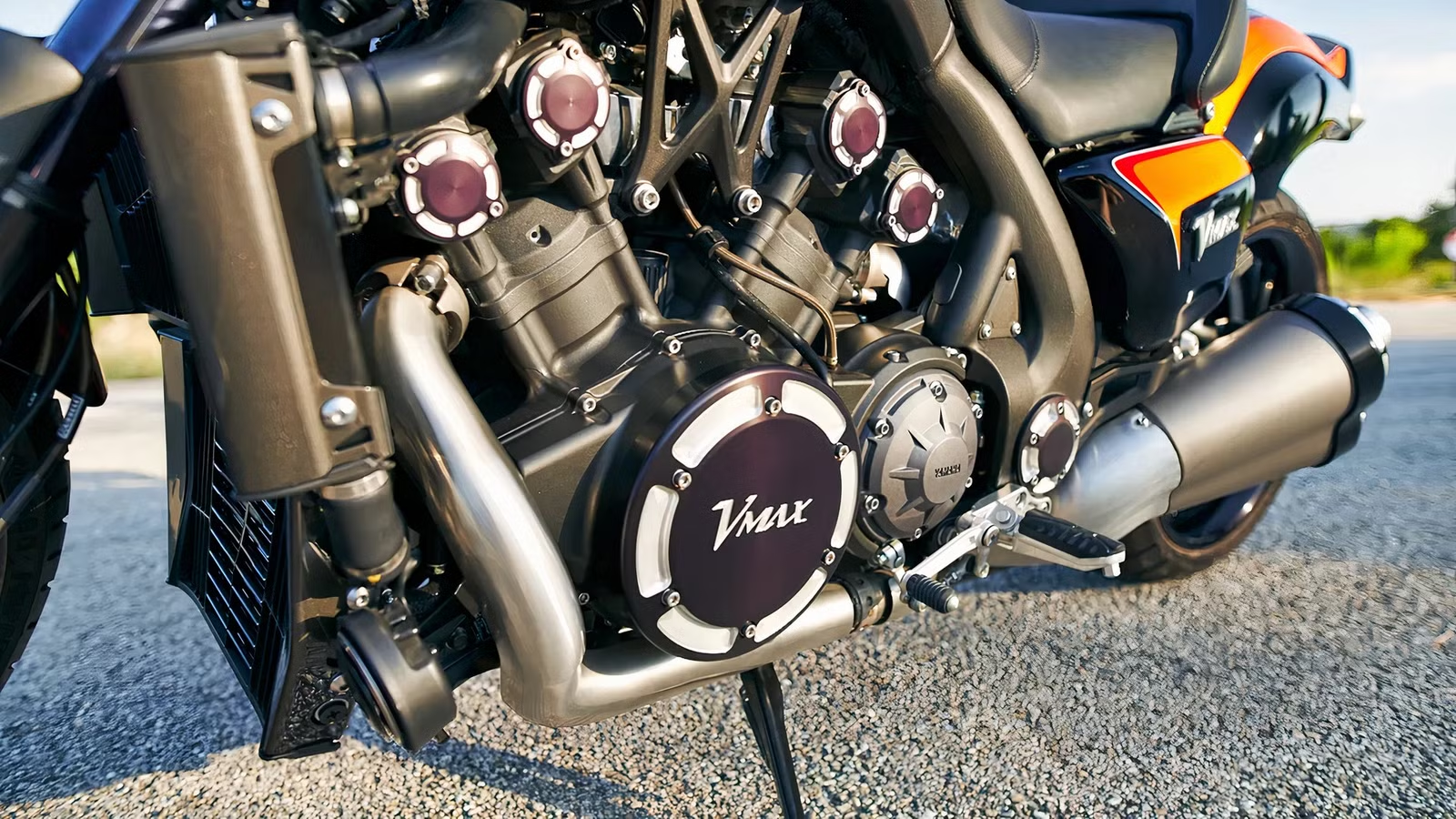
To understand why this motorcycle is an absolute drag strip weapon, you have to look at what it hides underneath that brutal looking tank and air intakes. When it debuted in 1985, it shook the industry with its concept of shoving a massive 1,198cc, liquid-cooled, 70-degree V4 engine into a street-oriented chassis. The motorcycle produces a heady 145 horsepower, an unbelievable output for the mid-1980s timeline. To make sure that power reached the asphalt as efficiently as possible, the engineers gave it a heavy-duty low-maintenance shaft drive.

The tech that made the vicious power output possible was a clever engineering tech called the V-Boost. At 5,750 rpm, a tiny servo-driven motor would open butterfly valves inside the intake manifold to link paired carburetor runner tracks together. By 8,000 rpm, these valves would open completely, allowing each cylinder to pull air and fuel through two carburetors instead of one. The result was a dramatic supercharger-like top-end surge that riders equated to having their arms pulled out of their sockets.
Later generations took that brutal V4 engine architecture and scaled it to unhinged proportions. Engine capacity swelled to a colossal 1,679 cc 65-degree V4, producing a mind-bending 197 horsepower and 123 pound feet of torque. Even with a heavy weight of 683 pounds, the motorcycle did the 0–60 mph run in under 3 seconds. It’s a number no factory Milwaukee-Eight Big Twin has been able to achieve, regardless of how well you tuned it.
The 80s Drag King Legend: Yamaha VMAX

This tire shredding icon is none other than the Yamaha VMAX 1700. The second generation VMAX arrived in 2009, ditching the mechanical V-Boost carb setup for a modern electronic fuel injection. Yamaha engineers brought in YCC-I (Yamaha Chip Controlled Intake), which electronically lifted the air horns inside the air-box at 6,650 rpm to instantly shorten the air intake track length from 150mm down to 52mm, allowing more air volume into the engine and boosting high-rpm power. Paired with fly-by-wire YCC-T (Yamaha Chip Controlled Throttle) mapping, it gave riders seamless continuous thrust all the way to its redline.
Sadly, we can’t have a good thing for a long time. Tightening Euro 5 emission norms eventually killed off Yamaha’s flagship V4 (besides Honda V4s as well). Re-engineering a high-strung 200 horsepower monster of an engine to meet strict environmental norms without completely dulling its performance edge wasn’t an economically viable step for the bikemaker, especially for a low-volume motorcycle.
Yamaha officially discontinued the VMAX, meaning the MY2020 model was the last of this fire-breathing muscle bike. You might find contradictory information in the form of fake online renders and YouTube concept videos of 2023 or 2025 VMAX 1700 models, and shady marketplace listings. It is best to ignore them as the VMAX bloodline officially ended in 2020.
The Used Market Reality: Yamaha VMAX 1700 Prices And Collector Status

Yamaha did a good deed of not reviving the VMAX nameplate with a watered-down version of the motorcycle, thus ensuring the VMAX name remains undiluted. This resulted in the Gen 2 models turning into bonafide collector items that hold their value exceptionally well. The secondary market value for clean Gen 2 VMAX 1700 motorcycles typically range from $18,000 and $29,000, depending on mileage and overall condition. The 2018-2020 “Final Edition” models command an additional 15% premium over earlier Gen 2 models.
Even a $25,000 pristine used VMAX 1700 is a cooler proposition than a brand new $40,000 Harley CVO or a custom Breakout. It triumphs the Harleys as a performance-to-dollar investment especially for riders who prefer straight-line thrills and mechanical engineering over brand value and leather-clad culture.
That said, a used VMAX comes with its set of rear-world trade-offs as well. A VMAX fuel tank holds just 3.96 gallons of fuel under the seat. Combine that with a low fuel economy of 30 to 35 miles per gallon, and you are looking at a realistic range of 120 miles. Another trade-off is the rear tire. Sending around 175 rear-wheel horsepower through the fat 200 mm rear tire will have you destroying the tires within a short span of time, meaning you will have to keep a separate savings account just for the tires.
Used Yamaha VMAX Checklist And Buyers Guide

If you have your mind set on getting a used Gen 2 VMAX 1700, here are some things to look out for, along with a thorough pre-purchase mechanical inspection. First off, check the stator and voltage regulator. The high electrical loads and engine bay heat degrade these charging components over time, leading to battery discharge and hot restart issues, where the warmed up motorcycle refuses to start after shutting the engine off. Thereafter, check the water pump weep hole for oil or coolant residue. Also, make sure the dual radiator fan relays trigger reliably as that giant V4 engine generates massive amounts of heat in stop and go traffic. Check the shaft drive fluid levels and look out for excessive backlash during low-speed throttle roll-offs.
To sum up, the Yamaha VMAX 1700 is a lot more than a discontinued cruiser — it is a rolling piece of automotive history that birthed the muscle cruiser segment. It is proof that a Japanese bikemaker can build an American muscle cruiser better than America could, leaving behind a legacy no modern Harley Big Twin can match.

Related posts


Latest Post


No Comments