
The Rarest AMC Muscle Car Ever Produced
Few automakers have a legacy as underappreciated as American Motors Corporation. Born from the 1954 merger of Nash-Kelvinator and Hudson Motor Car Company, AMC carved out a scrappy, independent identity at a time when the Big Three dominated every conversation. While rivals chased volume, AMC chased ingenuity — and nowhere was that more evident than in its muscle car lineup, which remains criminally overlooked by collectors even today.

AMC found success focusing on compact cars, which positioned the company well as the industry dove into the pony car and muscle car wars of the mid-to-late 1960s. The company entered this performance arena with the AMX muscle car.
The AMX – named after American Motors eXperimental concept vehicles – had a brief two-year production run as a standalone model. At the muscle car era’s peak, the AMX nameplate moved to the Javelin, creating the Javelin AMX for two more years before tightening emissions regulations ended the muscle car party. AMC continued using the AMX badge on performance variants through the 1980s, much like Chevrolet’s SS and Dodge’s R/T designations.
Despite its short lifespan, the original AMX introduced innovative features to the market and created a lasting legacy. The model produced several genuinely rare muscle cars, including at least one particularly exceptional variant that remains significant in automotive history.

The 1969 AMX California 500 Special Is The Rarest AMC Muscle Car
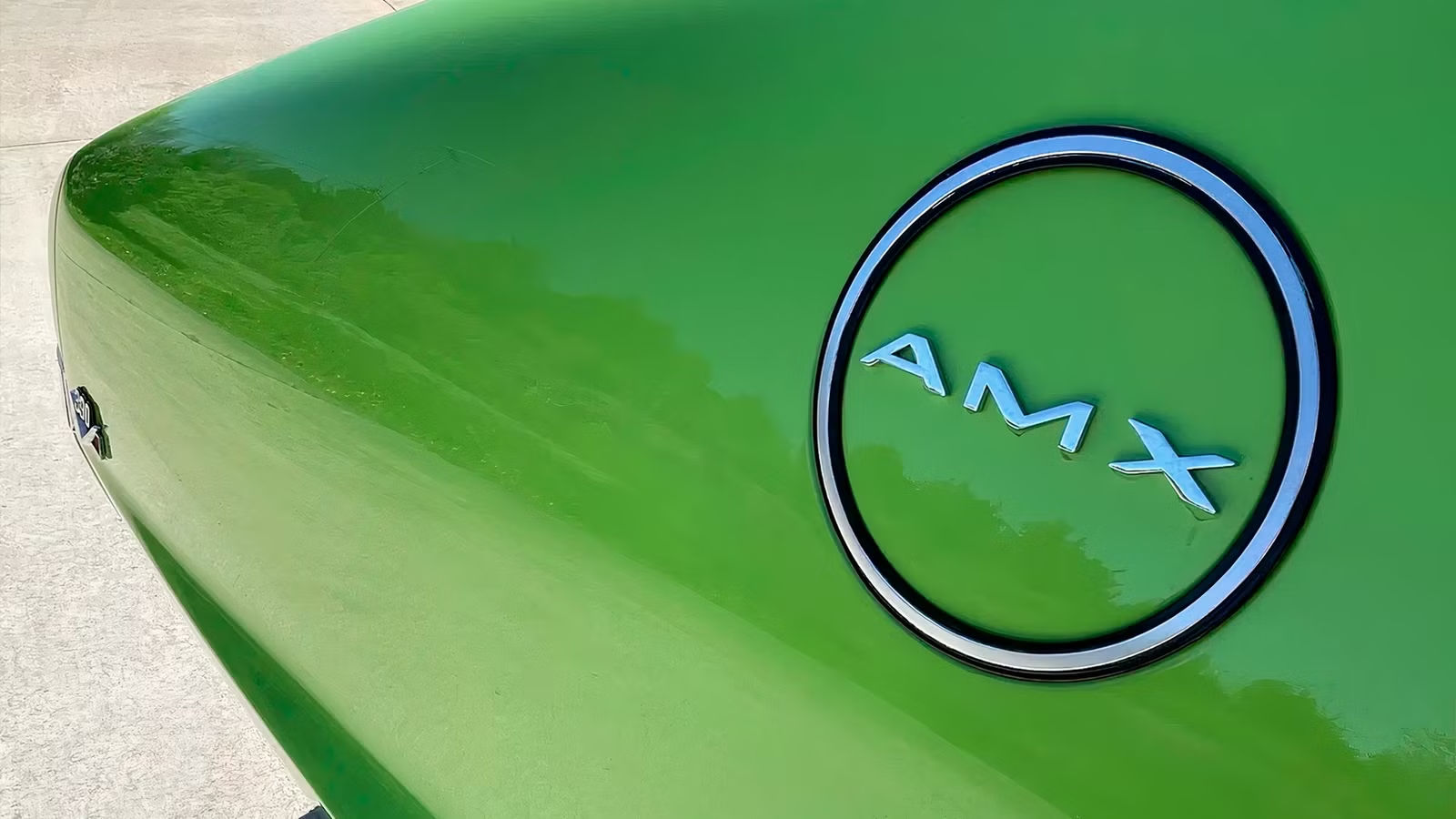
AMC launched the AMX in 1968, capitalizing on growing consumer appetite for nimble sports cars powered by robust V8 engines. The following spring of 1969, the company rolled out its Big Bad color series, producing 283 vehicles in Big Bad Green. Among these was a special example that served as the official pace car for Riverside International Raceway’s 1969 racing season.

Seizing this opportunity, the Southern California American Motors Dealer Association commissioned 32 replicas of the pace car. These vehicles were distributed exclusively through association dealerships, instantly creating what would become one of 1969’s scarcest muscle cars and arguably the most collectible performance offering AMC ever produced.

While AMC regularly developed special editions to generate enthusiasm across the country, the California 500 Special remained a regional exclusive. The model came generously equipped with features including tinted windows, air-conditioning, automatic transmission, and a 3.54 rear differential.

Distinctive brass badges adorned the hood, featuring “500 Special” script alongside crossed checkered flags to mark its racing heritage. The centerpiece of the California 500 Special, however, was its 390-cubic-inch V8 powerplant, delivering an impressive 315 horsepower and 425 pound-feet of torque.
AMC AMX California 500 Performance Specifications

|
Engine |
Power |
Torque |
0-60 MPH |
|---|---|---|---|
|
6.4-Liter V8 |
315 hp @ 4,600 rpm |
425 lb-ft @ 3,200 rpm |
6.5 seconds |
Any automotive historian will tell you that a muscle car is only as good as its engine, and the 1969 AMX California 500 Special benefited from AMC’s small-block 6.4-liter V8. It shared its block with smaller 290-cid and 343-cid versions but featured larger rod bearings (2.25 inches, up from 2.1) along with a forged steel crankshaft and connecting rods.

Those forged internals proved their worth in high-stress, maximum-load situations such as quarter-mile runs, delivering the durability that serious performance demanded. The engine’s legacy stretched to future higher-performance variants, including the 340-hp version fitted to the AMC Rebel muscle car and the 330-hp 401-cid V8 in the 1971 AMC Javelin AMX.
The AMC AMX Was A Corvette Competitor

Even though it looked more like the pony cars that were gaining acceptance at the time, the 1969 AMC AMX was taking direct aim at the Corvette, which at the time was just a year into its third generation. The two were the only American-built two-seaters on the market, and they were very similar in their dimensions, with the AMX undercutting the Corvette’s price by a meaningful margin.
Dimensionally, the 1969 AMX was over five inches shorter than the C3 Corvette and rode on a marginally smaller wheelbase (just one inch). It was wider than the Corvette, but its front and rear tracks were narrower, and it sat higher — the net result being that the AMX was probably not as composed at higher speeds.

But because it was slightly lighter and its engine more powerful than the base Corvette’s, the two would run neck-and-neck in the zero-to-60-mph sprint. However, the Corvette did offer a 390-hp engine option that would pull decisively ahead on the quarter-mile strip.
The AMC AMX wasn’t just a competitor for what the Big Three were putting on the road at the time; it was also an innovator in both performance and vehicle safety. Twice named the SAE Best Engineered Car, the AMX featured an automatic transmission that drivers could shift manually in a 1-2-D pattern, holding each of the lower gears until a manual upshift was performed.
What The 1969 AMC AMX California 500 Special Is Worth Today

It’s difficult to precisely ascertain what a 1969 AMX California 500 Special is worth today becauseso few of them change hands — mainly because only 32 were builtin 1969, and some estimates put the number even lower. Only a handful are believed to survive.

According to Hagerty, a 1969 AMX 390 in good condition is valued at around $33,200, making it a reasonable assumption that a California 500 Special commands at least double that figure. By comparison, the almost equally rare S/S AMX in good condition is valued at approximately $84,000.

Classic.com doesn’t break out separate statistics for the California 500 Special, but tracks the broader 1969 AMC AMX market. Values have fluctuated in recent years, reflecting broader softness in the collector car market.
The 1969 Hurst S/S AMX Is Another Rare And Collectible AMC Muscle Car

|
Engine |
Power |
Torque |
0-60 MPH |
|---|---|---|---|
|
6.4-Liter V8 |
340 hp @ 5,100 rpm |
425 lb-ft @ 3,600 rpm |
4.2 seconds |
(Specs courtesy of Automobile-Catalog)
The second-rarest AMC muscle car is also from 1969 – the 1969 Hurst S/S AMX. The S/S stands for Super Stock, an NHRA class for street stock cars. Its sole purpose was to run fast quarter-miles, and it shipped from the factory in white and without a radio, heater, sound insulation, or a factory warranty, because race cars often live fast and die hard.
The cars were delivered from the factory to Hurst Performance for race prep before going to their respective dealers. American Motors rated the S/S AMX engine at 340 hp, but the NHRA stepped in and reclassified it at over 400 hp — though many believe the true output was higher still. Regardless, the one-ton car could accelerate to 60 mph in less than 4.5 seconds and scorch the quarter mile in the low 11-second range.
The 1969 Hurst S/S AMX is in high demand, and the Hagerty valuation tables reflect this. There aren’t many bought and sold, even though it is rumored that as many as 40 could still exist. Classic.com has recorded transaction prices ranging widely, underscoring just how much condition and provenance drive value on these ultra-rare machines.
The AMC AMX Is A Rare, Forgotten Muscle-Car

The AMC AMX is one of those overlooked gems in the auto industry, save for its dedicated owners and fans. The two-seat muscle car was only around for three model years and was overshadowed by its bigger sibling, the Javelin, which proved itself on America’s tracks against the Big Three’s Camaros and Mustangs.

Unlike its two-seat contemporary, the Corvette, the AMX is long gone, as is American Motors and most of the models it produced (save for Jeep). But in its brief time, AMC left us with some genuinely rare cars, including the California 500 Special and the Hurst S/S.

More than a muscle car, the AMX was also an innovator, and there were some impressive one-offs — none more striking than the highly modified Breedlove AMX. In the hands of Craig Breedlove, these cars set 90 speed and endurance records before the AMX had even reached showrooms.
Sources: Hagerty, Automobile-Catalog, Bonhams, Classic.com, RM Sotheby’s.

Related posts

Latest Post


No Comments