
The Pushrod Engine Design That Still Beats Modern Rivals
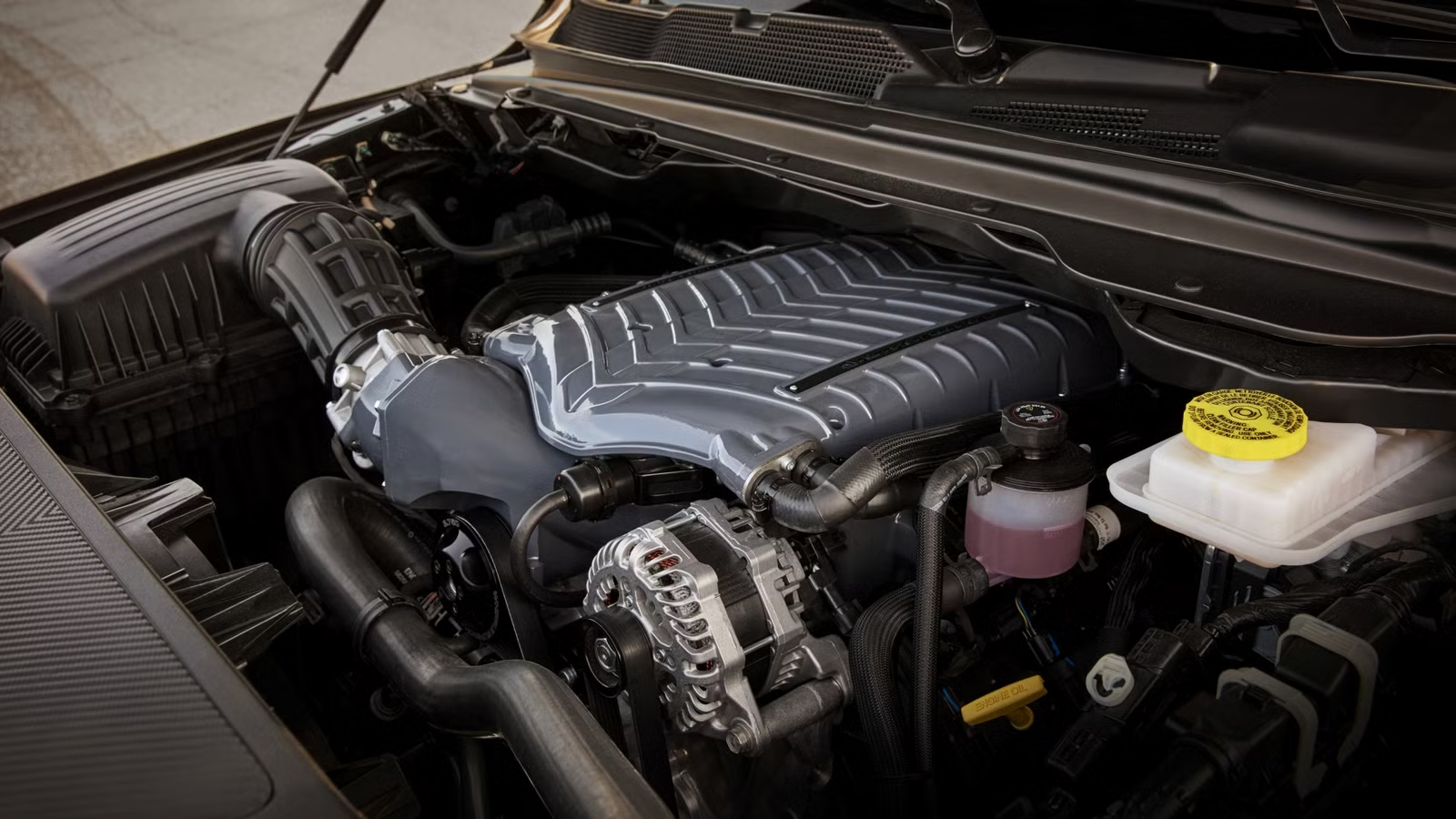
Isn’t it remarkable that a V-8 engine architecture introduced in 2003 is still powering brand-new performance trucks in 2026? This pushrod platform has produced power ranging from about 400 horsepower to almost 800 horsepower with the help of supercharging. Yet, what’s interesting isn’t just that it has survived, but rather that the same basic architecture has been constantly iterated and improved over time, keeping it relevant two decades later. While overhead cam engines long ago became the default for performance applications, this pushrod design remains useful because of its compact dimensions, simplicity, and strong power-to-weight ratio.
The Pushrod V-8 Refused To Become Obsolete
While the pushrod design may be one of the oldest engine architectures, it still offers advantages in terms of overall packaging compared with modern designs. Chrysler also has a longstanding history with this layout, which proved pivotal because the brand knew how to create a strong foundation worth improving upon.
Why The Original Engine Design Was Critical

In the post-war era, Chrysler was dedicated to figuring out how to force more air through an engine, and one of its ideas was the concept of a hemispherical, or dome-shaped, combustion chamber. The benefits of this design included a centrally positioned spark plug that allowed for large valves, favorable airflow, and shorter flame travel. Chrysler’s first production engine with this design arrived in 1951 with the 331-cubic-inch FirePower V-8, which produced 180 horsepower. It may not seem impressive today, but at the time, that was a significant amount of power, proving that the new design could deliver a meaningful performance advantage.
The 426 Turned The Architecture Into A Performance Legend


This dome-shaped combustion chamber, which became known as the “Hemi,” would quickly prove to be a success, and in the 1960s, the design would go on to power the legendary 426-cubic-inch V-8, the first engine directly called a “Hemi” by Chrysler. The 426 Hemi was designed from the start for stock-car and drag racing and was also known as the “Elephant Engine” because of its massive size and power.

The public’s first real taste of this engine came in 1966 with the detuned “Street Hemi” variant. Even then, this big-block V-8 produced about 425 SAE gross horsepower, making it one of the highest-performance powerplants available during the golden era of muscle cars, as seen in vehicles such as the 1969 Dodge Charger R/T. The second-generation Hemi was truly a racing engine for the street, but the later design would have a much broader mission. The real question was: Could Chrysler adapt this 1950s-era concept and still make it competitive in the 21st century? The answer would arrive in 2003 with a surprisingly familiar design.
The Third-Generation Hemi Made The Old Formula Modern

In 2003, Chrysler brought the Hemi name back to the mainstream, adapting its pushrod architecture to be more versatile than ever before while also meeting modern standards. This third generation is the engine that ultimately evolved into the 392 and supercharged 6.2-liter engines still being used today.
The 5.7-Liter Hemi Started With 345 Cubic Inches

If you hadn’t guessed yet, the engine we have been alluding to is the third-generation Chrysler Hemi, which launched in 2003 in the Dodge Ram 1500. The original third-gen Hemi was a 5.7-liter, 345-cubic-inch, cast-iron-block, pushrod V-8 with two valves and twin spark plugs per cylinder, producing 345 horsepower in the Ram 1500. Despite being called a “Hemi,” the third-generation engine’s combustion chambers were flatter than those of its predecessors and were not truly hemispherical.
One of the reasons for this change was to accommodate the twin-spark-plug design, with the two plugs positioned to shorten the flame travel across the combustion chamber. That improvement led to faster combustion, cleaner emissions, and better efficiency, three things the Hemi would need to remain relevant in the modern age. The Hemi’s compact and relatively simple design was also a plus, while the deep-skirt block and cross-bolted main caps helped ensure that the platform retained the structural strength for which the Hemi family had become known.
Chrysler Kept Improving It Instead Of Replacing It

The original 5.7 Hemi was produced from 2003 to 2008, but the 425-horsepower 6.1-liter SRT variant introduced for the 2005 Chrysler 300C SRT8 gave enthusiasts a first modern taste of the Hemi’s deep-rooted racing heritage. By 2006, cylinder-deactivation technology had begun to be integrated into 5.7-liter units, followed by a major “Eagle” revision for the 2009 model year that introduced variable valve timing and increased output. In 2011, a production 6.4-liter version arrived in the Dodge Challenger SRT8, producing 470 horsepower, and soon after came the first 707-horsepower supercharged 6.2-liter Hellcat variant, initially offered in the Dodge Challenger and Charger SRT Hellcat.
While all these variants differ greatly in terms of performance and components, they still share the same basic architecture at their core. Cylinder-head design, airflow, compression, and internal components changed several times, but the fundamental pushrod layout remained largely unchanged because its versatility allowed Chrysler to modernize the platform as new technology became available.
Its Compact Architecture Is The Real Secret

While the shape of the combustion chamber may have changed over the generations, the Hemi’s pushrod layout didn’t because its compact dimensions made it flexible while also leaving significant room for added power, technology, and displacement.
Two Valves And One Camshaft Can Still Move Serious Air

If we take a look at the basic third-gen Hemi architecture, its design is as simple as it gets: cam-in-block, hydraulic roller lifters, pushrods, rocker arms, and two valves per cylinder. What is often understated about pushrod designs is their physical compactness compared with overhead-cam engines, which require camshafts above the valves and therefore have a taller overall architecture.
The pushrod design allows for significant displacement in a relatively compact package, which makes this powerplant ideal for project cars and engine swaps of all types. With the Hemi’s massive aftermarket support, you also get plentiful parts availability and options when it comes to everything from valvetrain components to rotating assemblies.
The Same Basic Block Architecture Can Handle 800-Plus Horsepower

While the original third-gen 5.7 produced 345 horsepower when it debuted and eventually reached about 395 horsepower in later applications, it was clear that this block design was capable of considerably more. The 6.2-liter Hellcat family proved that assumption, with the Redeye producing 797 horsepower and the SRT Demon pushing 808 horsepower on 91-octane pump fuel, with up to 840 horsepower possible with 100-octane race fuel.

The 5.7 variant utilizes a nodular-iron crankshaft, while later performance variants switched to forged-steel crankshafts. The Hellcat engine includes forged rotating hardware and specialized cylinder heads that use larger 2.138-inch intake and 1.654-inch exhaust valves. The 6.2-liter Hellcat uses a 4.090-inch bore and 3.58-inch stroke, while the 6.4 uses the same 4.090-inch bore and a longer 3.72-inch stroke. Despite all these variations, the architecture itself left enough headroom to support a massive range of power outputs without requiring Chrysler to abandon the fundamental block and pushrod design.
The “Old” Hemi Is Still Being Built For New Trucks

If you think the third-gen Hemi has lost its luster today just because it is based on a design from 2003, the latest Ram trucks tell a very different story. In 2026, Ram is putting the latest variants of the third-gen Hemi into new performance trucks while also offering the architecture as a crate powerplant for custom builds and restomods.
The TRX And Rumble Bee Show How Far The Formula Has Come

The Hemi is not dead. Ram has brought the Hemi back for the 2027 Ram 1500 lineup, with the 395-horsepower 5.7-liter Hemi serving as the base engine in the $59,995 Ram 1500 Rumble Bee. The optional 470-horsepower 6.4-liter Hemi also makes a return, while the 777-horsepower 6.2-liter supercharged Hemi sits at the top of the range. That 777-horsepower engine can be found in both the 1500 Rumble Bee SRT, a street-focused muscle truck, and the 1500 TRX SRT, an off-road performance truck.
Is that a big deal? The performance numbers certainly suggest it is. The Rumble Bee SRT can sprint from zero to 60 mph in just 3.4 seconds and reach a 170-mph top speed, figures that would have been difficult to imagine from a full-size pickup when the third-gen Hemi first debuted in 2003. The continued success of the third-gen Hemi shows that a strong foundation is not something to simply discard; it is something that can remain relevant for decades with the right development.
Mopar Still Sells The Architecture As A Crate Engine

Even more impressive is that Mopar still sells an entire catalog of Hemi variants as crate engines. Here is a basic price ladder of what is available: $7,495 for the 5.7-liter 345, $9,600 for the 6.4-liter 392, $17,925 for the Hellcrate 6.2, $21,807 for the Hellcrate Redeye, and $29,995 for the Hellephant A30 426.
That last one is not found in any production Dodge vehicle and produces 1,000 horsepower and 950 pound-feet of torque from a supercharged 7.0-liter Hemi, giving it the same 426-cubic-inch displacement as the legendary second-generation Hemi from the 1960s. Mopar also sells complete installation kits for certain crate engines, including an ECU, wiring harness, documentation, and other components, although buyers should be aware that these powertrains may not be legal for use in emissions-controlled street vehicles.

Modern V-8 engines may be more sophisticated in areas such as variable valve lift and DOHC valvetrains, yet the Hemi remains relevant because a good architecture does not become obsolete simply because a newer one exists. Its combination of compact packaging, displacement, torque, a relatively straightforward valvetrain, massive aftermarket support, and decades of factory development explains why this pushrod V-8 continues to compete with much newer engine designs.
Sources: Dodge, Ram, Chrysler, Mopar, Holley, Hagerty

Related posts





Latest Post


No Comments