
The World’s First Turbocharged Production Car Was A V8 Muscle Car
Turbocharging is now so deeply embedded in the automotive mainstream that it’s easy to forget it was once a radical experiment. Today’s performance icons — from the Mercedes-AMG C 63, which swapped its legendary 6.2-liter naturally aspirated V8 for a highly downsized turbocharged hybrid four-cylinder, to Ferrari’s turbocharged V8 and hybrid V6 road cars — rely on forced induction to meet ever-tightening emissions and fuel economy standards. The downsized, boosted engine is the new normal. But every revolution has a starting point.

So where did the turbocharged production car actually begin? The answer takes us back to 1962 and a thoroughbred American muscle car with a V8 engine — one that relied on something as strange as “Turbo Rocket Fluid” to run.
The Oldsmobile Jetfire Is The World’s First Turbo V8 Car
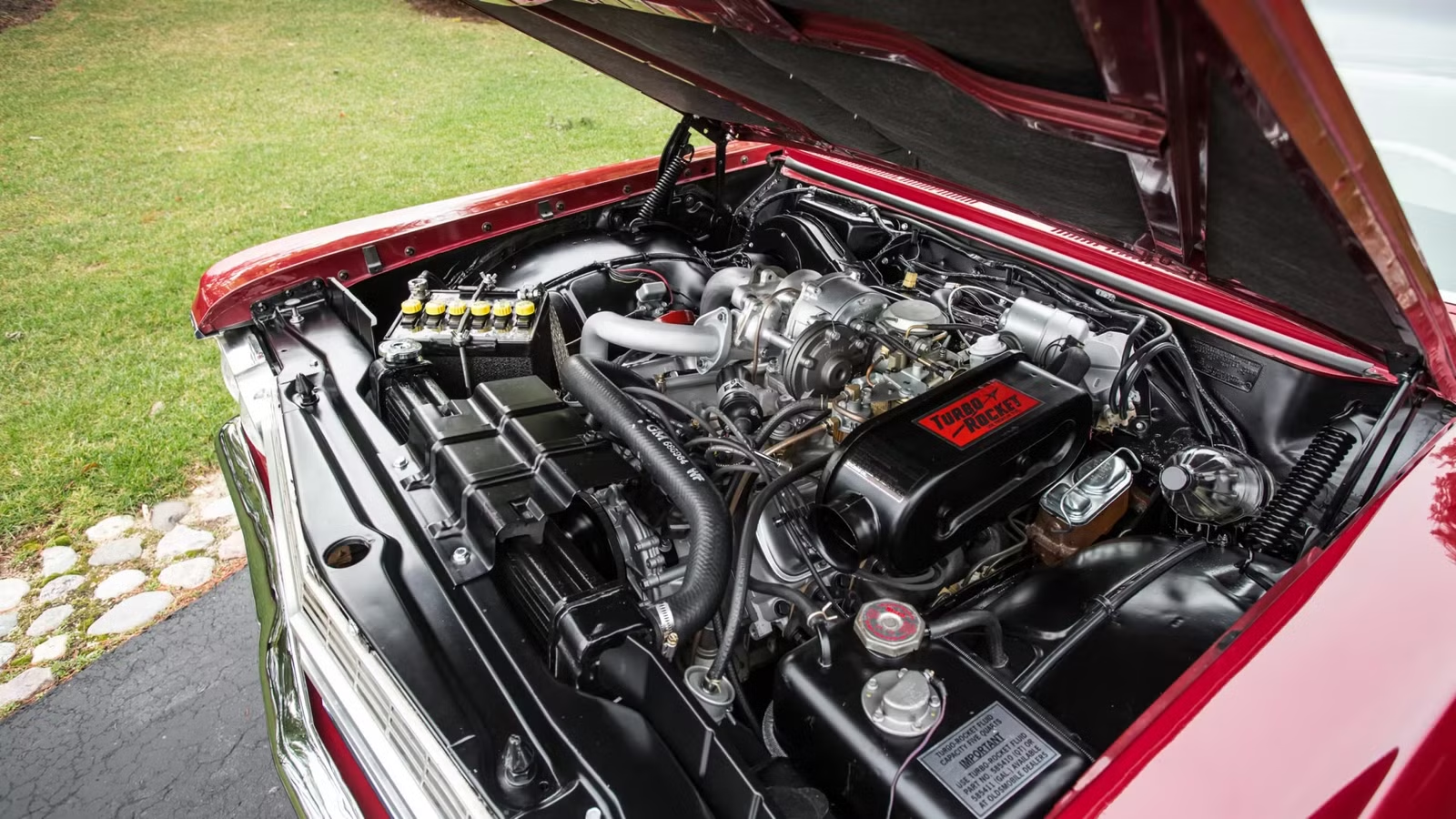
The 1962 Oldsmobile Jetfire is the world’s first series production car with a turbocharged engine. The Jetfire F-85 used GM’s 215 cu-in V8, which was also one of the first engines to use all-aluminum construction. The Oldsmobile Jetfire was a revolutionary model, and is generally forgotten, and was manufactured for two years – 1962 and 1963. The engine used a Garrett turbocharger and also required a special “Turbo Rocket Fluid” to operate, without which the engine would not function correctly and could lead to disastrous results.

Due to the complexity of the engine and its operation, Oldsmobile only manufactured 9,607 units of the model between 1962 and 1963. While it was available with a manual and automatic transmission, the automatic was by far the more popular choice, and only a handful were built with the manual. Today, it is estimated that fewer than 20 examples of the Jetfire F-85 Turbo Rocket still have operational factory turbocharged systems.
The Oldsmobile Jetfire Turbo Rocket V8 pioneered turbocharging in production cars. While the concept of boosting a production engine eventually caught on industry-wide, its water-methanol injection system proved too complex for everyday ownership, and manufacturers worked around it to improve long-term reliability. Even so, the Jetfire’s turbo V8 demonstrated the performance potential of smaller, boosted engines — paving the way for everything from the Buick Grand National to today’s EcoBoost-powered Fords.
The First American Turbocharged V8 Production Car Made 215 HP
Engine Specs
|
Manufacturer |
Oldsmobile (General Motors) |
|
Production Years |
1962-1963 |
|
Displacement |
215 cu-in (3.5-Liter) |
|
Configuration |
Turbocharged V8 |
|
Power |
215 hp at 4,600 rpm |
|
Torque |
300 lb-ft at 3,200 rpm |
|
Transmission |
4-Speed Manual / 3-Speed Automatic |
|
Fuel Type |
Gasoline |
|
Notable Application |
Exclusive to the 1962-63 Jetfire F-85 |
(Source: General Motors, Mecum)
For the first time in history, Oldsmobile built a turbocharged V8-powered production car in 1962. The Oldsmobile F-85 Jetfire used General Motors’ 215 cu-in (3.5-liter) V8 engine. With a 90-degree V-bank, the engine featured an overhead-valve (OHV) layout with two valves per cylinder, and both the block and cylinder head were cast in aluminum.
The engine was the first series production turbocharged unit and used a Garrett AiResearch T5 turbocharger. A single-barrel Rochester side-draft carburetor was positioned upstream of the turbo. The system also relied on “Turbo Rocket Fluid” — a water-methanol injection mixture used to suppress detonation under boost. The fluid consisted of 50% distilled water and 50% methyl alcohol, plus a corrosion inhibitor.
This engine was exclusive to the 1962–63 Jetfire F-85 and never appeared in any other GM model. Running a 10.25:1 compression ratio — notably high for a turbocharged application — it produced 215 hp at 4,600 rpm and 300 lb-ft of torque at 3,200 rpm. Maximum boost from the turbocharger was limited to 5 psi.
Nearly all examples of the Oldsmobile Jetfire F-85 built between 1962 and 1963 left the factory with the 3-speed Hydra-Matic automatic transmission. An extremely limited number were fitted with a floor-mounted 4-speed manual, and finding one today is exceptionally rare.
The 1962–1963 Oldsmobile Jetfire F-85 Turbo Rocket was the world’s first series production car with a turbocharged engine, making it extraordinarily significant. It introduced several firsts simultaneously: all-aluminum construction for both block and head, and water-methanol injection for detonation control. At a time when cast-iron engines were universal, the Turbo Rocket V8’s aluminum architecture kept its weight to approximately 320 lbs — a remarkable achievement for the era.
With a 215 cu-in displacement producing 215 hp, the engine achieved the tidy benchmark of one horsepower per cubic inch. Production was kept deliberately low due to the mechanical complexity involved. Today, fewer than 20 examples are known to still have a working turbocharging system.
Oldsmobile Turbo Rocket V8 Engine – Highlights
- 215 cu-in V8 makes 215 hp (1 hp / cu-in)
- First turbocharged V8 production car in the world
- One of the first aluminum head and block construction
- Required special “Turbo Rocket Fluid” to operate
- Used a Garrett AiResearch T5 turbocharger
A 1963 Oldsmobile F-85 Jetfire Is Worth Just $27,900 Today
Oldsmobile Jetfire F-85 Turbo Rocket V8 Production
- In 1962 only 3,765 units were built
- In 1963 just 5,842 units were manufactured
- The Oldsmobile Jetfire had a total production run of 9,607 units
- The 3-Speed Automatic Gearbox is extremely common on the Oldsmobile Jetfire
- Whereas the 4-Speed Manual Gearbox is rare to find
The Oldsmobile Jetfire F-85 Turbo Rocket V8 had a limited production run across its two years of availability. In 1962, Oldsmobile built just 3,765 units; in 1963, that figure rose to 5,842, for a total production run of 9,607 units. The vast majority left the factory with the automatic transmission, while only a handful were fitted with the 4-speed manual. The Jetfire F-85 Turbo Rocket V8 is considered highly collectible today, with as few as 20 working examples known to survive with an intact, functioning turbocharger system.
Oldsmobile Jetfire Current Values
|
Condition |
1962 MY Value |
1963 MY Value |
|
Concours Condition |
$47,000 |
$56,000 |
|
Excellent Condition |
$36,100 |
$42,800 |
|
Good Condition |
$23,300 |
$27,900 |
|
Fair Condition |
$15,000 |
$22,000 |
(Source: Hagerty)
According to Hagerty, a 1962 Jetfire F-85 in good condition is worth around $23,300 on average, while fair-condition examples can fall to approximately $15,000. Excellent-condition cars are valued at roughly $36,100, and a Concours-quality example commands around $47,000.
A 1963 Jetfire F-85 Turbo Rocket V8 is worth more, averaging around $27,900 in good condition, with fair examples valued near $22,000. A well-maintained excellent-condition car is worth approximately $42,800, while a true Concours specimen can reach $56,000.
Sources: Mecum Auctions, Hagerty, General Motors

Related posts




Latest Post


No Comments