
Touring Motorcycles That Give Gold Wing Owners Something To Think About
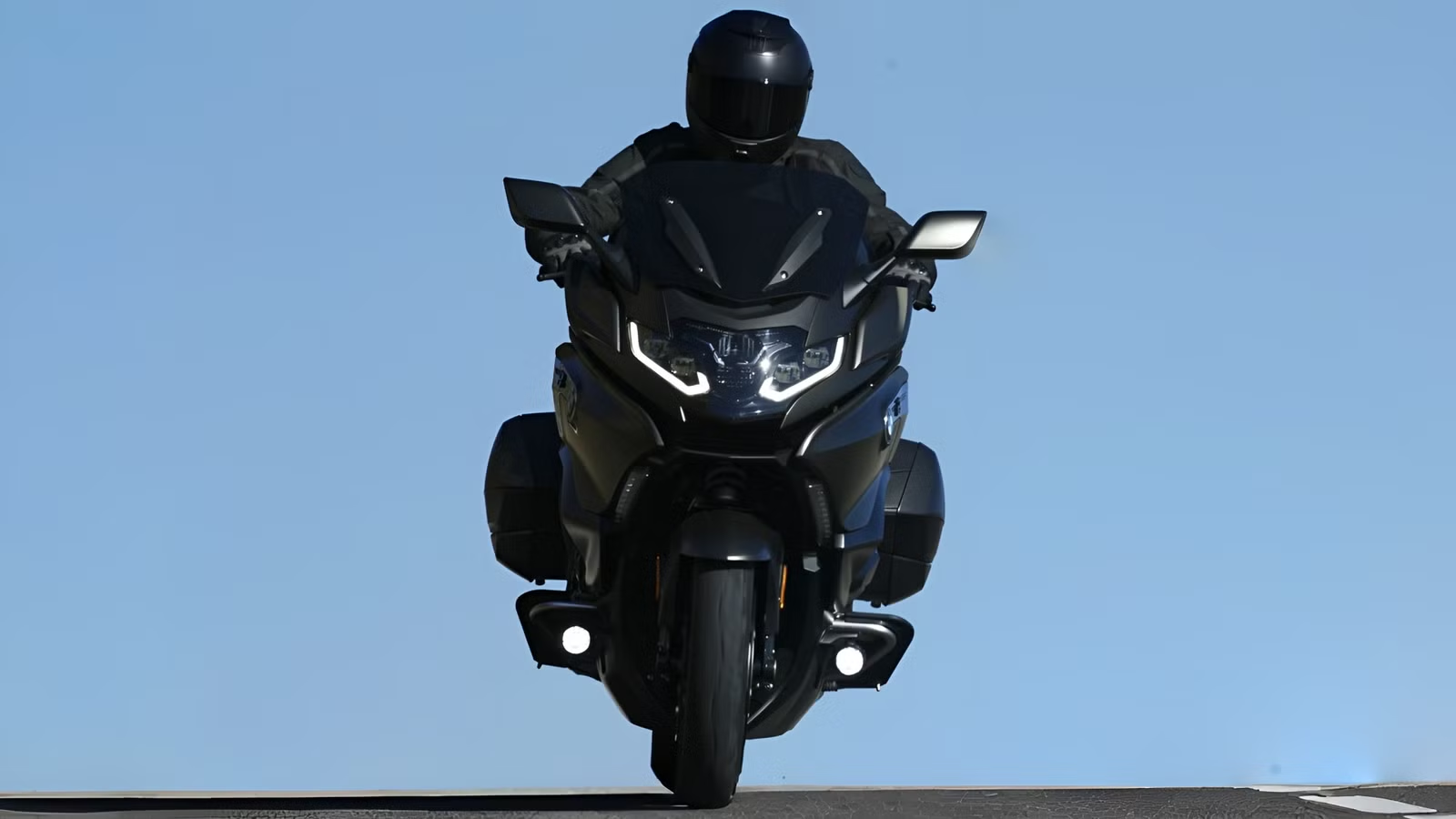
For more than five decades, the Honda Gold Wing has been the motorcycle every other touring bike gets measured against. Its silky 1,833cc flat-six, available automatic, and a walking mode that eases it in and out of tight spots have made Honda’s flagship the default answer for riders who measure their trips in states rather than miles.

But being the benchmark doesn’t make it the only answer. From Bavarian inline-sixes and big-inch American V-twins to sport-tourers and even a three-wheeled grand tourer, the touring segment is packed with machines that approach long-distance riding differently. None of them is a Gold Wing clone, but each of these 10 tourers gives Gold Wing owners something worth thinking about.
Harley-Davidson CVO Street Glide 3 Limited
Price: $54,999
The CVO Street Glide 3 Limited is the most expensive machine here, and also the most unconventional. Harley redesigned its trike lineup for 2026, and this factory-custom version pairs the Milwaukee-Eight VVT 121 V-twin, which makes 114 horsepower and 138 pound-feet of torque. Underneath, the redesign brings an all-new rear suspension that ditches the old solid axle, while the reverse system now runs off the engine’s starter. With all three wheels planted, there’s no bike to balance at stoplights, in parking lots or on sloped driveways.

The comfort list matches the price. Heated rider and passenger seats with individual controls, a heated passenger backrest, heated grips, a 12.3-inch Skyline OS touchscreen with navigation, and six-speaker Rockford Fosgate audio all come standard. Of course, all that luxury comes at a cost. Oh, and if the CVO price is too steep, the non-CVO Street Glide 3 Limited starts at $39,199.
Harley-Davidson CVO Street Glide Limited
Price: $51,999

The Gold Wing’s luxury is quiet and engineered. The CVO Street Glide Limited delivers luxury in the American custom tradition, sitting at the very top of Harley-Davidson’s Grand American Touring range. Its Milwaukee-Eight VVT 121 V-twin makes 115 horsepower and 139 pound-feet, with peak torque arriving at just 3,000 rpm, while SHOWA suspension and Brembo brakes handle the chassis duties.
The comfort list mirrors the trike’s, with heated seats, a heated lower passenger backrest, heated grips, a 12.3-inch Skyline OS touchscreen with navigation, and a six-speaker Rockford Fosgate Stage II audio system. However, at $51,999, it is more expensive than a Gold Wing Tour, is heavier, and offers neither an automatic transmission nor reverse. This is the pick for the Gold Wing owner who has the budget and wants big-inch V-twin character more than the most refined ride.
Harley-Davidson CVO Road Glide ST
Price: $44,999

Not every Gold Wing owner wants to float down the interstate. For those who would rather attack a mountain pass, Harley-Davidson’s CVO Road Glide ST is a bagger built in the image of the King of the Baggers race machines. Its Milwaukee-Eight 121 makes 127 horsepower and 145 pound-feet. It also has the racing-inspired hardware that backs that up.
Eight ride modes, including Track and Track Plus, make the intended audience obvious, and that focus costs touring practicality. There is no top case, so luggage space shrinks to about 68 liters. The audio system drops to two fairing speakers, and the moto-style bar on six-inch risers puts the rider in a more aggressive stance.
Indian Pursuit PowerPlus 112
Price: $36,999

The Pursuit is Indian’s modern full dresser, and the PowerPlus 112 version is its strongest case against the Gold Wing. The liquid-cooled 1,834cc V-twin makes 126 horsepower and 134 pound-feet of torque. It sits in a cast-aluminum frame with a chassis-mounted fairing, an inverted fork, Brembo front calipers, and an electronically adjustable rear preload.
The tourer features blind spot warning, rear collision warning lights, tailgate warning, and electronically linked brakes, alongside lean-sensitive ABS and traction control. It also includes a heated two-up seat, heated grips, a power windshield, and a 7-inch RIDE COMMAND display with navigation, while the saddlebags, trunk, and dash hold good storage space. The trade-off is weight—937 pounds in running order.
Indian Roadmaster 116
Price: $34,999

Indian’s Roadmaster takes a very different approach to covering big miles than the Gold Wing. It is built around the air-cooled Thunderstroke 116, a 1,890cc V-twin that pumps out 126 pound-feet of torque, delivering its pull low in the rev range. The Rear Cylinder Deactivation shuts off the rear cylinder at a stop for added comfort.
The equipment list is where the Roadmaster earns its place here. A two-up seat with independent heated and cooled controls for rider and passenger, heated grips, a push-button power windshield, keyless ignition, three ride modes, and cruise control all come standard, along with a 7-inch display offering navigation.
BMW K 1600 GTL
Price: $30,095

If any motorcycle shares the Gold Wing’s core idea, it is the K 1600 GTL. Both are full-dress tourers built around a six-cylinder engine, but BMW chose an inline-six that makes 160 horsepower and 132.7 pound-feet. The GTL also starts within a few hundred dollars of the Gold Wing Tour. The GTL, however, leans toward performance touring, with a 160-HP engine that rewards revs.
It does not leave Gold Wing owners short on convenience, either. Reverse Assist, heated grips, seat heating, side cases, a top case, Keyless Ride, and a 10.25-inch TFT display with navigation are standard. What it lacks is an automatic transmission; the closest BMW gets is the Shift Assist Pro quick shifter, but it’s optional. At 789 pounds road-ready, it is also lighter than the Gold Wing.
BMW R 18 Transcontinental
Price: $24,395

BMW takes an entirely different route with the R 18 Transcontinental, a heritage-styled full-dresser built around the 1,802cc “Big Boxer” twin, rated at 91 horsepower and 120 pound-feet. That is far less peak power than the K 1600, but the delivery is the point, with the torque arriving low in the rev range. It also brings a top case, backrest, and heated passenger seat as standard.
Under the retro styling hides plenty of tech, including available radar-based active cruise control, a Marshall Gold Series audio upgrade, and a 10.25-inch TFT screen alongside four analog dials. The compromise is mass. It weighs 954.6 pounds road-ready, which is heavier than a Gold Wing Tour. This is a bike for riders who value style and relaxed boxer torque over outright agility.
BMW R 1300 RT
Price: $22,745

Sometimes the smartest upgrade is shedding weight. BMW’s R 1300 RT tips the scales at 620 pounds road-ready, swapping the full-dresser formula for a sleeker sport-touring one. Also, its 1,300cc boxer twin makes 145 horsepower and 110 pound-feet. BMW’s Automated Shift Assistant is another plus.
The RT also offers radar-based tech, with the optional Riding Assistant package adding active cruise control and lane change warning. Dynamic ESA, cruise control, keyless ride, tire pressure monitoring, and heated grips are standard. But Dynamic Chassis Adaption, a Comfort Passenger package, and a variable luggage system cost extra, so the price climbs quickly. Riders who want a sharper, more compact tourer and are willing to spec it carefully will find a lot to like.
Suzuki GSX-S1000GX+
Price: $18,949

The GSX-S1000GX+ is the outlier on this list, and that is the point. Suzuki calls it a sport crossover, pairing a twin-spar aluminum frame with the upright ergonomics of the V-Strom 1050. Power comes from a GSX-R-derived 999cc inline-four that makes 152 hp and 78.2 pound-feet. Suzuki’s electronic suspension, smart cruise control, and a bi-directional quick shifter give it a premium edge.
For a Gold Wing owner, the appeal is a radically lighter, sharper bike for a lesser price. It has a 511-pound curb weight before the side cases are mounted, which is far less than a base Gold Wing. The compromises are a tall 33.3-inch seat and a chain final drive rather than a shaft. Think of it as a second bike for spirited weekends, or a downsizing option for riders done with full-dress weight.
Yamaha FJR1300ES
Price: $18,299

Not every alternative needs a big-inch engine or a $50,000 price tag. Yamaha’s FJR1300ES shares the Gold Wing’s shaft drive and Japanese engineering in a far lighter sport-touring package, with a 1,298cc liquid-cooled inline-four, a six-speed gearbox with an assist-and-slipper clutch. Electronically adjustable suspension at both ends, traction control, cruise control, and D-Mode engine mapping come standard.
Part of the FJR’s charm is how little Yamaha has meddled with it. The engine and chassis have stayed largely unchanged for two decades. Of course, a Gold Wing owner will notice what’s missing. The cockpit feels dated next to the Honda’s and there’s no automatic or reverse for tight spots. Still, as a lighter, more affordable companion to a Gold Wing the FJR1300ES is hard to argue with.
Source: BMW, Harley-Davidson, Indian, Yamaha, Suzuki

Related posts



Latest Post


No Comments