How Much It Costs To Replace A Kia Niro Hybrid Battery In 2026
7 minutes reading
Sunday, 6 Sep 2026 17:30 0 70 autotech
Buying a hybrid vehicle like the Kia Niro for long-term ownership means eventually confronting an inevitable reality: at some point down the road, the high-voltage traction battery pack may need to be replaced. The good news for hybrid owners is that high-voltage battery replacements are substantially cheaper and far less labor-intensive than those required for battery electric vehicles (BEVs). Hybrid battery packs carry much smaller total energy capacities, typically between 1.3 kWh and 1.6 kWh, and share propulsion duties with an efficient internal combustion engine rather than taking on the entire workload alone.
Since its global introduction for the 2017 model year, the Kia Niro has stood out as one of the most practical, value-focused compact crossovers on the market. By pairing a naturally aspirated 1.6-liter four-cylinder engine with a parallel electric motor and a six-speed dual-clutch transmission, the Niro delivers exceptional fuel economy at an accessible price point. However, as early first-generation Niro models cross the decade mark and accumulate six-figure mileage totals, long-term owners and second-hand buyers are closely evaluating replacement costs, performance specifications, expected battery lifespan, and Kia’s industry-leading warranty coverage in 2026.
How Much A Kia Niro Hybrid Battery Replacement Costs
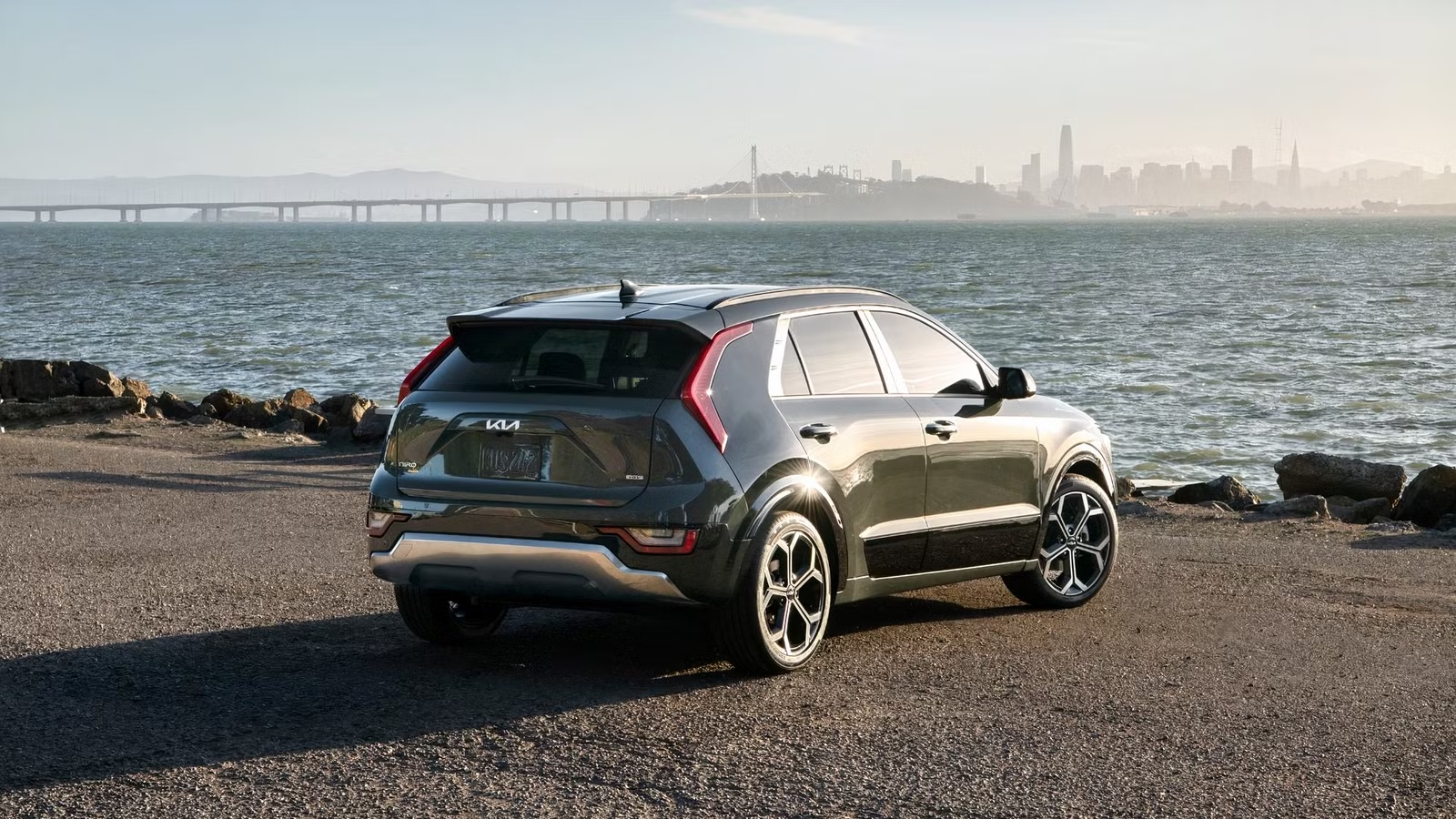
2026 Kia Niro Hybrid Parked In A FieldKia
According to Kia factory parts listings and independent specialized service data, a new Original Equipment Manufacturer (OEM) replacement battery pack for a Kia Niro Hybrid ranges between $3,500 and $4,800 for the physical part alone. When factoring in diagnostic fees, shop labor, high-voltage safety disconnections, and cooling system checks, total out-of-pocket costs at an authorized Kia dealership typically range between $4,500 and $6,500.
For owners out of warranty, alternative service channels offer noticeable savings. Third-party hybrid battery specialists such as GreenTec Auto and Exclusively Hybrid offer reconditioned packs for first-generation Niro models starting between $2,200 and $3,200. These packs utilize tested, cell-matched modules salvaged from low-mileage donor vehicles or rebuilt with new battery cells.
Rear 3/4 action shot of 2026 Kia Niro Hybrid driving on roadKia
Alternatively, independent facilities certified in high-voltage hybrid systems generally charge lower labor rates ($120–$160/hour) compared to dealership service centers ($180–$250/hour). Sourcing a reconditioned or aftermarket pack through an independent specialist typically reduces the complete parts-and-labor total to between $2,800 and $4,000.
While opting for a third-party replacement can significantly reduce repair costs, secondary-market high-voltage packs introduce inherent trade-offs in quality, safety, and longevity. Remanufactured units often rely on reconditioned modules where only individual failing cells are replaced; if remaining aging cells are improperly capacity-matched, the pack can quickly fall back out of balance and fail prematurely. Furthermore, budget aftermarket options may lack strict factory-grade thermal management and precise voltage calibration, risking software communication errors with the vehicle’s ECU, erratic power delivery, or shorter warranty coverage compared to a genuine OEM unit.
How Kia Niro Battery Specifications Impact Replacement Costs
2019 Kia Niro Hybrid PowertrainKia
A detailed close-up shot of the 2027 Kia Niro’s engine.Kia
Those $1,000–$2,500 gaps between OEM and third-party quotes aren’t random — they reflect the engineering complexity locked inside the Niro’s specific battery architecture. The overall replacement cost and engineering complexity of a hybrid battery are tied directly to its hardware specifications. Unlike many early hybrid competitors that relied on older Nickel-Metal Hydride (NiMH) chemistry, Kia engineered the Niro with lightweight, high-energy-density Lithium-ion Polymer (Li-ion Polymer) cell architecture from launch.
How Long Kia Niro’s Hybrid Battery Lasts
Kia Niro 2017-2019 Hybrid BatteryBest Hybrid Batteries
Kia’s lithium-ion polymer hybrid batteries are designed to last between eight and 15 years, or roughly 100,000 to 150,000 miles under normal driving conditions before experiencing significant degradation. Under ideal operating conditions, many high-mileage Niro models comfortably cross the 180,000 to 200,000-mile mark on their original factory pack.
Because standard non-plug-in hybrids maintain a tight operational state-of-charge (SoC), rarely dropping below 40 percent or charging above 80 percent, the battery experiences significantly less chemical strain than a full EV pack subjected to frequent deep discharges and DC fast charging. However, real-world longevity depends on several environmental and operational factors: ambient temperature and climate, cabin cooling maintenance, driving patterns, and storage.
Rear 3/4 action shot of 2019 Kia Niro HybridKia
Starting off with climate and temperature, sustained exposure to extreme heat accelerates chemical wear in lithium-ion cells. Vehicles operating primarily in hot southern climates may experience capacity degradation earlier than those in temperate regions. As for cabin cooling maintenance, the Niro uses interior cabin air to keep the high-voltage battery cool via air intake vents located near the rear seats.
Keeping these vents free of pet hair, dust, and luggage obstructions is crucial for thermal management. Driving habits can also affect your battery’s lifespan. Frequent short trips that prevent the system from reaching optimal operating temperatures, or leaving the vehicle parked unused for extended months, can lead to individual cell voltage imbalance over time.
How Kia’s Warranty Changes Dramatically If You’re Not the First Owner
One of the primary selling points for the Kia Niro when purchased new or through certified programs is the brand’s competitive factory warranty coverage. Kia has consistently used its warranty package to alleviate buyer anxiety about long-term hybrid battery reliability. For original owners, the high-voltage battery pack is covered under terms that rank among the best in the automotive industry. However, navigating battery warranty claims requires understanding the distinctions among original retail purchasers, subsequent secondhand buyers, and specific regional legislative mandates.
In the United States, federal law mandates that hybrid emissions components be covered for a minimum period, but Kia goes beyond federal requirements in several areas. Crucially, coverage terms depend heavily on whether the vehicle was purchased new, acquired second-hand, or registered in a state that follows California Air Resources Board (CARB) zero-emission mandates (such as California, New York, Massachusetts, and Vermont). In CARB states, hybrid battery warranties on eligible Partial Zero Emission Vehicles (PZEV) are extended by law to 10 years or 150,000 miles, regardless of ownership transfer.
Second-Hand Kia Niro Buyers Lose Half Their Battery Coverage — Unless They’re In These States
Front 3/4 action shot of 2027 Kia Niro HEV driving on roadKia
Understanding the exact coverage thresholds prevents unexpected financial surprises when servicing a high-mileage or second-hand Kia Niro. The matrix below outlines Kia’s standard high-voltage battery warranty terms across ownership tiers and regions in 2026.
Ownership Status / Region
Battery Warranty Coverage Period
Mileage Limit
Transferability Conditions
Original Owner (Non-CARB State)
10 Years
100,000 Miles
Non-transferable (Drops to 5-Year/60,000-Mile coverage for 2nd owner)
Original Owner (CARB State)
10 Years
150,000 Miles
Fully transferable to subsequent owners within CARB state jurisdiction
Subsequent Owner (Non-CARB State)
5 Years (from original in-service date)
60,000 Miles
Applies automatically to remainder of 5-year/60k window
Kia Certified Pre-Owned (CPO)
Reinstated to 10 Years
100,000 Miles (from original in-service date)
Must be purchased through an authorized Kia CPO dealer
Replacement OEM Battery (Dealer Installed)
12 Months / 1 Year
Unlimited Miles
Parts-and-labor warranty on out-of-pocket dealer replacements
Third-Party Remanufactured Pack
1 to 6 Years (Supplier Dependent)
Varies (Often Unlimited)
Coverage provided by third-party vendor (e.g., GreenTec)
For owners facing an out-of-warranty battery failure in an aging first-generation Niro, evaluating the vehicle’s market value against repair costs is essential. Spending $7,000 for a dealer OEM replacement on a car worth $8,000 makes little economic sense. However, sourcing a $3,000 remanufactured pack from an independent specialist allows owners to cost-effectively extend the operational life of an otherwise reliable crossover.
Base Trim Engine
1.6L I4 Hybrid
Base Trim Transmission
6-speed auto-shift manual
Base Trim Drivetrain
Front-Wheel Drive
Base Trim Horsepower
103.5 HP @5700 RPM
Base Trim Torque
106.3 lb.-ft. @ 4000 RPM
Base Trim Fuel Economy (city/highway/combined)
53/54/53 MPG
Base Trim Battery Type
Lithium polymer (LiPo)
Make
Kia
Model
Niro
Sources: Best Hybrid Batteries, NetCarShow, J.D. Power, Edmunds











No Comments