The Used Luxury Sedan You Should Buy Despite 100,000 Miles On The Odo
9 minutes reading
Monday, 28 Sep 2026 01:01 0 43 autotech
Luxury cars aren’t always viewed as the toughest vehicles on earth. Once we get to a certain mileage in them, we start to think about trading them in or buying newer to avoid the headaches and high costs that typically come with them. For something like a BMW 3 Series, iSeeCars estimates the average new model has an average lifespan of just over 118,000 miles. So why would we keep it much over 100,000 or buy one nearing the end of its life?
Then there is this Lexus sedan, though. Despite now being a discontinued plush model, it is a safe bet to buy even when the odometer is approaching six figures.
100,000 Miles Doesn’t Have To End A Luxury Sedan’s Story
Front 3/4 action shot of 2008 BMW 3 Series driving on roadBMW
Crossing 100,000 miles can make some luxury cars look like a financial time bomb, but mileage alone doesn’t tell you much about what is left to give. A well-maintained E-Class, A6, or 5 Series can still have plenty of life left, while a neglected 60,000-mile example can be much worse. Service history matters more than the number on the odo.
There are also exceptions within high-end brands themselves. The E90 3 Series was never built to be a powerhouse, but its naturally aspirated inline-four and conventional drivetrain are straightforward by BMW standards, while the chassis was built around rear-wheel drive and a proper mechanical feel rather than an abundance of electronics. It is the exact kind of build that makes 100,000 miles look irrelevant.
Proven Powertrains Can Make High Mileage Less Of A Concern
Close-up shot of 2013 Audi S4 engine bayAudi
The engine under the hood can also separate a luxury sedan worth buying or keeping over 100,000 from one that becomes an expensive driveway ornament. Naturally aspirated engines have generally aged the best, but there are also some examples of reliable turbos out there. The current generation of Audi S6 is equipped with an EA839 bi-turbo V6, and despite its 444-horsepower output, it is very well respected in terms of dependability.
The same applies across the market. Lexus V6s, Mercedes inline-sixes, BMW straight-sixes, and Audi V6s can all make strong used buys, especially if they have been used over generations of models and have been refined. The trick is knowing which engines have proven durable and which have expensive weak points before buying.
The Lexus GS 350 Was Built To Take The Miles
Front 3/4 shot of 2020 Lexus GS 350 parkedLexus
Lexus is synonymous with dependability thanks to its strict quality control, attention to detail, work with Takumi Masters, and its status as the luxury arm of Toyota. The 2013–2020 Lexus GS 350 (L10) is one of the used luxury sedans that make 100,000 miles look like warm-up numbers.
iSeeCars says the average lifespan of a GS 350 is 165,888 miles, or around 15.4 years, and that it has a 30.3 percent chance of reaching 200,000 miles during its usable lifespan.
Its Naturally Aspirated V6 Has A Reputation For Longevity
Shot of 2020 Lexus GS 350 engine bayLexus
At the center of why the Lexus GS 350 can last such a long time is the engine under the hood. It is equipped with a 3.5-liter naturally aspirated 2GR-FKS V6 (between 2016 and 2020; 2GR-FSE from 2013 to 2015) good for up to 311 horsepower at 6,600 rpm and 280 pound-feet of torque at 4,700 rpm. The Toyota 2GR family has been used in everything from the Camry, Avalon, Highlander, and Sienna to the Venza and Tacoma, so it is exceptionally well-proven across a wide range of driving demands, not just luxury.
There is no turbocharger to complicate things and add higher internal pressure and heat; the D-4S port and direct fuel injection system helps mitigate carbon buildup; it runs on a heavy-duty timing chain instead of a belt; and its 60-degree configuration is nicely balanced, reducing vibrations that wear out internals.
RWD Models Are The More Dependable Pick — Here’s Why
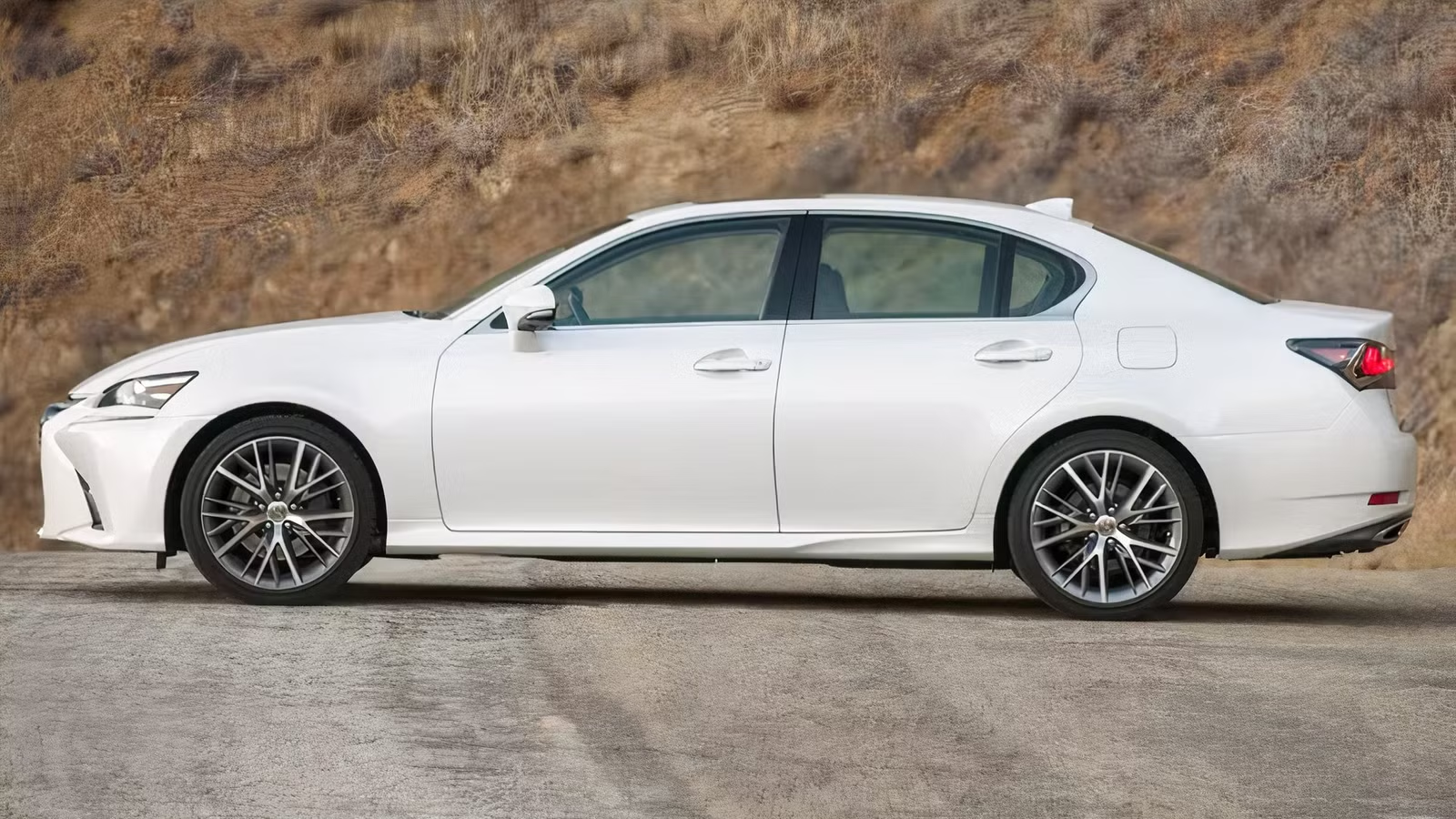
Profile shot of 2020 Lexus GS 350 parkedLexus
As standard, the GS 350 was sold as a rear-wheel-drive sedan, which comes equipped with an eight-speed auto transmission. Choose one of these if you want a sportier, lighter ride. All-wheel-drive was also originally available, which means you get a six-speed and a little more sure-footedness in the wet.
RWD models are likely to be a little more dependable, thanks to fewer moving parts, such as the front differential found on AWD models. However, the AA80E eight-speed and A760H six-speed are both very reliable transmissions. There are fewer parts to go wrong with the six-speed automatic, and it is understressed, while the eight-speed is reportedly very responsive and holds up very well with simple fluid changes.
The GS 350 Still Makes Sense With 100,000 Miles
Front shot of 2020 Lexus GS 350 parkedLexus
Aside from the Toyota engine that has proved itself so many times, the Lexus GS 350 is still worth looking at with 100,000 miles on the clock because it still gets the basics of long-lasting luxury just right. It is not the most tech-laden used luxury sedan on the market, but it has a quiet air of quality that has aged exceptionally well.
GS 350 Maintenance Costs $592 A Year — Half What Most Luxury Sedans Cost
Shot of 2020 Lexus GS 350 interior showing cabinLexus
RepairPal says the average annual maintenance bill for a GS 350 is just $592, making it far cheaper than the $976 a year it costs to maintain the average full-size luxury sedan. They also say that a 100,000-mile service, which includes oil and filter change, leak inspection, and tire rotation, will cost up to $789.
Of course, this doesn’t take into consideration the previous service costs, but if you find a model that has already been maintained up to this point, you do get a lot for your money. Even if you have to carry out the 100,000-mile service yourself (on a model that has previously been well-maintained), it is still cheaper than a 100,000-mile service for a 7 Series ($1,363–$2,280).
Front 3/4 action shot of 2020 Lexus GS 350 drivingLexus
It is not just the mechanical side that holds up; the cabin hasn’t aged badly at all. The final model year gets leather upholstery, wood trim, soft-touch materials, and aluminum detailing, while heated and ventilated seats make it a nice sedan to be in on long trips. There is also a 12.3-inch display, so things don’t look totally out-of-date.
Higher trims are even plusher, with semi-aniline leather, a heated steering wheel, and a 17-speaker Mark Levinson audio system. Legroom is impressive over both rows, at 42.3 inches in the front and 36.8 inches in the back, while a maximum cargo capacity of 18.4 cubic feet gives it the status of luxurious, reliable, and useful. Yes, it does lack the screen-heavy look of new sedans, but its simplicity is part of why it is aging so nicely.
90% Of Owners Would Buy It Again — And Some Are Chasing 400,000 Miles
Front 3/4 shot of 2020 Lexus GS 350 parkedLexus
There are currently 74 owner reviews on Kelley Blue Book (as of September 2026). 90 percent of these owners say they’d recommend buying a final-model-year GS 350, and have rated it 4.7 out of 5 overall. This includes ratings of 4.6 out of 5 for value and styling, 4.7 out of 5 for performance and quality, and 4.8 out of 5 for reliability.
We’d say the final-gen GS 350 would be the age bracket to look at because it has slightly newer tech, but it is not the only generation that is capable of going the miles. According to a discussion onClub Lexus,one owner has claimed to have found a 2007 GS 350 with 267,500 miles on the odometer for sale, while others say they are confident that their GS 350 models will see 300,000 and 400,000 miles. Of course, there will be some repairs to take into consideration with these models if they make it, but it does show a nearly unwavering love for this luxury sedan.
A 100,000-Mile GS 350 Can Still Be Worth Buying
If you are looking at buying a 100,000-mile fourth-gen GS 350, there are some problems to be aware of. Early models are prone to battery drain and infotainment glitches, while noises from the vacuum pump on the engine (both the FKS and FSE) have been reported widely, and lower control arm bushings are prone to wear, which can make the steering a bit vague. On the whole, though, they are considered rather bulletproof.
Despite Lexus’ other-worldly reputation for holding value, now that the final model year of the GS 350 is over five years old, prices are starting to drop very slightly. There are three GS 350 trims to choose from and average used prices (according to Kelley Blue Book) are below $31,000. The base trim ($26,200), the F SPORT ($29,900), and the F SPORT Black Line ($30,100). With the iSeeCars estimated annual mileage of 10,333 miles considered, that means the average 2020 GS 350 should have around 62,000 miles on the clock. That means there is still a great deal of life in them, and even older models, if properly maintained, still have a long way to go before being destined for the scrapyard.
Close-up shot of 2020 Lexus GS 350 F grilleBring A Trailer
The base GS 350 is arguably the best-value choice. It gives you the same 3.5-liter V6 and Lexus-grade quality without paying for the additional sportier hardware on higher trims, making it the version to consider if long-term ownership matters. The higher trims get you more equipment and slightly nicer finishing touches in the cabin, but if it is engine longevity and relatively well-priced luxury you are after, there is no harm in choosing the entry-level model.
The GS 350 can make sense at 100,000 miles because it is made to see the miles with proper Lexus/Toyota design thinking. At 100,000 miles, a lot of luxury cars start making you wonder what is about to go wrong. The GS 350 can make you wonder how many more miles it has left. Buy the right one, keep up with the maintenance, and six figures can look more like the halfway point than the end point.
Base Trim Engine
3.5L V6 Gas
Base Trim Transmission
6-Speed Automatic
Base Trim Drivetrain
All-Wheel Drive
Base Trim Horsepower
311 hp
Base Trim Torque
280 lb-ft @ 4800 rpm
Fuel Economy
19/26 MPG
Make
Lexus
Model
GS
Segment
Midsize Luxury Sedan
Infotainment & Features
6 /10
Sources: Lexus, RepairPal, J.D. Power, iSeeCars, Club Lexus, and Kelley Blue Book.












No Comments