The Used Luxury SUV That Delivers Range Rover Interior Quality At Toyota Money
8 minutes reading
Sunday, 9 Aug 2026 13:00 0 95 autotech
The used luxury SUV market is full of vehicles that lose value fast and vehicles that hold it well, but rarely does one model manage to do both things in a way that actually benefits the buyer. This 2023 Genesis, however, is that rare exception. It has depreciated hard enough to undercut segment norms by a wide margin, yet it still delivers a cabin experience that rivals SUVs costing twice as much. The catch lives in the fine print of its warranty, and understanding that fine print is the difference between feeling ambushed and feeling like you’ve found a genuine bargain.
The SUV in question originally stickered well north of $60,000 in higher trims, loaded with Nappa leather, a 14.5-inch curved display, and a build quality that had reviewers comparing it to Land Rover and Mercedes cabins rather than anything wearing a Hyundai-adjacent badge. Three years later, that same vehicle has a resale value of roughly $32,200, according to Kelley Blue Book’s June 2026 depreciation data. That’s a 37 percent drop in value, which puts a nearly-new luxury SUV in the same price bracket as a fully loaded, brand-new Toyota Grand Highlander.
That’s the number that matters here, and it’s worth sitting with. A three-year-old vehicle that once demanded flagship-luxury money now costs about what a shopper would pay for a top-trim mainstream three-row SUV, fresh off the truck with a full warranty and zero miles. For someone cross-shopping a new Toyota against a lightly used luxury SUV, this SUV’s depreciation curve has effectively erased the price gap between “premium” and “practical.”
2022 Land Rover Range Rover action shot driving along a roadLand Rover
Genesis isn’t alone in depreciating quickly, but a 37 percent three-year drop is steep even by luxury SUV standards, and it’s worth noting depreciation figures vary depending on trim, mileage, and region. iSeeCars’ broader dataset puts its three-year depreciation closer to 21 percent, a meaningfully smaller number. The gap between the two data sets likely comes down to methodology and trim mix, but even at the more conservative iSeeCars figure, this SUV is still shedding value faster than most rivals in its class. The KBB figure and the $32,200 resale number are the ones anchoring this piece, and they hold up as a real, verifiable snapshot of what these vehicles are trading for right now.
The 2023 Genesis GV70 Delivers Range Rover Interior Quality At Toyota Money
Fine Print That Scares Away Buyers, And Why It Creates A Rare Used-Car Bargain
Low angle front 3/4 shot of 2023 Genesis GV70 in red driving on city sreetGenesis
So why is a genuinely excellent luxury SUV like the 2023 Genesis GV70 depreciating at nearly double the rate of some competitors? The answer isn’t build quality, reliability, or brand perception in isolation; it’s warranty structure, and it’s worth understanding exactly how the fine print here works before writing it off as a red flag.
Genesis backs every new vehicle with a 10-year/100,000-mile powertrain warranty, one of the most generous coverage packages in the industry. The catch is that this coverage applies only to the original owner. It is explicitly non-transferable. A second owner buying that same 2023 GV70 doesn’t inherit any portion of the powertrain warranty; instead, they pick up only what’s left of the vehicle’s five-year/60,000-mile new-vehicle limited warranty, a considerably shorter runway that several dealership and industry sources confirm applies to any Genesis changing hands.
2026 Genesis GV70 3.5T Sport Prestige AWD EngineLyndon Conrad Bell | TopSpeed
This is the detail that spooks the used-car market. Shoppers see “no powertrain warranty for second owners” and instinctively price in risk, which drags down resale values across the board. It’s a rational reaction, but it’s also precisely what creates the opportunity here. The warranty gap isn’t a hidden defect discovered after purchase; it’s a publicly documented, easily verifiable structural quirk of how Genesis writes its coverage. A buyer who reads the fine print before signing isn’t walking into a trap; they’re making a calculated trade, accepting shorter drivetrain protection in exchange for a luxury interior at a price point that would otherwise be unreachable. That’s an informed decision, not an ambush, and it’s the entire reason this particular depreciation curve is worth exploiting rather than avoiding.
Inside The Genesis GV70 Cabin: Luxury That Punches Far Above Its Price
Interior dashboard view in the 2023 Genesis GV70Genesis
Interior view in the 2023 Genesis GV70Genesis
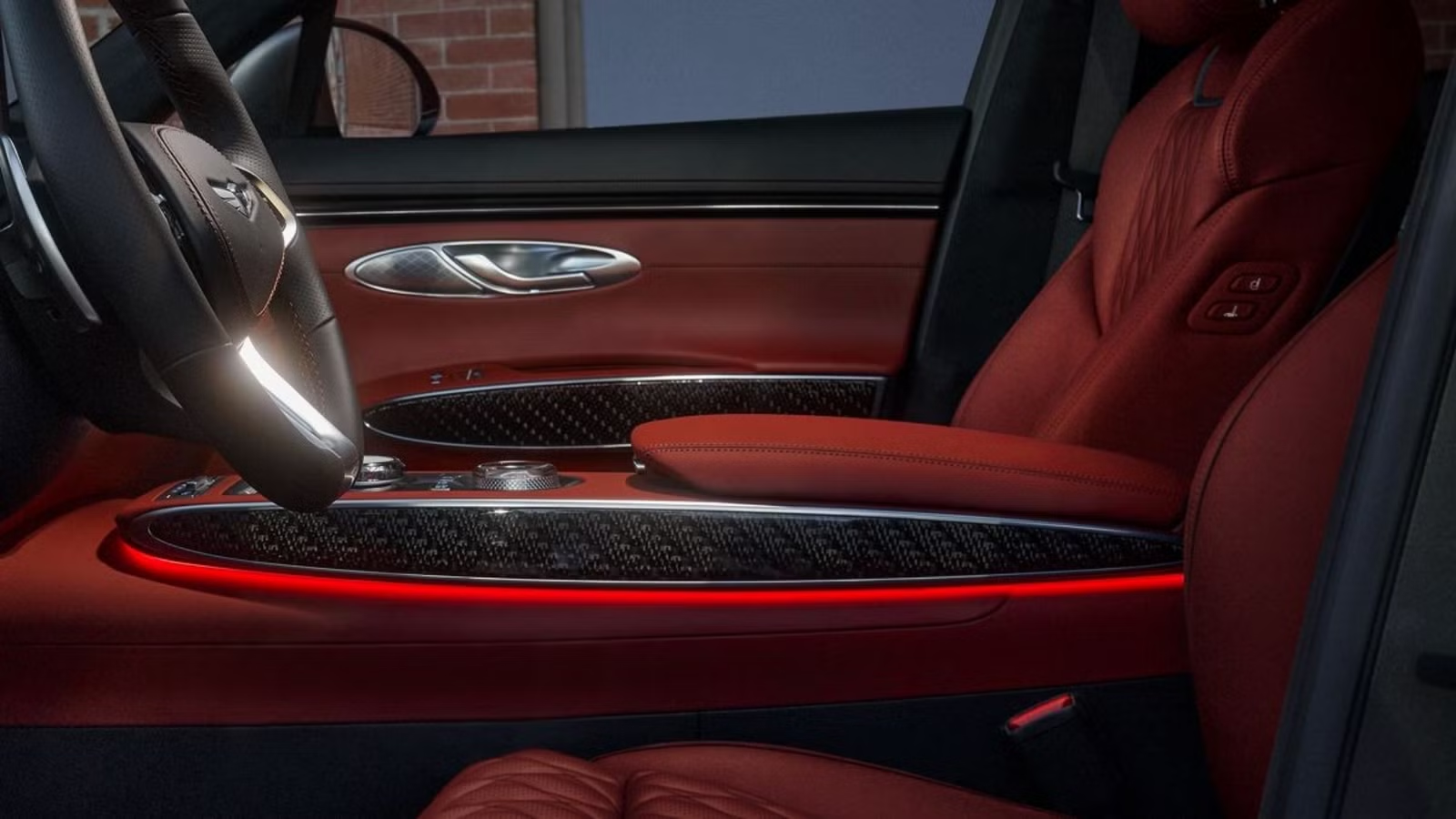
Step inside a Genesis GV70, and the $32,200 asking price starts to feel almost absurd. The cabin was designed to compete directly with Range Rover, Mercedes-Benz, and Porsche, and in a lot of ways, it succeeds. Nappa leather upholstery, open-pore wood trim, and knurled metal switchgear give the interior a tactile richness that mainstream three-row SUVs simply can’t match at any price. The 14.5-inch HD display integrates navigation, media, and vehicle settings with a crispness that still looks contemporary years after launch, and the crystal-finish rotary shifter remains one of the more memorable interior touches in the segment.
Material quality aside, the GV70’s cabin also benefits from genuinely thoughtful ergonomics: a low, wide dashboard, excellent forward visibility, and seats that offer the kind of long-distance comfort usually reserved for vehicles costing considerably more. Road and wind noise are well suppressed even at highway speeds, reinforcing the sense of occupying a genuinely premium space rather than a value proposition dressed up to look like one. For a buyer coming out of a mainstream SUV, the jump in perceived quality is immediate and obvious the moment the door closes, and that’s before accounting for the fact that this same experience, new, would have cost tens of thousands more.
Where The GV70 Stands Against The Lexus RX And Other Used Luxury SUV Rivals
A Red 2023 Lexus RX 350h Parked Side OnLexus
The comparison point that matters most here is the Lexus RX, the used luxury SUV benchmark for resale strength. Kelley Blue Book’s data on the 2023 Lexus RX shows a 27 percent depreciation over three years, with a current resale value around $37,600. That means the RX is retaining meaningfully more value than the GV70, roughly ten percentage points less depreciation, and commanding a resale premium of over $5,000 for a directly comparable model year.
That gap is exactly the arbitrage this piece is built around. The RX earns its stronger resale through Toyota-backed reliability reputation and a warranty structure that doesn’t create the same second-owner penalty. But that reputation comes at a real dollar cost to buyers purchasing used, since the RX’s stronger residuals mean less relative bargain for the same money spent. The GV70, dragged down by its non-transferable powertrain coverage, is priced to reflect a risk that a well-informed buyer can manage, while delivering a materially richer cabin experience than the RX’s more conservative, Toyota-influenced interior design.
Rear three-quarter view of a red 2023 Genesis GV70Genesis
Other rivals in this depreciation-driven used luxury bracket — think Genesis’s own GV80 in shorter supply, or aging Audi Q5 and Volvo XC60 trims — tend to either cost more at comparable spec or fall short of the GV70’s interior richness. None currently combine steep enough depreciation with cabin quality this strong to create the same value gap.
Who Should Buy A Used Genesis GV70, And When The Warranty Trade-Off Is Worth Making
Rear seats in the 2023 Genesis GV70Genesis
This deal isn’t universal, and the buyer profile matters as much as the price. The sweet spot is a GV70 with somewhere between 20,000 and 35,000 miles on the odometer, since that’s the range where a meaningful chunk of the inherited five-year/60,000-mile new-vehicle warranty is still intact, typically leaving one to two years and 25,000-plus miles of coverage on non-powertrain components even after the powertrain protection has effectively reset to nothing for the second owner.
The ideal buyer is someone financially prepared to self-insure powertrain risk, whether through a healthy emergency fund, a third-party extended warranty purchased at the point of sale, or simply a track record of driving Hyundai/Genesis-family vehicles without major drivetrain issues, a group with a genuinely strong reliability history despite the warranty asterisk. This buyer also tends to value cabin experience and daily comfort more than badge-driven resale confidence, someone who wants to feel like they’re driving something special every day rather than optimizing purely for lowest lifetime cost of ownership.
Side profile of a white 2023 Genesis GV70Genesis
Buyers who should think twice are those planning to keep the vehicle for 10-plus years or 150,000-plus miles, where the absence of extended powertrain coverage carries more real financial exposure, or shoppers who prioritize resale certainty over present-day luxury. For everyone else, the GV70 in the $30,000s represents one of the more legitimate value plays in the used luxury SUV market right now: eyes open, fine print read, and a cabin that punches well above its price tag.
Base Trim Engine
2.5L Turbo Inline-4 Gas
Base Trim Transmission
8-Speed Automatic
Base Trim Drivetrain
All-Wheel Drive
Base Trim Horsepower
300 hp
Base Trim Torque
311 lb-ft @ 1650 rpm
Fuel Economy
22/28 MPG
Make
Genesis
Model
GV70
Segment
Compact Luxury SUV
Infotainment & Features
9 /10
Sources: Genesis, iSeeCars, Caredge, Kelley Blue Book











No Comments