
The Suzuki 4×4 That Became A Global Legend Without Ever Needing Big Power
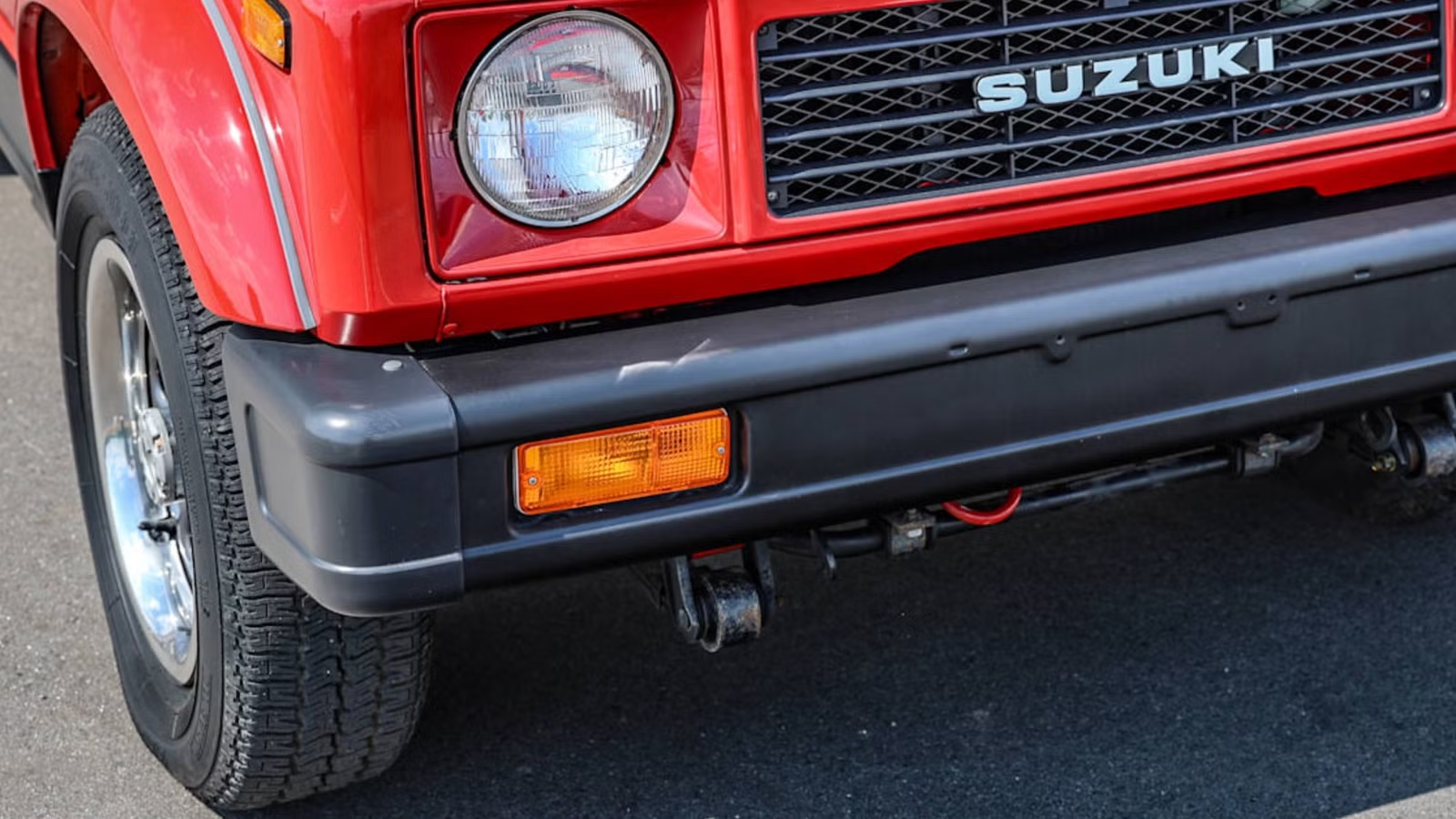
Most Americans associate the Suzuki brand with motorcycles and ATVs but, as mind-blowing as it may seem, the Japanese manufacturer was actually selling four-wheeled passenger vehicles here until 2012. While the U.S. market proved difficult for Suzuki, they have a great reputation worldwide with their lineup of compact cars, vans, and SUVs. One of their 4x4s, which had a brief presence in the States, is a global off-road superstar that has enthralled the planet, despite never having any kind of power under the hood. Suzuki stumbled upon the right formula of a compact four-wheel-drive sport ute with just enough power to get the job done, but not so much that it would price-out most of Earth’s inhabitants.
Looming Conflict For Suzuki

As unlikely as it sounds, Suzuki started out making looms for the silk industry, and was quite successful at it, but wanted to diversify and began developing a compact passenger car. Then, WWII broke out and the Japanese government determined that civilian vehicles were non-essential and banned their production before Suzuki could get one to market. Mitsubishi built the Zero fighter aircraft that bombed Pearl Harbor, and Toyota, Nissan, Isuzu, as well as Kawasaki manufactured weapons of war, but Suzuki never contributed a thing to Japan’s losing effort. After the war, Suzuki finally got their car out with the 1955 Suzulight. It was a compact front-wheel-drive car with a 360cc two-stroke, two-cylinder engine that featured radical innovations for the time, such as four-wheel independent suspension and rack and pinion steering.
Suzuki M.C.

Suzuki first got into the motorcycle game in 1952 with a 36cc one-horsepower, two-stroke engine that was attached to a two-wheel bicycle and was, given its output, unironically named the “Power Free.” In 1954, they got a little more serious with the motorcycle and introduced the Colleda CO with a three-horsepower 90cc four-stroke one-cylinder engine. Rather than just a bike with a motor, this was a framed motorcycle with a three-speed rotary gearbox, telescoping forks, teardrop fuel tank, and kick-starter. The name “Colleda” most likely comes from the Japanese phrase kore da, which means “This is It!” or “This is the one,” and that seems accurate, since it was one of the few true motorcycles available. Suzuki chose 90cc as the displacement, because the law at the time allowed riders to operate a motorized bike of that size without a special license.
Jumpin’ Jimny! It’s a Suzuki Light Jeep

In the late 1960s, Suzuki acquired the rights and tooling for the HopeStar ON360, a very tiny off-road vehicle made by the struggling Hope Motor Company. They tweaked the design and in 1970 started selling it as the Jimny LJ10, or Light Jeep 10. As for the name Jimny, it’s probably a portmanteau of “Jeep” and “Mini”, which fits as it was a mini-Jeep that found an open gap in the car market. It was the first four-wheel-drive kei car, which is the smallest category for Japanese street-legal rides, that comes with certain tax breaks and other advantages. To keep the Jimny’s overall length within the three-meter kei car standard, Suzuki located the spare tire inside the vehicle, making it a three-seater. The Jimny started out with a 24.7-horsepower air-cooled 359cc two-cylinder, but was upgraded to a 27.6-horsepower liquid-cooled version. For export, starting in 1975, the Jimny was equipped with a 32.5-horsepower 539cc inline-three. The first-gen Jimny was a smash success in Japan, and as the decade wore on, it began to conquer the world, despite having very modest performance.

Suzuki Samurai Invades America

The Jimny made a splash in the Pacific Rim, Northern Europe, South Africa, and South America, where its rugged off-road capabilities and affordability really caught on, but Suzuki realized they had to penetrate the U.S. market if it was to truly be a global sensation. In 1985, the Jimny hit the American shores for the 1986 model year as the Suzuki Samurai, and like everywhere else on the planet, it was an instant hit. Off-roading was really starting to take off as a hobby in the ’80s and the 4×4 Samurai was capable, reliable, and most importantly cheap. Starting at just $6,550 ($19,963), it was around two-thirds the price of a new 4WD Jeep Wrangler (introduced in 1987), as well as being lighter and more nimble on the trail. Sales of the Samurai hit 100,000 units in 18 months, making it one of the most successful Japanese vehicle debuts ever. Because it was a compact and capable machine, it also became popular as a street vehicle, and is one of the iconic vehicles that defined the ’80s.
Samurai Spec Sheet

The Samurai came equipped with a 63-hp, 74 lb-ft 1.3-liter inline-four engine, paired with a five-speed manual transmission. With its modest engine output, many people initially dismissed the Samurai, but because it was so light, with a curb weight of around 2,000 pounds, it had a surprisingly strong power-to-weight ratio. It was a part-time four-wheel-drive ride with a two-speed transfer case and manual locking front hubs. Coming stock with 8.3 inches of ground clearance, this compact 4×4 had excellent visibility, extremely short overhangs (~35° approach, ~46° departure), and a very tight turning radius, making it a capable off-roader. The solid axle with leaf springs in front and back suspension got an upgrade in 1988 with softer springs, better shocks, as well as a beefier anti-roll bar. Not that it made much of a difference, but the I-4 gained an additional 3 hp in 1990.
Roll-Over Rumors Mark The Last Samurai

After questionable testing, Consumer Reports published an article in July 1988 “Warning: The Suzuki rolls over too easily” in which they alleged that during emergency maneuvers, the Samurai would roll over. Suzuki countered with a lawsuit that showed CR testers intentionally tried to flip the Samurai until they got the rollover results, and that the trials did not represent anything that was likely to happen in the real world. The controversy drew in the National Highway Traffic Safety Administration (NHTSA), which determined that the Samurai was not any more likely to roll over than any other SUV and that the tendencies were well within the acceptable range. Unfortunately, the Samurai’s reputation suffered, as it became a running joke on late-night TV and in popular culture. Sales dropped dramatically in 1989 and sputtered along until 1995 when Suzuki finally pulled the plug on it. As for the lawsuit, it was eventually settled with no money changing hands and neither party admitting to wrongdoing.
Jimny Still Jumping Overseas

Despite fizzling out in the U.S., due to what many consider an unfair media campaign, the Suzuki Jimny continued to thrive everywhere else on the planet. The third-gen from 1989-2018 featured a redesigned body with smoother aerodynamics, a 3-link coil suspension for a smoother ride, the addition of an automatic transmission, and up to 85 horsepower from the 1.3-liter I-4. The fourth-gen Jimny, launched in 2018, brought the iconic subcompact 4×4 up to modern standards with tech goodies galore, from an infotainment system to driver-assist safety features. With the exception of North America and Europe, the Jimny is still available in most of the world, and continues to impress with sales of over a half-million since 2018. The latest iteration of the Jimny has graduated to 101 hp, which is still not extraordinary, but the fact that so many people want one after a half-century, despite the lack of big-time power, is a testament to its inherent and enduring appeal.
Why the U.S. Needs a Samurai Reboot

The brilliance of the Suzuki Samurai was its affordability, reliability, but also that it was mechanically simple, which made modding it a breeze. There really isn’t anything available in the U.S. that matches everything the Samurai brought to the table in the mid-’80s, and there is clearly a market for an affordable, customizable 4×4. The Jeep Renegade came closest, but it lacked the key qualities that made the Samurai such a capable off-roader, and it is not even produced in America anymore. Recreational off-road vehicles are more popular than ever, and if there were something like a Jeep Wrangler with a Kia Soul price tag, it would be a massive hit. The Suzuki Jimny is that exact vehicle, and retro ’80s is huge right now, so if the Samurai were to make a comeback in America, it would be more than welcome.
Suzuki Samurai Prices And Values

For those unwilling to hold their breath until the Jimny returns to our shores, used ones are shockingly and delightfully cheap. Hagerty puts a fair condition value on the 1986 Samurai at between $3,100 for a fixer-upper to just $30,500 for a Concours condition showpiece. J.D. Power, which bases its prices on real world sales, has even better news for collectors with a high retail value of only $3,325. The most expensive Samurai sold at a Mecum auction is a highly-original 1990 JL with less than 10,000 miles on the odometer that sold for $27,500 in 2026. Bring a Trailer has sold some astonishing custom Samurais for under $10,000, and their top seller was a low-mileage 1987 JX that went for $24,500 in 2025. For the record, some OG Jimnys were actually imported to the U.S. and they too are extremely affordable, with a 1972 model that sold for $27,500 in 2022 being the cap. The fact that it is possible to get one of these in perfect condition with a 4-inch lift and 15-inch wheels for less than $10,000 speaks to the enduring value proposition of the Samurai.
Sources: Bring a Trailer, Hagerty, J.D. Power, Mecum, Suzuki

Related posts

Latest Post


No Comments