
Dodge Dropped A 345-HP Dual-Quad Big-Block Into A Sedan Five Years Before The GTO
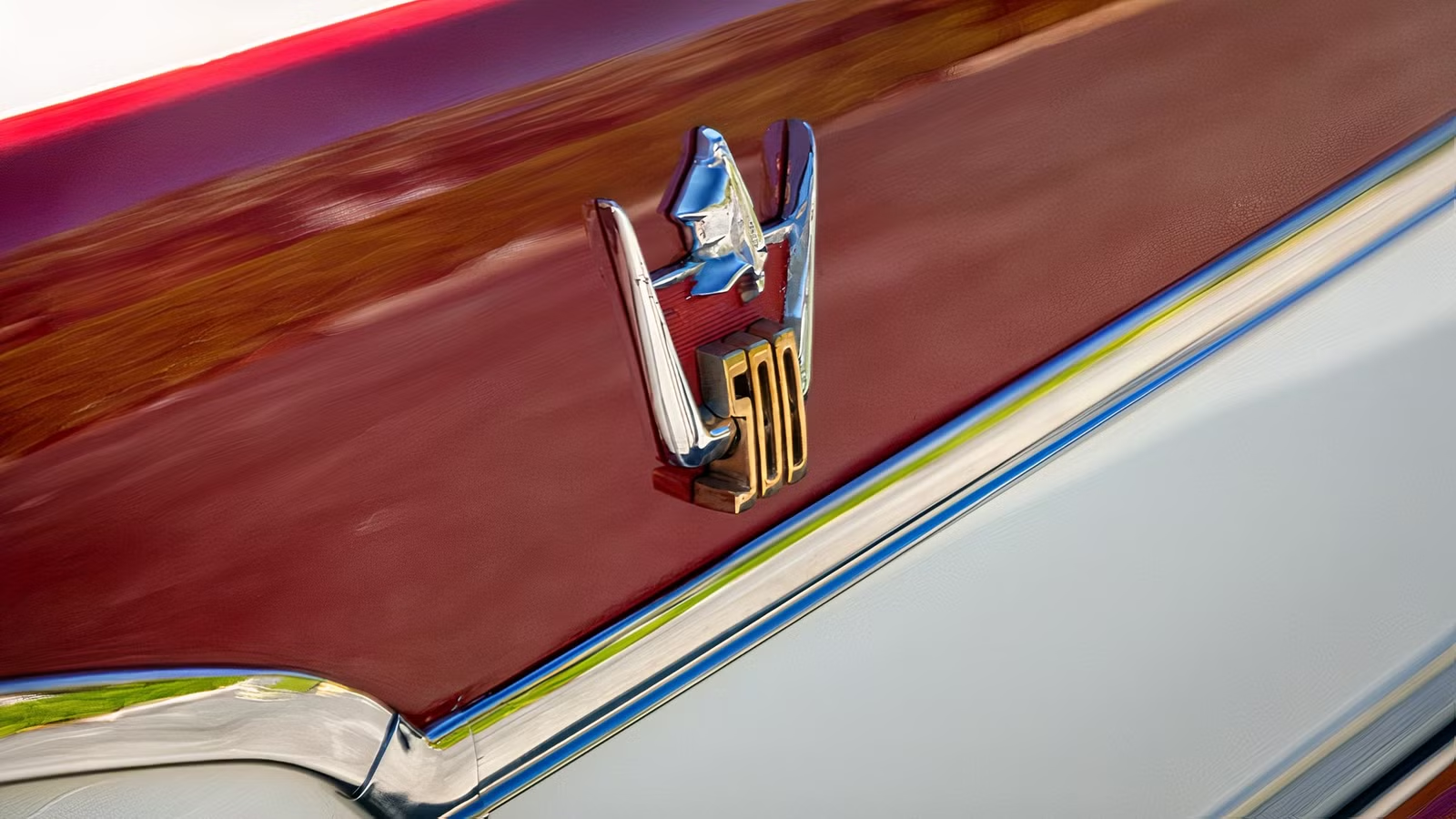
Imagine it’s 1959, and you pull up next to a big sedan with tall fins. You recognize the badge: It’s just a Dodge, so it’s not packing the big “FirePower” Hemi, like the Chryslers do. Then the light turns green and Wham, the car takes off. You just tried to drag race the first muscle car. If you think the 1964 Pontiac GTO was the first muscle car, think again. Mopar was putting big power in mid-market models five years earlier.
Pontiac Fans Will Tell You The GTO Got There First

By the 1964 model year, Detroit was certainly selling performance vehicles. But for the most part, they were limited to the “personal luxury car” segment. Think of the Chrysler 300, Chevrolet Corvette, and Ford Thunderbird. Many made big horsepower, but at a cost. They were top-trim vehicles targeted at the top of the market.
Pontiac debuted the GTO package for its Tempest in 1964. Purists were incensed that the Detroit automaker dared swipe a badge normally reserved for Ferrari. But Car and Driver leaned into the comparison. Though the magazine wasn’t able to organize a direct head-to-head between the Ferrari and the Pontiac, its editors did extensive reviews of both cars. They admitted the two cars had different purposes: “The Pontiac will beat the Ferrari in a drag race, and the Ferrari will go around any American road circuit faster.” In fact, the Pontiac raced to 100 mph in 11.8 seconds.

The new Pontiac was a nimble midsize coupe with a 389 cubic-inch 348 horsepower V8. Many enthusiasts consider this moment the birth of the muscle car segment. But the truth is that Dodge dropped a 345-hp V8 in a mid-trim car five years earlier.

Mopar’s First Hemis Were For Luxury Buyers Only

Mopar debuted its first V8 with hemispherical combustion chambers for Chrysler’s 1951 model year. The “Firepower” V8 (now known as the first-gen Hemi) borrowed the shape of its cylinder heads from an experimental 2,500 hp V16 the company had developed to replace the P-47 Thunderbolt’s radial engine during WWII. The hemispherical combustion chambers increased valve size and improved airflow. And the new V8 was limited to Chrysler Corporation’s luxury cars.
Privateer racing teams took the new engine to the 24 Hours of Le Mans, clocking a faster average speed than the Mercedes-Benz 300SL. When Chrysler folded its racing-developed technology back into the street engine, it broke 300 hp. The 1955 Chrysler C-300 model was actually named in honor of this achievement.

The resulting “banker’s hot rod” was such a hit that it inspired the personal luxury car horsepower wars of the 1950s. Ford debuted the 1958 Thunderbird with a 300-horsepower rating. In 1958, Cadillac tuned the Eldorado’s 365 V8 to break 300 hp as well.
But if you couldn’t afford one of these luxury machines, you had to watch the budding horsepower wars from the sidelines. Then, in 1959, Chrysler Corporation changed the market forever.
The 1959 Dodge D-500 Was The First Muscle Car

By 1958, Chrysler Corporation was ready to roll out the Firepower V8’s lightweight replacement. The “B” engine was a big block V8 with wedge-shaped combustion chambers. It debuted with a 350 ci and 361 ci displacement. The bigger V8 (with a 4.125-in bore and 3.375-in stroke) peaked at 320 bhp.
For 1959, Chrysler debuted a version of the 361 that used a 4.030-inch bore and a 3.750-inch stroke to hit a 383 ci displacement. Chrysler Corporation may have been tempted to limit this new engine to its Chrysler 300, which had morphed into the 300 “letter series” in the years since the C-300. But instead, it offered the new 383 in every single Dodge available with a V8.

Buyers could order the full-size, entry-level Dodge Coronet, mid-trim Royal, and top-tier Custom Royal with either tune of the 383 V8. Both tunes adopted the D-500 badge that Dodge had used in previous model years (though for different engines). The base “D-500” tune used a single 4-barrel carb to make 320 hp at 4,600 rpm and 400 lb-ft of torque. The “Super D-500” used dual 4-barrel carbs to make 345 hp at 5,000 rpm and 420 lb-ft.
Mopar Muscle Cars Have A Long History

The Super D-500 1959 Dodges were pioneers, bringing 345 horsepower performance to even entry-level full-size sedans. Sure, the 1959 Chrysler 300E’s 413 wedge V8 made 380 hp. But the luxury car would set you back at least $5,319 for a hardtop (and $5,749 for a convertible). Meanwhile, the Coronet V8 started around $2,707 and the Super D-500 package added about $466 to that. At $3,173, the Super D-500 Coronet was less than two-thirds the top-trim Chrysler’s price.
Chrysler Corporation also sold cheaper full-size cars through Plymouth. But according to Over Drive Magazine, Plymouth’s 1959 “Golden Commando” tune of the 361 V8 was rated for just 305 hp. Buyers would have to wait a few more years for the legendary days of Plymouth muscle.

A 1959 Dodge Coronet wasn’t a svelte midsize like many 1960s muscle cars. But in 1959, stuffing a V8 in anything smaller than a full-size sedan represented a real engineering challenge that Chrysler Corporation wasn’t ready to take on. Heck, even the Corvette debuted with an I6.
At the end of the day, the 1959 Dodge Super D-500 was the first muscle car. It offered V8 engine output that had previously been reserved for luxury vehicles to the everyman in base trims. Heck, you could even order a D-500 “Sierra” or “Custom Sierra” station wagon.
The public went gangbusters over the new 383 cubic-inch V8. In fact, the factory building them couldn’t keep up with demand. Chrysler Corporation did some quick math and came up with a very creative solution. The company reduced the bore of the big 413 it had engineered for its Chrysler 300s to build more V8s that were technically 383 cubic inches. The result was the “raised block” 383 (4.031-in bore and 3.75-in stroke) installed in some Chrysler Windsors and Saratogas that had been ordered with a “383” engine.
The Dodge D-500 Is A Muscle Car Legend

Chrysler Corporation never released production numbers on the 1959 Dodge D-500 and Super D-500. We don’t even know for sure how many 383 V8s drivers bought that year. We do know that Dodge produced 151,851 vehicles for the 1959 model year. About 15,600 of those had a six-cylinder engine, while around 136,200 were equipped with a V8.

VIN M352107882 is a red and white 1959 Dodge Custom Royal Convertible. It was originally optioned with the Super D-500 package. Mecum Auctions claimed it was “1 of 984 produced for the 1959 model year” when it sold for $165,000 in 2025. That’s muscle car royalty.
VIN M374104525 is an even rarer piece of automotive history. It’s a 1959 Dodge Sierra Wagon finished in pink and optioned with the D-500 package. Mecum claimed it was “1 of an estimated 30 D500 wagons built in 1959” when it went up for auction in 2019. I’m shocked it went for $27,500. Someone is driving around in a muscle wagon legend at a bargain price.
Sources: Over Drive Magazine, Muscle Car Club, Dodge

Related posts


Latest Post


No Comments