When we buy a sports car, we don’t always think about keeping it for a long time. Picture it: you’ve just bought a sports car, the weather is good, you spend all summer driving it, you look at how much you have spent on gas and repairs, and then you realize you can’t use it for much more than an inconvenient mode of transport in the winter. You then sell it. We have seen it countless times before, even with some of the best sports cars, but this Japanese model is different. Owners just don’t get rid of it.
Sports cars are usually bought with the heart and sold with the head. A Ferrari 458, certain Porsche 911 models, or an Acura NSX can become a prized possession because rarity and collector demand become part of the equation.
There is another type of sports car that is easily overlooked: ones that don’t need to become collectible to survive years and years. Models like the Toyota GR86 aren’t particularly exotic, and Toyota hasn’t built it as some limited-run halo car. It is simply a small, rear-drive coupe with an NA engine under the hood, a six-speed manual box, and a starting price tag of just over $30,000.
2027 Toyota GR86 side action shotToyota
It is a formula that is getting harder to find today, and the GR86 is one of the few new cars that give us a truly affordable route into a traditional sports car setup without needing to spend Corvette money or buy a luxury coupe. It is one of the cars that also shows why certain cars get such a cult following: there is very little between you and the mechanical bits that make them entertaining. This Mazda hits that sweet spot better than most, and it has for the last 30+ years.
The Mazda MX-5 Miata Became The Sports Car Owners Keep Forever
Front 3/4 action shot of 2023 Mazda MX-5 Miata driving on roadMazda
Since gracing our roads in 1990, the Mazda MX-5 Miata has been a constant sports-car presence. We are now in the fourth generation of this iconic, lightweight, fun sports car. The NA Generation ran from 1990 to 1997, the NB Generation ran from 1998 to 2005, the NC Generation ran from 2006 to 2015, and the current generation, the ND Generation, started life in 2016 and is currently ongoing.
It is not just the number of owners we see on the road with an MX-5 (of all ages), but according to iSeeCars, it is the sports car that owners are most reluctant to let go of. 7.6 percent of MX-5s make it to 15 years with their original owners, compared with just 4.1 percent of sports cars overall. This makes it the longest-kept sports car on the market.
Lightweight Fun Keeps The Miata Feeling Special
Front 3/4 action shot of 2025 Mazda MX-5 Miata driving on roadMazda
Insane power has never been the aim for the MX-5 Miata. Its driving character comes from rear-wheel drive, a lightweight build, decent manual transmissions, and usable power. The heaviest generation of the MX-5 is the NC (“the boat”), which tips the scales at between 2,450 and 2,590 pounds (with the PRHT models weighing the most, thanks to the folding hardtop mechanism).
The NA Generation weighs in at between 2,100 and 2,200 pounds; the NB Generation, between 2,260 and 2,470 pounds; and the current ND Generation, including the 2026 MX-5 Miata, between 2,150 and 2,350 pounds. All of them are lighter than most sports cars, and that matters when you don’t have a massive engine to rely on.
2026 Mazda MX-5 Miata Making A TurnMazda
Mazda generally targets 50:50 weight distribution for the MX-5, keeping the front and rear evenly loaded for predictable turn-in and ride balance. The real fun is when you combine what comes from that. There simply isn’t much to overwhelm the tires, brakes, or suspension, so the MX-5 can make tepid speeds feel very exciting. It also means you can actually use more of what the car has.
You don’t need a runway or racetrack to enjoy driving it. You can work the chassis through tight corners, lean on the throttle, feel the rear end squirm, and still be operating within legal limits. It’s an old-school sports car recipe, really: put the weight in the right places, keep the center of gravity low, give enough power to play with, and resist the temptation to bolt another 500 pounds of gear onto it. That’s why the MX-5 has survived; Mazda continues to understand that speed isn’t the only way to make a car fun. A TopSpeed review of the 2022 MX-5 Miata (ND) sums it up nicely.
So, does the MX-5 live up to its reputation? In short, it does. It offers one of the best driving experiences in the automotive world and is quite an affordable sports car as well. I now understand why enthusiasts enjoy driving this car on any occasion. Even having one as a daily driver doesn’t stop some people I know.
Affordable Ownership Makes The Miata Easy To Hold Onto
Rear three-quarter shot of a 2025 Grey Mazda Miata MX-5 parked by a beachMazda
Not only is the Miata one of the most affordable new sports cars today, but it is estimated to keep ownership costs down in the long run. The 2026 MX-5 Miata has a starting price of between $31,665 for the MX-5 Miata Sport and $43,730 for the MX-5 Miata Club RF. So, not the most expensive, but still exceptionally entertaining. However, when it comes to long-term costs, there isn’t much in the class that beats it.
Rear 3/4 shot of 2023 Mazda MX-5 Miata parkedMazda
RepairPal estimates it will cost you, on average, $429 a year for maintenance; CarEdge says it will cost you, on average, $2,071 a year to insure a Mazda model, or $369 cheaper than other popular brands; and iSeeCars estimates that an MX-5 will depreciate by just 30.8 percent in the first five years, or by around $12,500.
The Miata’s Deliberately Simple Engineering Is The Real Secret To Its Longevity
Profile shot of 2026 Mazda MX-5 Miata RF in white parkedIan Wright | CarBuzz | Valnet
For NA-gen models, either a 1.6-liter inline-four good for 116 horsepower or a 1.8-liter inline-four good for up to 133 horsepower sits under the hood. The NB-gen gets either a 140 or 142-horsepower 1.8-liter inline-four under the hood, while the limited run of the Mazdaspeed between 2004 and 2005 has, to date, provided us with the only factory-built turbocharged MX-5.
The NC-gen is equipped with a 170-horsepower 2.0-liter inline-four, and the current generation is equipped with a 2.0-liter Skyactiv-G inline-four that shifts out 181 horsepower and 151 pound-feet of torque. Power output has never been its forte, but the MX-5’s engines have generally avoided the sort of complicated tech that can turn aging sports cars into financial pits.
Close-up shot of 2023 Mazda MX-5 Miata engine bayMazda
Older models are very well catered for by enthusiast communities, and there is a huge wealth of replacement parts and owner knowledge around to help you keep an MX-5 on the road rather than scrapping it. It makes you want to get your hands dirty. You generally don’t need a specialist workshop every time a suspect noise appears, and that really makes a difference when the years start to rack up. There’s nothing really exotic about the MX-5, for any year, and that is one of the biggest reasons so many have managed to stick around.
Like we find with many long-lasting cars, the MX-5 has been kept simple over the years, but incrementally tweaked. The NA is equipped with double wishbones at all four corners, giving you nice control of camber, toe, and wheel movements. The NB still gets the basic layout but is fitted with revised suspension geometry and stiffer components.
The NC gets a three-link multi-link rear, while the ND returned to a compact, lightweight rig, with double wishbones up front and a multi-link rear. Importantly, none of the systems are needlessly complicated.
Front shot of 2026 Mazda MX-5 Miata RF in white parkedIan Wright | CarBuzz | Valnet
Then there are the electrics. Modern MX-5s are equipped with ABS, traction and stability control, airbags, and all the safety gear you’d expect today, but there aren’t loads of active systems to go wrong. No adaptive suspension, torque-vectoring all-wheel drive, or hybrid rigs to get between you and the chassis.
That means fewer things to diagnose and fewer electronic layers getting in the way of the old-school mechanical work that we like to feel in our hands and underfoot. In short, it is still very fun yet easy to care for.
Proven Reliability Gives Owners More Reasons To Keep It
Front 3/4 shot of 2000 Mazda MX-5 Miata (NB) in greenBring A Trailer
Sports cars don’t generally have the best reputation for being reliable, but again, thanks to the years of refinement and a relatively simple build, the MX-5 is a class of its own. iSeeCars rates the MX-5 Miata 8.8 out of 10 for reliability, says it has a 4.1 percent chance of reaching 200,000 miles, and an average lifespan of 145,900 miles. The BMW Z4 has an average lifespan of 84,100 miles and a reliability rating of 7.1 out of 10.
There is a catch to the MX-5’s long ownership time, though. Despite being one of the best to drive, it is the least driven car in the U.S. per year, with an average of just 5,073 miles driven. We wouldn’t say this has anything to do with the car not being enjoyable to drive or with people being scared it will break, but rather with the fact that it is definitely more suited to being driven in the summer or on weekends.
Rear 3/4 high-angle shot of 2025 Mazda MX-5 MiataMazda
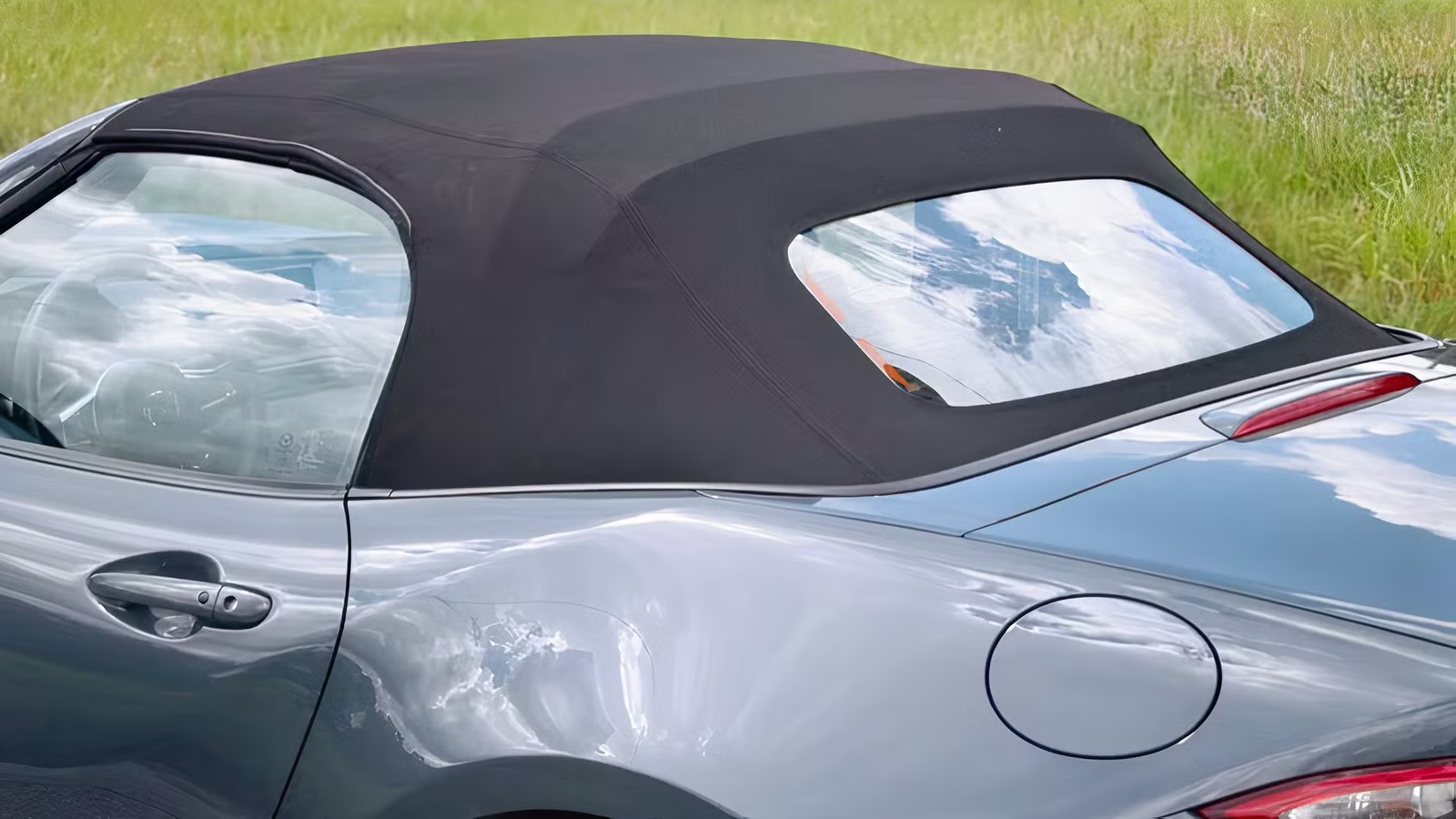
Regardless, all generations of the MX-5, despite problems with sill and underbody rust, seized brakes, soft top rotting, and some reported oil leaks, are well-received by their owners for dependability.
The MX-5 Miata Is The Sports Car Worth Holding Onto
Front 3/4 shot of 2023 Mazda MX-5 Miata parked on roadMazda
If you are looking for a sports car that can truly double as a family mover, we’d suggest looking for something like the BMW 3 Series or the Cadillac CT4. If you are looking for all-round cheap ownership and old-school guts, there isn’t much like an MX-5. At the time of writing, according to Classic.com, the average auction price for a NA-gen model is $12,459; for the NB-gen, $13,374; for the NC-gen (excluding the Mazdaspeed model), $15,531; and for the current-gen, $25,463.
The MX-5’s appeal isn’t from being the quickest, the flashiest, or the most exotic. The same basic qualities that make an NA-gen model appealing still make today’s version appealing; Mazda got it right then and still does today.
Profile shot of 2025 Mazda MX-5 Miata interior shot showing front seatsMazda
Newer sports cars are getting heavier and faster, but the MX-5 has remained something rather unusual in the modern auto market: a model whose best features are ones that will age the best and not become obsolete when something new comes along. You know what you are getting here. The original MX-5 models were fun to drive and easy to care for, and little has changed today.
Base Trim Engine
2.0-liter I4
Base Trim Transmission
6-Speed Manual
Base Trim Drivetrain
Rear-Wheel Drive
Base Trim Horsepower
181 HP @7000 RPM
Base Trim Torque
151 lb.-ft. @ 4000 RPM
Make
Mazda
Model
MX-5 Miata
Segment
Sports Car
Sources: Mazda, iSeeCars, J.D. Power, Classic.com, FuelEconomy.gov, CarEdge, and Kelley Blue Book













No Comments