
The Soviet 4×4 That Beat The Jeep Cherokee XJ To The Unibody Coil-Sprung Formula By Seven Years
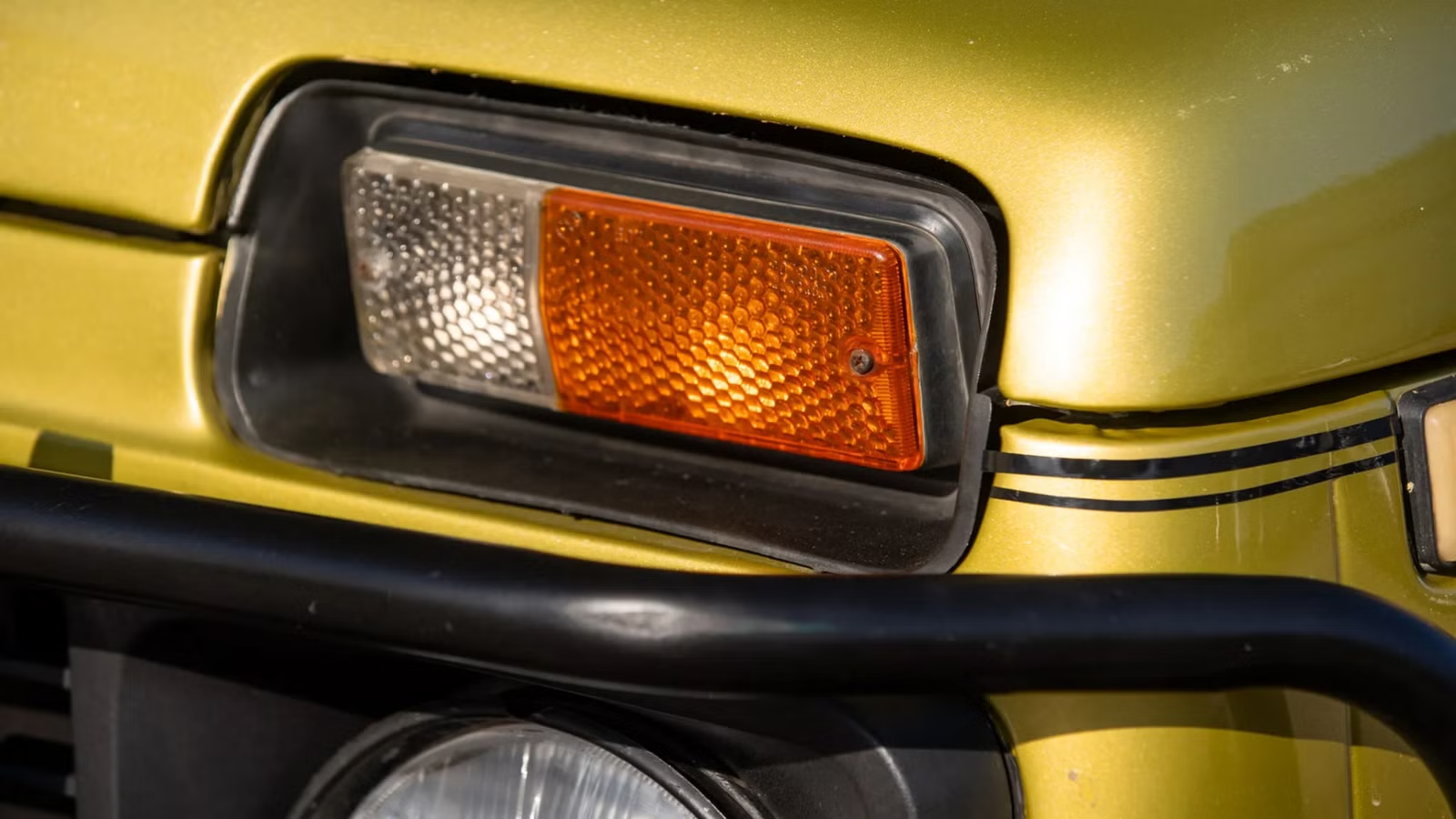
The 1984 Jeep Cherokee XJ gets credit for inventing the compact unibody 4×4, and it earned that as the first American unibody compact SUV, whose pattern plenty of imitators followed. The formula was simple: a car-like unibody shell, coil springs, a real low range, and a footprint small enough to park downtown.

Every account of how the modern crossover got serious starts in Toledo, in 1984, with AMC engineers who wanted a Jeep that didn’t drive like a truck. That account is seven years late, and the manufacturer that got there first shipped hardware the Jeep never received.
The 1984 Jeep That Set The Standard For Every Modern Crossover
Jeep launched the XJ Cherokee in 1984 as its first unibody model, but the work started six years earlier. American Motors and Renault engineers began sketching in 1978, working from clay models and leaning on European styling cues.

Rollover risk was the sticking point, so AMC’s Gerald C. Meyers brought in Ford engineer Roy Lunn to solve it. Lunn’s answer was Quadra-Link, which located the live front axle with four leading control arms, two above and two below, to limit both fore-aft movement and axle rotation under acceleration and braking.
A Panhard rod located the axle side to side, and the coil springs sitting on top of the housing were the first ever fitted to a Jeep front suspension. French automotive engineer François Castaing handled the drivetrain and built it around a much smaller engine than four-wheel-drive vehicles normally carried, which cut weight.

The result was an SUV that weighed barely 3,000 pounds, light enough that even the four-cylinder was enough for light work. Unibody construction did the rest, trimming mass, improving fuel economy, and freeing up cabin space.
Leaf springs at the rear held up the back of every XJ built between 1984 and 2001, four-leaf packs with a fixed eye at the front and a shackle at the rear. Solid axles sat at both ends, which meant the coil-sprung comfort only ever applied to half the car.
None of that dented the reputation, and Jeep sold the XJ in nearly every country in the world. The profile stayed recognizable from the first year to the last and is beginning to rise in value in the used market today.
The Lada Niva Beat The Cherokee XJ By Seven Years

Soviet premier Alexei Kosygin handed AvtoVAZ a brief for a vehicle that could serve rural areas, since sedans were useless on dirt tracks. It became the first car the company designed that wasn’t a Fiat underneath. The first prototype arrived without a real roof or doors and was judged too utilitarian, which forced a rethink.
What came back had a closed, car-like body and unibody construction. Testing ran through the Ural mountains, Siberia, and the deserts of Kazakhstan, with the prototype pitched against military vehicles and Land Rovers.

The production version, revealed in 1977, used coil springs on all four wheels, the front suspension was independent, and the rear used a five-link live axle. Jeep’s version of the same idea turned up seven years later with coils at the front and leaf springs at the back.
Coil springs at every corner gave the Soviet car ride quality the Jeep only ever delivered at one end, and it kept a live rear axle for load carrying anyway. That difference matters as much as the seven-year head start.

Beating the XJ to market is only half of it. The combination of unibody architecture, independent front suspension, and coil suspension made it one of the first mass-produced off-road vehicles to use the layout nearly every crossover follows today, with only the obscure GAZ-M-72 of 1955 getting there earlier.
The designers described their own creation as a “Renault 5 put on a Land Rover chassis,” which is close to accurate. British journalists reached for a different comparison before it went on sale there, calling it the Russian Range Rover.
Why The Lada Niva’s Lack Of Power Mattered Less Than Its Three Differentials

The Lada Niva’s three differentials are what separate a genuine full-time 4×4 from a part-time system. It buys the driver something specific: four-wheel drive that stays engaged on pavement, all the time, without anyone having to think about it.
A center differential lets the front and rear axles turn at different speeds, which is what stops the driveline binding when a part-time system is left locked on dry asphalt. Locking that center diff turns the whole thing back into a hard-coupled 4×4 the instant traction disappears.

The 1976 final prototype settled the hardware, pairing a 1,568-cc engine lifted from the VAZ-2106 with permanent four-wheel drive and a transfer case with a lockable central differential. The transfer case carries genuine high and low range gears, and it locks on the fly, with no locking hubs to climb out and turn.
Ground clearance came in at 235 mm, or 9.3 inches, from a carbureted 1.6-liter overhead-cam four making 72 hp and 93 lb-ft. Packaging did that work, not power, which is exactly why the car got dismissed by people reading the horsepower column and nothing else.

The Niva could wade through water 20 inches deep, climb a 58% slope, and clear roughly 39 inches of snow; towing was rated to 1,900 pounds. A spare tire lived under the hood, and every car left the factory with a 21-piece toolkit for roadside repairs.
Lada eventually drove a handful of them to a Mount Everest base camp at 17,060 ft as a publicity stunt, which is a strange thing to attempt in a 72 hp economy car and a perfectly reasonable thing to attempt with three differentials.
Canada Sold The Lada Niva For Nearly Two Decades And America Couldn’t

Lada Canada started importing in late 1978 for the 1979 model year, opening with the Lada 1500. The Niva followed for the 1981 model year and did very well, with over 12,000 sold in its first year. By the mid-1980s the lineup ran to the 1600, the Signet, and the Niva 4×4, and by the early 1990s the Niva was available as an SUV, a convertible, and a pickup.
That’s a broader range of body styles than most mainstream brands offered in the segment at the time. Canadian cars picked up the Cossack trim level’s cloth seats and sunroof. Importer body kits were fitted during final assembly at Lada’s Halifax facility, and Canadian Cabrios came standard with a brush bar, BSA alloy wheels, and Cossack seating.
Roughly 10,000 Ladas a year moved through Canadian dealers right up until the brand pulled out in 1998, and the Niva was the last model Lada sold there. It was never sold in the United States.

The car was never federalized for the American market, which is the reason an enthusiast can spend a lifetime here without seeing one in traffic. Cars older than 25 years are exempt from most Department of Transportation regulations, which makes Canadian-market Nivas legal to import today. Americans who were never allowed to buy one new can now buy one used, and Canada spent nearly two decades stocking the shelf for them.
No 2026 Crossover Will Sell You What A 1977 Lada Had As Standard

The Ford Bronco Sport tops out at 8.8 inches of ground clearance, and only with the available all-terrain tires, since most trims sit at 7.8 inches. Low-range gearing isn’t offered on it. A 1977 Niva left the factory with 9.3 inches and a two-speed transfer case.
The Subaru Outback Wilderness clears 9.5 inches, beating the Niva on the number most buyers actually check. Underneath it runs Symmetrical All-Wheel Drive and dual-function X-MODE, with no two-speed case, no lockable center differential, and no low range. The extra height comes without the gearing to use it.

The Jeep Cherokee Trailhawk had the whole package, with a two-speed unit giving a 2.92:1 reduction, a locking rear differential, and a 51:1 crawl ratio. It went out of production alongside the KL in 2023. The Renegade Trailhawk’s advertised 20:1 is first gear multiplied by final drive, so there is no further reduction gearing anywhere in the system.
AvtoVAZ holds type approval for the Niva Legend through 2029 and began serial production of a modernized version on July 20, 2026. The 2026 Cherokee returned with Active Drive I, no locking differential, and no low range. Jeep defined this formula and no longer builds it, while the company that got there first still does.
Sources: Bring A Trailer, Jeep

Related posts

Latest Post


No Comments