
The Pontiac V8 Built To Bury Chevy’s LS6 454
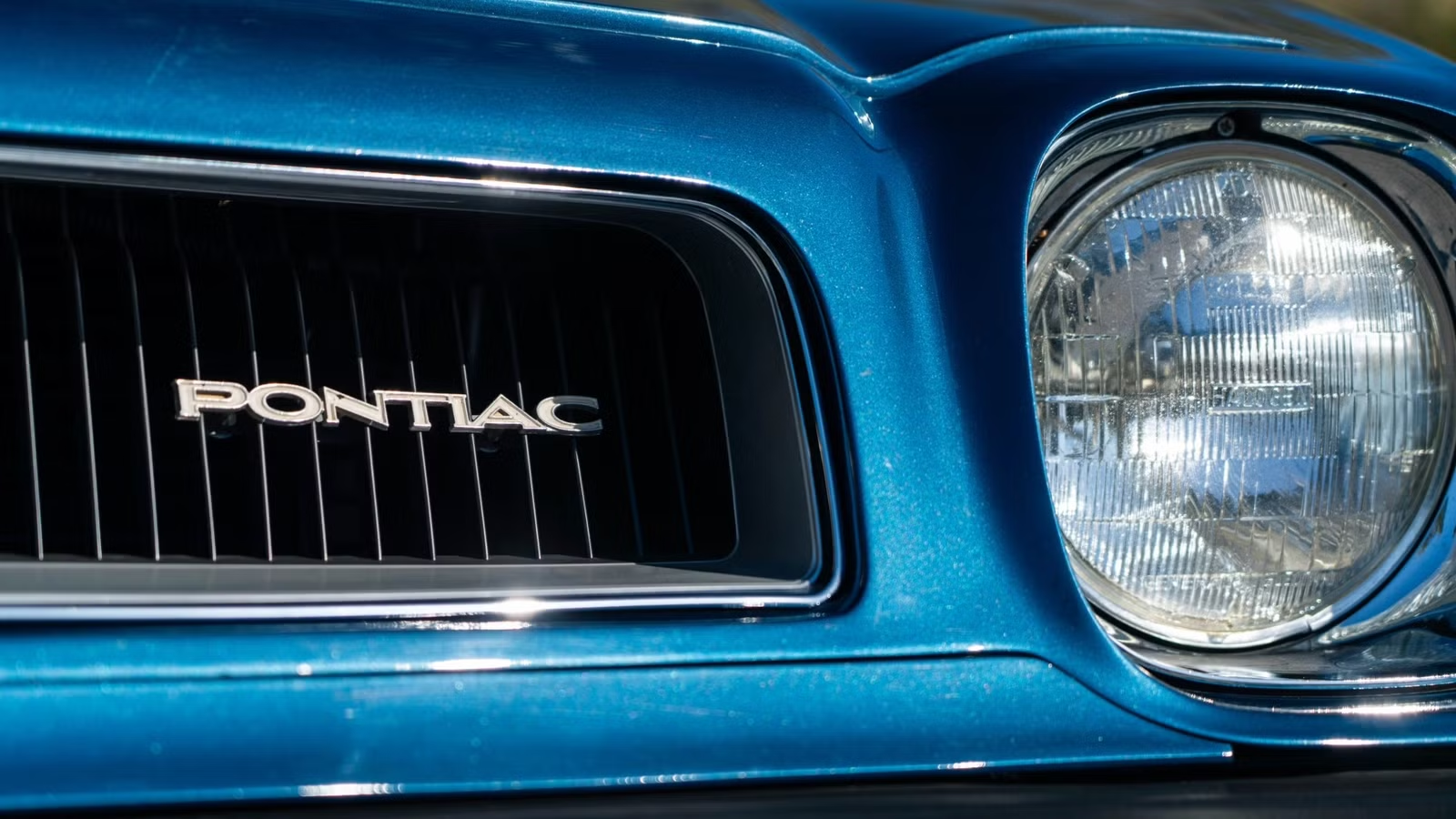
Chevrolet‘s 454 LS6 was the undisputed bully of the early-1970s drag strip, and Pontiac knew it. Rather than accept second place, the division’s engineers treated every humbling loss as a design brief — and what they built in response became one of the most compelling V8 stories of the muscle car era.

Pontiac went back to the drawing board to figure out how to take the famous Chevy big-block V8 down without any remorse. Its engineers went big, hoping to embarrass other muscle cars. As a result, the brand was able to maintain plenty of torque as increasing emission standards took their toll on the muscle car era.
This Pontiac V8 engine was so successful that it evolved into a professional racetrack monster, produced only in small numbers. Simply wanting to crush Chevy led to years of unmatched performance innovation. It pushed strict boundaries to keep the racing spirit alive while most engines were getting choked out.
The 1970 Pontiac GTO Judge Ram Air IV Wasn’t Cutting It

Most enthusiasts would love to get behind the wheel of the 1970 Pontiac GTO Judge Ram Air IV. However, we have to face the fact that it wasn’t cut out to tackle the Chevy Chevelle 454 LS6, despite having a few advantages such as better handling, enhanced weight distribution, and superior cornering.
The 1970 Chevy Chevelle 454 LS6 was the undisputed drag strip king. It packed a 454-cubic-inch (7.4-liter) LS6 V8 producing 450 horsepower and 500 lb-ft of torque. This muscle car could accelerate from 0 to 60 mph in about 6.0 seconds, with the ability to cover a quarter mile in roughly 13.4 seconds and a top speed of 130 mph.
But the 1970 Pontiac GTO Judge Ram Air IV was no slouch. It had a 400-cubic-inch (6.6-liter) V8 engine that delivered 370 hp and 455 lb-ft of torque. This car accelerated from 0 to 60 mph in about 6.1 seconds and could cover a quarter mile in about 14.5 seconds, with a top speed of 130 mph. It wasn’t far behind, but it just couldn’t outrace the 454 LS6.
The Pontiac 455 High Output V8 Came To Race

The tables turned in 1971 when the Pontiac 455 High Output V8 hit the track. It was a 455-cubic-inch (7.5-liter) V8 with 335 hp and 480 lb-ft of torque. This engine launched the Pontiac Firebird Trans Am from 0 to 60 mph in about 5.4 seconds and covered a quarter-mile in around 13.4 seconds. Plus, it had a top speed of 125 mph.
Due to increasing emission standards in 1971, Chevy had to drop the compression ratio of the 454 LS6 from 11.25:1. As a result, its output was reduced to 425 hp. However, it was still the most powerful engine available, even if it lost a bit of its bite. But suddenly, Chevrolet faced real competition from Pontiac.

The 455 H.O. V8 was designed to fight tightening emission regulations and decreasing compression ratios. Engineers increased the displacement to 455 cubic inches to deliver ample torque and keep their muscle cars operating at peak performance, even when paired with emission-compliant components.
This cast-iron block engine with four-bolt main bearing caps also features larger round-port cylinder heads, a more aggressive camshaft, a reinforced bottom end, and enhanced intake manifolds. It’s fed by an aluminum intake manifold and a Rochester four-barrel carburetor, and was often paired with functional Ram Air hood scoops.
The Pontiac 455 Super Duty Took Things Even Further

While the 455 H.O. V8 was an excellent engine for the street, it evolved into the Pontiac 455 Super Duty to dominate racetracks as well. Rated at 310 gross horsepower during development, production SD-455s debuted at 290 net horsepower in 1973 after emissions recertification. Torque was rated at 390 lb-ft net. This engine was exclusively offered in the Firebird Trans Am and Formula.
It was bred for racing, with the ability to accelerate from 0 to 60 mph in roughly 5.4 seconds and cover a quarter-mile in about 13.5–13.8 seconds, with a top speed of 132 mph. Every engine was hand-built offline, separate from normal production. To withstand the extra stress of racing, it features a reinforced block with thicker main webs and four-bolt main bearing caps.
Chevrolet 454 LS6 Vs. Pontiac 455 Engines
|
Car |
Engine |
HP |
Torque |
0-60 MPH |
|
1970 Chevy Chevelle 454 LS6 |
454 ci 7.4-liter V8 |
450 Gross |
500 LB-FT |
6.0 seconds |
|
1971 Pontiac Firebird Trans Am 455 H.O. |
455 ci 7.5-liter V8 |
335 Gross |
480 LB-FT |
5.4 seconds |
|
1973 Pontiac Firebird Trans Am 455 Super Duty |
455 ci 7.5-liter V8 |
290 Net |
390 LB-FT |
5.4 seconds |
Unlike the 455 H.O., the Super Duty featured a forged steel crankshaft, forged steel connecting rods, and forged aluminum pistons. The round-port cylinder heads featured constant cross-section porting, swirl-polished valves, and integrated steel inserts for an enhanced high-flow capacity. Plus, the 455 Super Duty features a heavy-duty oil pump and unique internal oil drain-backs to sustain high-RPM endurance.
The engine was topped with an 800-CFM Rochester Quadrajet four-barrel carburetor and a high-lift flat-tappet camshaft. Overall, this upgraded engine variant was better equipped to handle the demands of professional racing, while the 455 H.O. remained an excellent street engine.
Why Pontiac Nearly Canceled The SD-455 Before Production

The fact that the Super Duty 455 reached showrooms at all was largely thanks to Pontiac’s engineering team, not upper management. Developed alongside the racing-inspired SD-366, the engine was originally envisioned as a race-bred street powerplant with an aluminum intake, freer-flowing cylinder heads, a Ram Air IV-style camshaft, and a forged steel crankshaft. But as emissions rules tightened and production costs became a greater concern, Pontiac and GM gradually softened the package, substituting a cast-iron intake, milder camshaft, and less expensive components while ensuring compatibility with options like air conditioning.
The project faced even longer odds after Pontiac’s new general manager, Martin Caserio, inherited the division in the wake of the disastrous 1972 Norwood assembly plant strike, which crippled Firebird production and cast doubt over the F-body’s future. Pontiac originally planned and even advertised the SD-455 for the GTO, Grand Prix, LeMans, and Grand Am before certification delays — including late camshaft and EGR revisions — confined it to the Firebird Formula and Trans Am. Early press cars generated glowing reviews that fueled a showdown between Pontiac’s engineers and management, ending in a compromise that kept the SD-455 alive. Despite the concessions, the engine retained its race-bred foundation and quickly earned a reputation for making even more power with minor modifications.
Why The SD-455’s 290 Horsepower Rating Was Misleading

A quick glance at the spec sheet can make the Super Duty 455 look outclassed. Chevrolet’s LS6 454 carried a factory rating of 450 horsepower, making it the most powerful production car in America in 1970. It’s no surprise it earned the nickname the “King of the Streets.” Meanwhile, Pontiac’s ultimate muscle-car V8 officially produced just 290 hp, which would hardly have raised any eyebrows in the 1960s horsepower wars.
In reality, that comparison ignores one of the biggest changes to hit the American auto industry in the early 1970s. The LS6’s headline figure was calculated using SAE gross horsepower, which measured an engine under ideal laboratory conditions. By the time the SD-455 arrived for 1973, automakers had switched to SAE net horsepower, a far stricter standard that accounted for production exhaust systems, engine-driven accessories, air cleaners, and emissions equipment. As a result, horsepower numbers across Detroit appeared to plummet almost overnight, even when engines changed very little mechanically.

The SD-455’s published figure became even more conservative before the engine reached showrooms. Pontiac initially planned to rate it at 310 net horsepower, but emissions certification concerns prompted engineers to replace the original Ram Air IV-style camshaft with a milder grind that produced cleaner exhaust emissions. That last-minute revision dropped the official rating to 290 horsepower, even though the engine retained its reinforced block, forged internals, and race-inspired cylinder heads. Despite its conservative factory rating, period tests proved Pontiac’s flagship V8 delivered the kind of performance enthusiasts expected and helped cement the engine’s reputation as one of the last truly great factory muscle car V8s.
Unfortunately, The 455 V8 Didn’t Last Very Long

The Pontiac 455 V8 engine was only in production from 1970 until 1976. The High Output was available from 1971 until 1973, but it didn’t become a high-performance icon until it received an aluminum intake and round-port heads in 1971. The 455 Super Duty, meanwhile, was only produced in 1973 and 1974.
This engine could have been de-tuned in 1976, but was discontinued instead. It failed to meet increasing federal emission standards and changing fuel economy regulations, including the switch to unleaded fuel. With the introduction of Environmental Protection Agency (EPA) regulations and the mandating of catalytic converters, the big-block muscle car era was facing new challenges. It didn’t help that rising insurance premiums targeting muscle cars made ownership extremely expensive.

General Motors decided to consolidate its engine manufacturing to cut costs while complying with federal environmental regulations. This was far more affordable than re-engineering, certifying, and testing unique engines across each of its brands. Its corporate strategy favored smaller, more efficient engines instead, so the large Pontiac V8 beasts didn’t make the cut.
This is not surprising, as the oil crisis caused gas prices to rise and buyers were looking for smaller, more practical options. About 3,838 H.O. V8 engines were made. Then roughly 295 455 Super Duty V8 engines were built in 1973, with production increasing to 1,001 in 1974. Now the rare engine lives on as a historic racing icon that did more than complete its mission to beat Chevrolet.
The SD-455 Was Pontiac’s Last True Muscle Car

It’s fitting that Pontiac, the division widely credited with launching the muscle car era with the 1964 GTO, also built what many enthusiasts consider the last muscle car of the golden era. The Super Duty 455 represented everything Pontiac Engineering stood for: a purpose-built V8 developed with racing lessons, overbuilt internals, and performance as the top priority. By the time production ended after 1974, catalytic converters, stricter emissions standards, and GM’s growing reliance on shared corporate powertrains had closed the door on race-inspired engines developed by individual divisions. Sadly, the SD-455 ended up being Pontiac’s last proper muscle car in many enthusiasts’ eyes.
While later models like the 1977 “Bandit” Trans Am and the 1989 Turbo Trans Am had muscle car styling features and V8s, they reflected a new performance philosophy built around image, turbocharging, and corporate parts-sharing rather than the traditional formula of stuffing a massive, purpose-built V8 into an intermediate or pony car. Pontiac’s last-ditch attempt to give its loyal fans a muscle car came in 2004 when it launched the fifth-generation GTO, but that car was quickly dismissed by muscle car purists since it was essentially a rebadged Holden Monaro coupe. GM ultimately shuttered the brand in 2010, making the SD-455 not only Pontiac’s last muscle car, but also the final expression of the engineering philosophy that made the division famous in the first place.
Buying A Pontiac 455 H.O. Or SD-455 Today

For many enthusiasts, owning a Pontiac powered by the 455 H.O. or SD-455 is about far more than adding another classic muscle car to the garage. These engines symbolized Pontiac’s refusal to surrender as emission regulations reshaped Detroit, and they showed the division could still build a V8 worthy of being mentioned alongside icons like Chevrolet’s LS6 454. Just as importantly, they marked the closing chapter of the original muscle car era, giving them an appeal that extends well beyond raw horsepower figures.
If you’re shopping today, 455 H.O.-equipped cars are the easiest and most affordable way in. Pontiac built roughly 3,800 H.O. engines, and because they were designed primarily as high-performance street engines, they’re far more common than their Super Duty counterparts. Stepping up to an SD-455 is another story entirely. Its race-bred engineering, two-year production run, and status as the last great factory muscle-car engine have made it one of Pontiac’s most sought-after collectibles. Genuine SD-455 Trans Ams routinely sell for well into six figures, with the rarer 1973 Endura-nose cars often bringing the biggest money. The redesigned 1974 “shovel-nose” Trans Ams generally sell for slightly less, but exceptional examples still command six-figure prices.
Because replacement 455 engines can resemble genuine H.O. and SD units, buyers should verify matching engine codes, VIN documentation, and Pontiac Historic Services (PHS) paperwork before paying collector-level prices. Find a straight one, and you’ll own one of the last great factory-built Pontiac muscle cars.
Source: How Stuff Works, Audrain Automobile Museum, Hagerty

Related posts



Latest Post


No Comments