
The Japanese Bike Mechanics Rarely See With Major Problems
In an era when motorcycles are increasingly defined by hi-tech features, including riding modes, cornering aids, and smartphone connectivity, there is still something deeply appealing about a machine that keeps things simple. The bikes that quietly earn trust from owners and mechanics alike are often not the most advanced, but the ones built around proven engineering, prioritizing durability over sophistication where fewer things could go wrong.

That is exactly why certain motorcycles earn a reputation for their outstanding dependability. They may not dominate spec-sheet arguments, but they keep showing up for years with minimal drama. One such motorcycle is a legendary dual-sport Japanese model that has remained mostly unchanged for decades while quietly earning a reputation as a reliable workhorse.
Why Some Motorcycles Rarely Visit The Workshop
Some motorcycles spend more time in the garage because they are fragile, while others rarely see a workshop because they are straightforward. The primary reason certain motorcycles avoid garage lifts comes down to a fundamental engineering principle – minimizing points of failure. Long-term reliability is usually the result of conservative engineering decisions to avoid unnecessary complexity. The motorcycles that earn legendary durability status use proven engine architectures and components that have demonstrated their longevity in real-world conditions. Instead of chasing the latest trend, they focus on consistency and ease of ownership.
Proven Engineering Often Outlasts Cutting-Edge Innovation


There is a reason old-school motorcycles have their loyal fan following. When a bike is built around mechanical honesty instead of layered electronics, there are fewer sensors to fail, fewer systems to diagnose, and fewer expensive surprises to worry about. That does not make a simple motorcycle primitive; it makes it practical. For many, reliability is the real luxury, because a bike that starts every morning and keeps working flawlessly even after abuse is worth more than one packed with features that can become liabilities over time. This approach is especially valuable in the dual-sport segment, and this Honda proves exactly that.
The Honda XR650L Is A Time-Tested Dual-Sport That Refuses To Quit
MSRP: $6,999

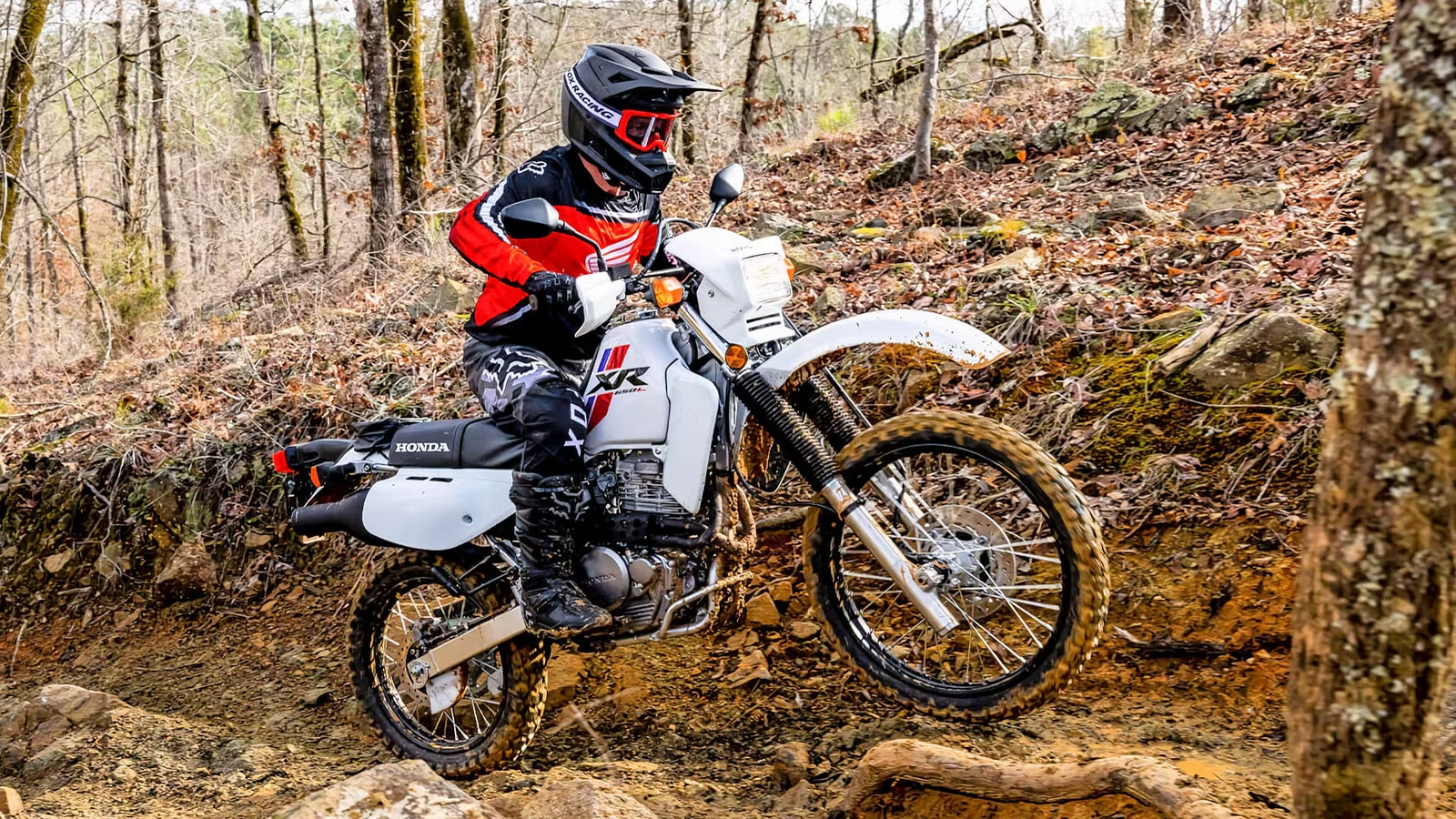
The motorcycle in context is the legendary Honda XR650L – a long-running dual-sport built with the sort of no-nonsense character mechanics tend to respect. First introduced in the early 1990s and still in production today, the XR represents one of the purest examples of Honda’s traditional durability-first engineering approach. The company positions it as a street-legal machine that can move from city streets to dirt trails without losing its composure, and that dual-purpose identity is what makes it special.

Honda has resisted the temptation to radically modernize the XR650L. The bike retains its air-cooled single-cylinder character, straightforward chassis design, and minimal electronic intervention. That continuity has allowed it to build a reputation that few modern motorcycles can match. Carrying a competitive base MSRP of $6,999 (plus a $600 destination charge), the XR650L sits in a relatively accessible part of the dual-sport market while delivering the kind of proven hardware that often matters more than a long feature list.
A 644cc Single-Cylinder That Mechanics Almost Never Worry About

Powering the Honda XR650L is a 644cc air-cooled single-cylinder four-stroke engine that churns out around 43.6 horsepower at 6,000 RPM and 38.2 pound-feet of torque at 5,000 RPM, paired with a five-speed manual gearbox. While on paper those numbers may not seem extraordinary, it is the kind of engine that earns confidence through repetition, not hype. This motor offers a wide powerband and minimal maintenance needs, which is exactly the kind of language riders want to hear when they plan to keep a bike for the long haul.
Air cooling is another significant factor in the engine reputation of the XR650L. Without radiators, coolant hoses, or thermostats, the XR650L eliminates several components that can potentially fail during hard off-road use. Fewer parts mean fewer opportunities for expensive breakdowns. Mechanics often describe engines like this as ‘under-stressed’, and that is precisely what contributes to their longevity. The Honda XR650L has proven itself across decades of real-world riding, from daily commuting to long-distance adventure travel and demanding trail riding.
Built To Handle Abuse On And Off The Road

The XR650L’s personality is shaped by the idea that a motorcycle should tolerate rough use without complaint. It is constructed on a rugged semi-double-cradle steel frame designed to absorb severe punishment. Equipped with heavy-duty 43 mm Showa cartridge front forks with 11.6 inches of travel and a Pro-Link Showa single rear shock delivering 11.0 inches of travel, this dual-sport soaks up rock gardens, deep ruts, and trail jumps with effortless composure.

With a massive 13.0 inches of ground clearance and full-size dirt bike wheels – a 21-inch front and an 18-inch rear – the Big Red Pig (as fans affectionately call it) rolls over obstacles that would stop smaller-wheeled adventure bikes in their tracks. Up top, factory-fitted handguards and a minimalist instrument cluster emphasize its purposeful, go-anywhere utility. Whether navigating congested urban gridlock or traversing isolated desert dual-track, the XR650L is engineered to bounce off boulders and slide out on gravel in style.
Easy Maintenance Keeps Ownership Stress-Free

Part of the XR650L’s charm is that it does not try to make maintenance feel like a specialist job. So, perhaps the strongest reason mechanics rarely see XR650Ls with major problems is that owners are more likely to keep up with maintenance. The motorcycle is exceptionally easy to work on, which encourages regular servicing rather than postponing it. Moreover, since production has been continuous for over 30 years, spare parts availability and modification options are virtually infinite. The XR650L’s simplicity also makes it attractive for long-distance travel. Carrying a small tool kit is often sufficient, and roadside repairs are far less intimidating than they would be on a modern motorcycle.
Old-School Simplicity Might Still Be The Ultimate Luxury

In today’s motorcycle market, simplicity has become surprisingly rare. Many dual-sport and adventure motorcycles now feature hi-tech electronics which undoubtedly improve performance, comfort, and versatility, but they also increase complexity and long-term ownership costs. When we talk about XR650L’s Japanese rivals, the Suzuki DR650S follows a similarly simple philosophy and has its own excellent reliability reputation, but it offers slightly less suspension travel and a lower overall off-road focus.

The Kawasaki KLR650 provides better wind protection and touring capability, yet its liquid-cooled engine and additional weight make it a different kind of machine. Honda’s own CRF450RL delivers significantly higher performance and modern technology, but it requires more frequent maintenance and comes with a substantially higher purchase price. What ultimately sets the Honda XR650L apart from others is the balance it strikes between durability, off-road capability, and minimal maintenance demands, making it one of the smartest buys in its class.
Source: Honda

Related posts

Latest Post


No Comments