
The Pontiac That Offered A 455 V8 For Less Than A GTO
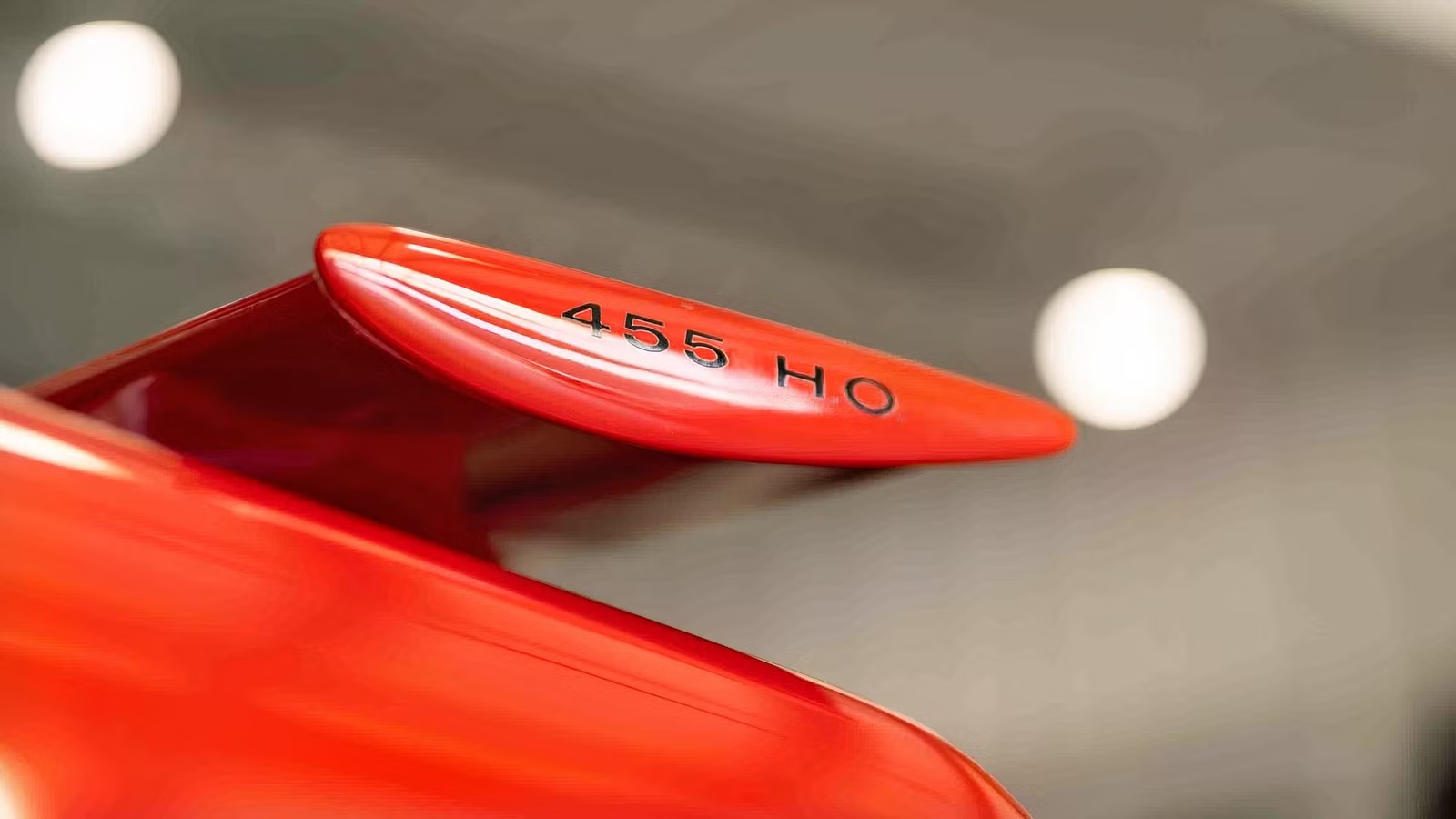
Pontiac gets plenty of credit for inventing the muscle car in 1964. But I’d argue that an equally impressive trick was making lightning strike again seven years later. By then, the GTO had become an icon with its own styling, reputation, and price tag. Pontiac’s engineers could have guarded that famous badge carefully. Instead, they took the original recipe, an ordinary midsize with a ridiculous engine, and handed it to buyers all over again. The only thing different this time around was the letters on the fender.
Pontiac Snuck A Big V8 Into A Tempest And Made History

It’s hard to imagine a world before the 1964 Pontiac GTO. Those three letters, which stood for Gran Turismo Omologato, would mainly have been familiar to fans of certain Italian sports cars. Then Pontiac introduced a $295.90 Regular Production Option, RPO 382, on its Tempest LeMans. The performance package came with a nearly unheard-of “GTO” badge.
RPO 382 upgraded the Tempest LeMans with a 325 horsepower, 389-cubic-inch V8. You could get a hardtop upgraded to a GTO for $2,852 total. This put you within spitting distance of expensive personal-luxury cars such as the 340 hp 1964 Buick Riviera, while saving roughly $1,500 off the fancy Buick’s $4,374 MSRP.
Before the GTO, much of Detroit’s big horsepower lived in larger, pricier cars. The 1964 GTO’s affordable performance marked the beginning of the muscle-car era. And buyers loved it. Pontiac expected to sell 5,000 units of the experimental option package. It moved 32,450 in the first year alone. And the GTO’s story was just beginning. By 1966, sales had nearly tripled to 96,946. That’s also the year Pontiac transformed what had been a niche option package into its own model.

Seven Years Of Success Turned The GTO Into A Premium Brand

In 1964 and 1965, the GTO was an obscure Tempest/LeMans option that enthusiasts in the know ordered. But as it became notorious at stoplights and car shows, its fame grew. For 1966, the GTO became its own V8-only Pontiac model. The once-strange badge was now the product.
To its credit, Pontiac didn’t suddenly levy an enormous surcharge for the GTO badge. But the sticker climbed with the era’s inflation. The 1964 GTO had made headlines with its $2,852 price tag as much as its performance. By 1971, a GTO hardtop would set you back $3,446. Add the new 455 High Output V8, and you’d be paying at least $3,583.

By 1971, GTO sales had collapsed to just 10,532 cars. Pontiac’s cheapest midsize, meanwhile, could still start below $3,000. Instead of stripping or downsizing the GTO itself, Pontiac had another route available: replicate the original GTO formula with its cheapest A-body.
Pontiac Went Back To Basics With The T-37

Midway through 1970, Pontiac introduced the Tempest T-37 hardtop as a new low-priced version of its midsize “A-body.” For 1971, the T-37’s mission was simple: save money on everything that didn’t hurt performance. The car had a cloth-and-Morrokide bench seat, vinyl floor covering, blackwall tires, and almost no exterior trim. Carpeting alone cost $21 extra. Pontiac pinched pennies everywhere except the engine bay. But the stripped-down T-37 made room for some serious engine options at a startling discount.
For 1971, Pontiac dropped the Tempest name and made the T-37 its entry-level midsize. Period magazine figures put the hardtop’s base price at $2,807. That incredible number happened to be $45 less than what the original 1964 GTO had cost: $2,852. Making it perform like a GTO would cost a bit more. But the result was still shockingly cheap.

When we adjust for inflation, there’s even more wiggle room here. That $2,852 1964 GTO works out to roughly $3,726 in 1971 dollars. Yet in 1971, Pontiac would sell you a T-37 hardtop with a 455 H.O. making more power than the original GTO for $3,206 total. The engine option itself cost $358, and its mandatory dual exhaust added another $41. Dollars per horsepower, it out-GTO-ed the original GTO.
A 455 T-37 Brought GTO Torque To The Masses

One of the T-37’s top engine options was the L75 455, which tied the original GTO’s 325 hp. To be precise, it made 325 gross hp at 4,400 rpm and 455 lb-ft at 3,200 rpm. In other words, the L75 was a stump puller hiding in Pontiac’s bargain bin. What’s wild is that the standard engine in the $3,446 1971 GTO was now just a 400-cubic-inch V8, so entry-level 1971 GTO output had fallen to 300 gross hp and 400 lb-ft.
The T-37’s inexpensive straight-line speed did come with tradeoffs. Even the $237 GT-37 package did not include the GTO’s rear stabilizer bar. Hot Rod’s GT-37 test car used high-rate coil springs instead, which helped handling but made the ride harsher. And even the 455 H.O. did not automatically bring heavy-duty suspension to a plain T-37; buyers had to select it separately.

Unfortunately, no period road test of a T-37 or GT-37 with the regular-output 455 has surfaced in our research. The GT-37 with the 400-cubic-inch V8, rated at 300 hp and 400 lb-ft, and a four-speed manual was proven to achieve a 14.565-second quarter-mile at 96.8 mph. But neither the 400 nor the regular-output 455 was the car’s top engine option.
The 455 HO T-37 Proves Pontiac Never Lost Its Mojo

Pontiac’s top 1971 performance engine was its LS5 455 H.O., and the powerplant was available in the T-37 as well as Pontiac’s pricier A-bodies. It added $358 to the $2,807 MSRP of a T-37 hardtop, though it required a $41 dual-exhaust upgrade. For $3,206 total, you could buy a 1971 Pontiac with 335 gross hp and 480 lb-ft of torque.
That $358 H.O. option bought more than a 10 hp bump. Pontiac paired the 455 H.O. with a 12-bolt rear end and made the heavy-duty M13 three-speed manual standard; buyers could instead choose a TH400 automatic or M22 close-ratio four-speed. This was steak-and-potatoes engineering: put the strongest engine in the cheapest body, then make sure the driveline could digest 480 lb-ft straight from the factory without coughing up its lunch. Pontiac may have considered carpet optional. The hardware between the crankshaft and rear tires was another matter.

The 1971 455 H.O.’s output was especially impressive because Pontiac had slashed compression across its lineup for lower-octane fuel. The new H.O. ran just 8.4:1 compression, yet engineers gave it round-port No. 197 heads, an aluminum intake, an 068 cam, and free-flowing exhaust manifolds. A period Motor Trend test of a 455 H.O.-powered GTO Judge recorded 0-60 mph in 7.0 seconds and a 14.9-second quarter-mile at 95 mph.
So did anyone actually order the lowest-trim Pontiac with the flagship engine? Absolutely. Specialist research suggests customers picked up 15 T-37 hardtops and 11 pillared coupes with the 455 H.O. That’s 26 total, of which 10 had automatic transmissions and 16 were stick shifts. The slightly more expensive GT-37 was even more popular with the H.O.: 54 were built with the engine in 1971.

Pontiac could have locked its impressive 455 H.O. engine behind an expensive GTO badge for the 1971 model year. The muscle-car party was winding down, but Pontiac apparently hadn’t heard last call. Instead, the automaker chose to offer a 455 H.O. midsize for $3,200 and change. That’s about $520 less than the original GTO would have cost, adjusted for 1971 inflation. The T-37 455 H.O. proves that Pontiac hadn’t forgotten the formula that made its original muscle car great.
Sources: GM Heritage Collection, Automotive Heritage Foundation, Pontiac

Related posts





Latest Post


No Comments