
Bruce McLaren’s Personal M6GT Coming To Goodwood 2026
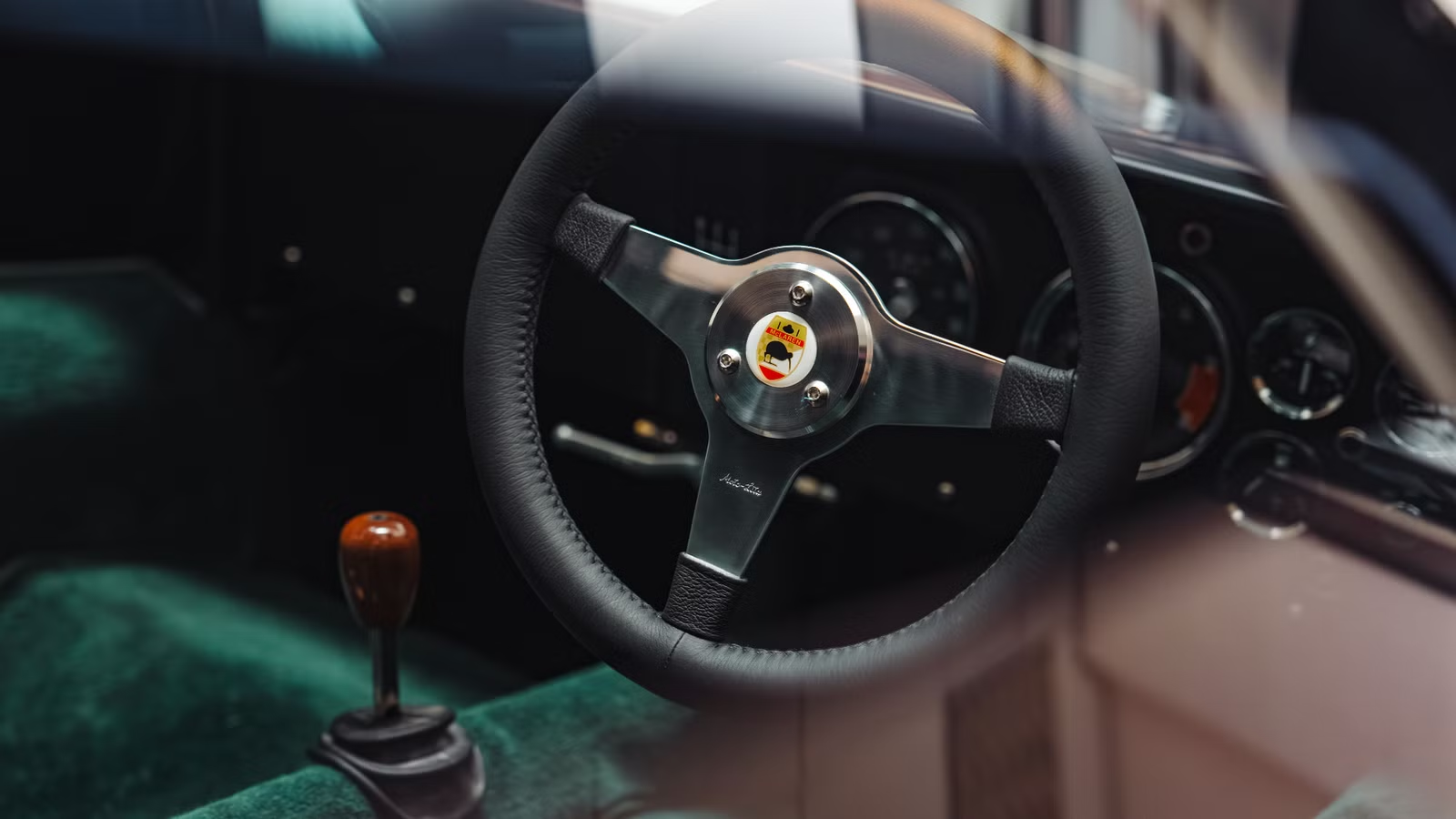
Before the McLaren F1 rewrote the rulebook for road cars, before the carbon tub and the gold-lined engine bay and the three-seat layout became the stuff of automotive legend, there was the M6GT. Built in the early 1970s as Bruce McLaren’s personal transport — a one-off prototype he drove to meetings and race events — the M6GT was the first time anyone at McLaren seriously asked the question: what if the racetrack came home with you?

Now, more than five decades later, McLaren Special Operations has rebuilt that car from the ground up, using original body moulds uncovered in the UK, period-correct hardware, and archival drawings held in McLaren’s own collection. The M6GT: Restored by MSO makes its first public appearance at Goodwood Festival of Speed on July 9–10, 2026, as the centrepiece of McLaren’s heritage display — and it is, in every meaningful sense, a monument to the founding philosophy that still runs through every car the company makes.
From the M6A Racing Program to Bruce’s Daily Driver

The M6GT’s lineage is inseparable from the M6A — the racing program that gave McLaren its identity in the late 1960s. The M6A was a purpose-built endurance racer: aerodynamically resolved, obsessively lightweight, engineered around the principle that nothing on the car should exist unless it earned its place. Bruce McLaren took those principles and asked a simple, radical question: could the same thinking produce a road car?
The answer was the M6GT. Its chassis traces directly to a period-built M6A racer, verified against historic McLaren reference vehicles to confirm its authenticity. The aerodynamic silhouette, the race-derived proportions, the lightweight construction philosophy — all of it flows from the endurance racing program. What made the M6GT different was intent: this was not a racing car with number plates bolted on. It was Bruce’s genuine attempt to design something a person could live with, drive to Heathrow, and park outside a meeting without apology.
He used the first prototype as exactly that. His personal transport. The car that carried McLaren’s founder between the Colnbrook factory, the circuits of Europe, and everything in between. That context matters, because it means the M6GT was never a concept or a showpiece — it was a working expression of a vision that Bruce believed in deeply enough to trust with his own daily commute.
The Restoration: Every Fastener Treated With Reverence

MSO’s approach to the M6GT restoration was built around a single principle: custodianship. Not interpretation, not reimagining — custodianship. Every decision made during the build had to be defensible against the original intent, and where original materials or components no longer existed, the team went to extraordinary lengths to recreate them faithfully.
The bodywork was formed using original moulds that MSO uncovered in the UK. When the team examined those moulds closely, they found evidence of historical modification within the tooling itself — subtle records of design decisions made during the original program, preserved in the material like a geological record. Rather than smooth those traces away, MSO chose to honor them, treating the moulds as a primary source document rather than just a production tool.
The Engine: Small-Block V8 With ‘Camel Hump’ Heads

Under the M6GT’s bodywork sits a period-correct small-block V8, fitted with ‘camel hump’ cylinder heads in line with the original specification. The camel hump designation — named for the distinctive raised casting on the valve covers — identifies a specific family of high-performance cylinder heads that were among the most sought-after performance components of the era. Their inclusion here is not a styling choice; it is a technical commitment to authenticity.
The gearbox is equally period-correct, matched to the engine as it would have been in the original car. MSO’s decision to source and restore a correct drivetrain rather than substitute a modern unit is consistent with the broader philosophy of the project: the M6GT: Restored by MSO is not a tribute car in the loose sense of the word. It is, as closely as the surviving materials and archival record allow, the car Bruce McLaren intended.
The M6GT’s Place in McLaren’s DNA — and the Shadow of the F1

It took 25 years for Bruce McLaren’s road car vision to reach its full expression. The McLaren F1, launched in 1992, delivered everything the M6GT had gestured toward: a highly tuned engine, butterfly doors, an aerodynamic silhouette, and a central driving position that placed the driver at the absolute heart of the machine. The F1 is widely regarded as one of the greatest road cars ever built, and its founding philosophy — racing engineering translated faithfully into something a person could drive on a public road — is precisely what Bruce was reaching for in the early 1970s.
Jon Simms, Director of MSO, described the project as “a labor of craft and care” that served as “both a technical education and a living reminder of Bruce’s ambition to take McLaren beyond the racetrack.” That framing is accurate. The M6GT: Restored by MSO is not a museum piece in the passive sense — it is a working argument about where McLaren came from and why that origin still matters.
Goodwood 2026: The M6GT Meets McLaren’s Living Lineage
The M6GT’s public debut at Goodwood Festival of Speed sits within a broader McLaren display designed to trace the full arc of the company’s history. The McLaren House at Goodwood brings together the M8A — the 1968 Can-Am racer that established McLaren’s engineering identity in North American motorsport — alongside the Austin 7 Ulster, an artifact of Bruce’s earliest racing life, and the McLaren F1 GTR, the road-going racing icon that carried his philosophy into the 1990s.

Related posts





Latest Post


No Comments