
Lexus’s 416-HP V8 Sedan Outclasses The BMW M3 And Mercedes C63 On Reliability
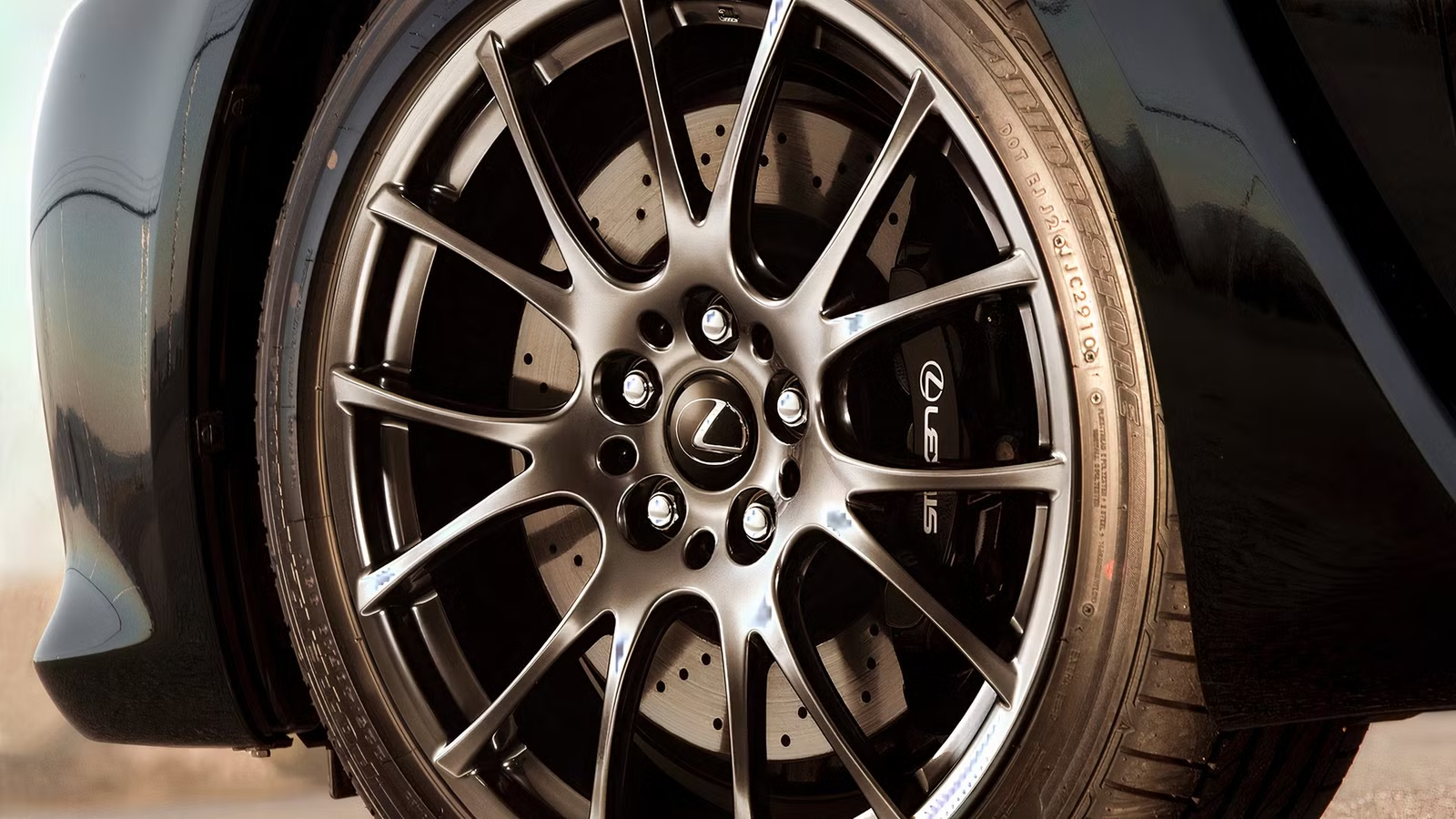
High-performance sedans offer the best of both worlds: family-car practicality with the power and pace to embarrass far more focused supercars. BMW helped establish the compact sports sedan formula with its original race-bred M3, and Mercedes-Benz soon joined the battle, unleashing its AMG division on the C-Class.

Then Japanese luxury automaker Lexus decided to take on the established German heavyweights in the super sedan era. Its contender may not command the same reverence or residual values as the E90 BMW M3 and W204 Mercedes-AMG C63, but with its naturally aspirated V8 era now drawing to a close, this overlooked performance sedan could yet have its day in the sun. Its appeal and collectibility look set to grow as enthusiasts turn their attention to the last of a dying breed.
BMW Started The Trend
The original E30 M3 laid the foundation for BMW M’s remarkable success. It was a sporty compact sedan developed for production car racing homologation, powered by a meager but rev-happy 2.3-liter four-cylinder engine producing between 192 and 238 hp. BMW raised the stakes with the subsequent six-cylinder E36 and E46 models, before breaking new ground with the E90’s S65 420 hp 4.0-liter V8, the first and only V8-powered production M3, which was sold from 2007 to 2013.

Mercedes-AMG beat its German rival to the V8 game by a decade, though. The W202 C43 AMG was produced from 1997 to 2000 with a 4.3-liter 302 hp V8. It was replaced by a 349 hp 3.2-liter supercharged V6 in the W203 C32 AMG (2001–2004), which then made way for the facelifted C55 AMG that received a 5.4-liter naturally aspirated V8, producing 362 hp. It soon raised the bar even higher with one of the most revered naturally aspirated V8s of all time, the roaring 451 hp 6.2-liter M156 that was fitted to the W204 C63 (2007–2014).
Then Japanese automakers came hunting for sports sedan buyers. Lexus was determined to prove it could be more than just a purveyor of restrained luxury, and was equally adept at catering for enthusiasts chasing genuine driving thrills.
From Staid To Exhilarating via Fuji
As the new premium division of Toyota, Lexus redefined the concept of supreme luxury in 1989 when it launched the brand and its first model – the exceptional LS 400. It quickly established itself as the pinnacle of refinement, and progressively expanded its reach to a wider audience with the likes of the mid-size 1993 GS 300 (a BMW 5-Series/Mercedes-Benz E-Class competitor), and the compact IS 300 in 2001 as its rival for the venerable 3-Series and C-Class.
The IS was more dynamic in concept, design and execution, and appealed to younger buyers, but the company still lacked a performance flag-bearer that could take the fight to the legendary M3 and AMG’s C-Class offerings. With typical Japanese determination and efficiency, Lexus created the IS F based on its second-generation XE20 IS platform.
The ‘F’ in the IS F was derived from Fuji Speedway, home to Toyota’s Higashi-Fuji Technical Center. The car’s launch material made no secret of the new high-performance sedan’s sporting ambitions, describing it as a car developed to deliver the “joy of driving”, and highlighting the extensive track testing it underwent at Fuji Speedway and numerous other famous circuits around the world. Clearly, Lexus intended the IS F to transform its image from staid and conservative to bold and exhilarating, and to take the fight directly to BMW M and Mercedes-AMG.
V8 Co-Developed With Yamaha

Lexus already had a proven reputation of producing exceptional V8 engines – after all, the 1UZ-FE 4.0-liter V8 that powered the segment-defining LS 400 was the gold standard for smoothness, refinement, quality and durability. But the company needed a new, more extrovert powerplant to take on its German rivals.
Accordingly, it developed the all-aluminum 2UR-GSE – a high-performance version of the 2UR-FSE used in the luxury Lexus LS 600h. For its sports sedan application, Lexus turned to Yamaha for the development of new cylinder heads, concentrating on airflow and combustion efficiency. The heads incorporated reshaped intake and exhaust ports, titanium intake valves and a dual-stage intake system that opened a secondary port above 3,600 rpm for improved high-end performance.
The 32-valve naturally aspirated 5.0-liter V8 had a compression ratio of 11.8:1, which was just a fraction off the 12.0:1 of the M3, and notably up on the 11.3:1 of the C63. Peak power was rated at 416 hp in the IS F, just 4 hp shy of the Beemer, but well off the 451 hp produced by the Merc. As the Lexus sat almost perfectly between the two German offerings in engine capacity, it’s no surprise that the torque outputs followed suit – the IS F producing 371 lb-ft to the M3’s 295 lb-ft and the C63’s mammoth 443 lb-ft. What was surprising, though, was the comparatively low 6,800 rpm rev limit compared to the 7,200 rpm available on the big-hitting C63, and the screaming 8,400 rpm redline of the M3 which emphasized its motorsport-derived character.
Launch reports at the time suggested that the relatively low rev limit was due to the company’s uncompromising attitude towards durability, but later evolutions of the 2UR-GSE upped the ante. In its final iteration in the IS 500 and LC 500, the compression ratio was increased to 12.3:1, torque climbed to 398 lb-ft and the redline was raised to 7,300 rpm, producing a peak power output of 471 hp.
Advanced Gearbox Tech, Competitive Performance

Technical innovation was a key component in the IS F, most notably in being equipped with the world’s first eight-speed automatic transmission in a production passenger car. Although it was a conventional automatic, in Manual mode it had the ability to lock the torque converter in gears two through eight, thus providing a direct connection between the engine and transmission for more immediate responsiveness and acceleration.
With paddle shifters as standard, it was credited with rapid shifts in just 0.1 seconds, and had a rev-matching feature on downshifts that reinforced the racetrack-bred credentials. Lexus claimed a 0-60 mph time of 4.6 seconds for the IS F, which was identical to the E90 M3 with the M-DCT dual clutch transmission, and just 0.3 seconds off the C63’s official 4.3 seconds. Independent testing saw the IS F complete the 0–60 mph sprint in 4.2 seconds, compared to the M3’s best of 4.1 seconds. The C63 AMG decimated its opposition with a remarkable time of just 3.9 seconds.

The IS F wasn’t perfect, though, with almost universal criticism of the car’s jarring, harsh suspension that was below par compared to the German sports sedans. The handling was less direct and involving, the electrically assisted power steering was vague and over-assisted, and brake pedal feel for the Brembo setup was soft and imprecise. But for a first attempt at a super sedan against its rivals that had already been in the performance game for decades, it was a commendable effort indeed.
And Lexus addressed many of these concerns for the facelifted and updated 2011 model year with revisions to the spring rates, shock absorber damping, rear bushings and rear camber settings, as well as an updated power steering calibration.
Priced For Battle

At launch for the 2008 model year, Lexus positioned the IS F right in the heart of the M3/C63 battle. At a base MSRP of $56,725, there was very little to separate it from its German rivals, although an extensive options list, including a high-end Mark Levinson audio system, navigation, and radar cruise control, could quickly push the price to almost $64,000.
Despite the IS F’s sporty demeanor, the car has suffered massively in depreciation – more so than the M3 and C63. Kelley Blue Book figures for 2026 show a typical resale value that has bottomed out at around $17,100 for the 2008 IS F, which represents a massive 72% hit compared to its original MSRP.
This is bad news for current owners hoping to offload their car for a reasonable price, but presents a fantastic opportunity for enthusiasts searching for an entertaining, naturally aspirated V8 sports sedan that can keep up with the best.
End Of An Era, Time To Shine

With demand growing rapidly for driver-oriented cars, Lexus IS F values are now steadily climbing, having risen by more than $1,500 in just a couple of months. High-mileage examples that have been driven extensively can still be found for as little as $12,000.
Reasonable 2008–2011 cars with 85,000 to 130,000 miles on the clock typically fall in the $25,000–$35,000 bracket. Later, updated models with lower mileages can stretch into the mid-$40,000s, while exceptionally well-preserved examples that have escaped the rigors of daily use can command as much as $60,000.
The sophisticated 2UR-GSE V8 is renowned for greater fuel efficiency than its rivals, and has the benefit of an impeccable reliability record that has always been a hallmark of Lexus V8s. This is reflected in the IS F’s average annual repair and maintenance costs across all model years, according to RepairPal. At an average of $531 per year, it’s less than half of the M3’s ($1,161) and the C63’s ($1,077) average annual costs. Accordingly, it’s one of the safest and most affordable options in its class as a used car purchase.
With the 2UR-GSE chapter in Lexus’s road-car history now closed, the spotlight may finally be shifting toward this overlooked naturally aspirated V8 sleeper and its potential as a modern, attainable classic.
Sources: Lexus, BMW, Mercedes-Benz, RepairPal, Bring a Trailer

Related posts




Latest Post


No Comments