
The Phantom Oldsmobile Muscle Wagon GM Officially Said Didn’t Exist
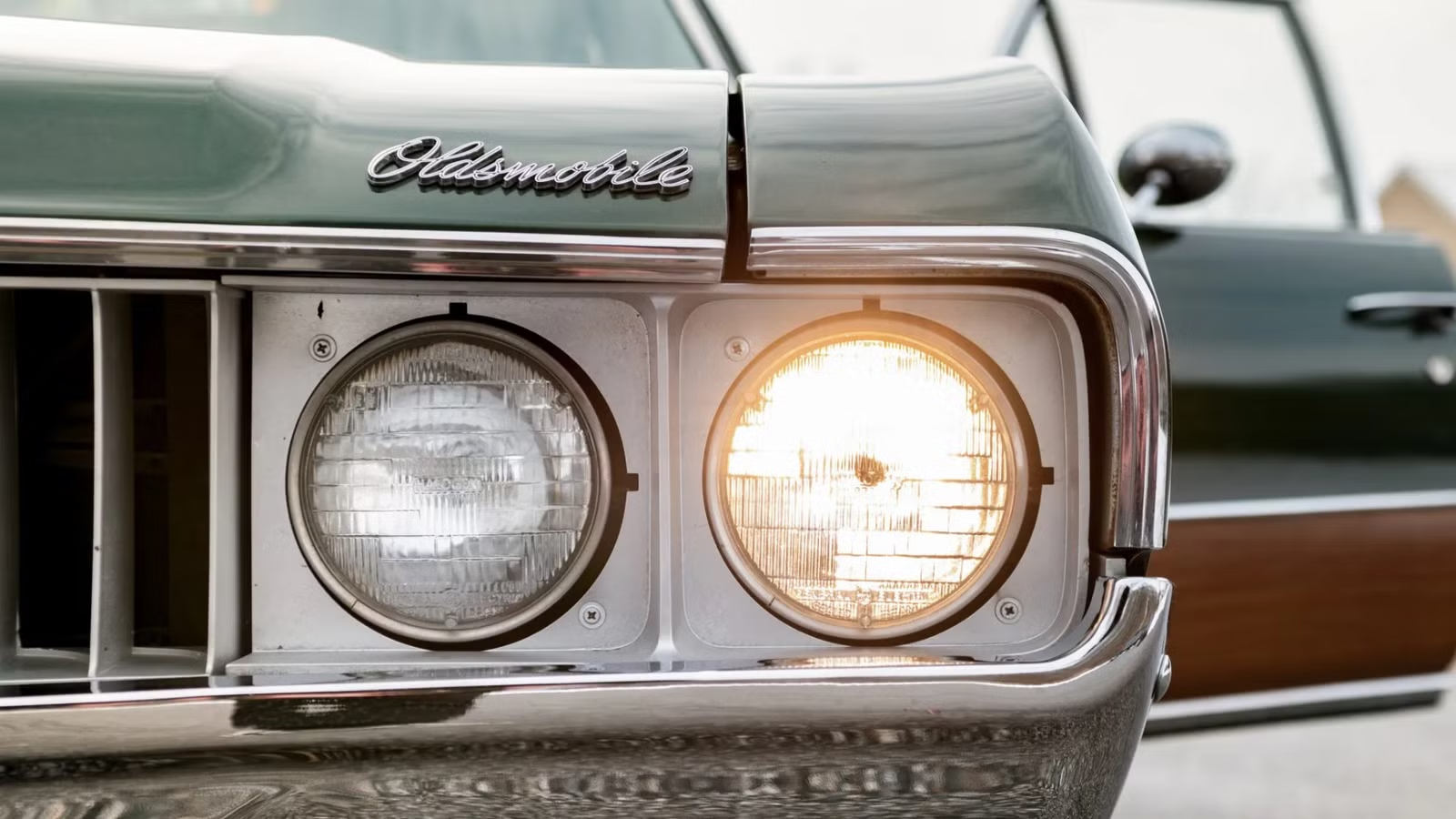
General Motors spent most of the 1960s telling its own divisions that no intermediate car could carry an engine larger than 400 cubic inches. It was an internal policy rather than a law, and Oldsmobile treated it that way. The division went around it in 1968 with an outside partner, did it again in 1969, and built at least one car that ignored the rule completely.

The wildest of those cars was not a coupe but a family wagon with a glass roof, and Oldsmobile never listed it and never admitted that it existed.
The 400-Cubic-Inch Rule That Oldsmobile Decided To Work Around
The 400-cubic-inch ceiling was a corporate agreement General Motors had set for all its brands in the late 60s. At the time, one in two cars sold in America was built by GM, and management worried that an open horsepower race would invite a government breakup. Every car and brand under GM was capped under that limit, except the Corvette.

Ford and Chrysler had no such arrangement, so the 426 Hemi, 440 Six-Pack, and 428 Cobra Jet went into mid-size cars while GM engineers worked with one hand tied.
However, GM’s 400 ci ceiling did not apply to cars the division never intended to sell. The engineers could build whatever they liked for internal testing. To get ahead of the curve and break GM’s corporate rule, Oldsmobile decided: if it couldn’t do it from the factory, why not hand the job to someone else?

George Hurst proposed dropping the 455 into a 442 chassis and selling the result as a “Hurst/Olds.” They built 515 examples for 1968 at Demmer Engineering in Lansing, Michigan, in a run that took 40 days. A second version followed for 1969, and GM dropped the restriction entirely for 1970.
The Skylight Wagon That Was Built On 442 Hardware

Oldsmobile restyled the Vista Cruiser for 1968 and replaced the earlier split skylight with a single piece of glass. The wheelbase stretched to 121 inches, making it the longest car in the mid-size class Oldsmobile sold.
Underneath sat the same GM A-body that carried the Cutlass and the 442. The rear suspension used coil springs where most rival wagons used leaf springs, so a loaded Vista Cruiser rode better than almost anything else with a tailgate.
From the factory, the engine list opened with the base 350 ci and climbed from there. Buyers in 1968 and 1969 could order the high-output 400 lifted straight from the 442, rated at 325 hp and 440 lb-ft, and toward the end of the decade the 455 ci took over as the top choice.

That 455 arrived for 1970, rated at 365 hp and 500 lb-ft, and the torque figure matched the LS6 Chevelle, the most feared car GM built that year. A wagon with a third-row seat had the same performance specs as the era’s benchmark big-block V8 muscle car.
The car measured roughly 18 feet long and weighed around 4000 pounds, so the big engines were not really luxuries once the family and the luggage were aboard. A 350 moved a Vista Cruiser adequately. But a 455 moved it forward like a muscle car.

None of that made it a 442, because Oldsmobile sold the 442 in 1968 as its own series with three body styles — Sports Coupe, Holiday Hardtop, and convertible — and 33,607 were built that year. There was never a catalog model called a Vista Cruiser 442, and no dealer could order one.
What buyers could do was work the options sheet. Ticking the big engine, the heavy-duty suspension, and a short axle ratio got you most of the hardware, but none of the badges, making it the ultimate sleeper wagon of its era.
The 1968 455-Powered Vista Cruiser Press Car That Broke GM’s Rule

Oldsmobile’s engineering group built a single 1968 Vista Cruiser that ignored the corporate rule completely. It received a 455 V8 block, cylinder heads, camshaft, and rear suspension from a 442, and Oldsmobile then handed the keys to Car and Driver.
Oldsmobile’s restriction was about the car, not the engine. The 455 sold all year in the full-size Delta 88, Ninety-Eight, and Toronado, but no mid-size A-body was allowed to have one, so no dealer could order a Vista Cruiser like this and no buyer could own one.
But it was the engine that made the idea work in the first place, as the Oldsmobile 455 produced its peak torque low in the rev range. This suited the heavy body far better than a high-revving small block would have, and it let a two-ton wagon leave the line without any fuss.

Car and Driver recorded 6.2 seconds to 60 mph and a quarter mile of 14.7 seconds at 93.6 mph. The test car had its second and third rows removed to save weight, so those numbers describe a stripped wagon rather than one loaded for a road trip.
However, getting it to stop was another matter entirely. The weak brakes needed 237 feet to come to a stop from 80 mph. A nose-heavy big block and period brakes made for a car that gathered speed far more convincingly than it shed it. But this complaint applied to plenty of full-size sedans at the time.
The press car demonstrated what the division could do if the rules changed, and when they did change for 1970, the 455 went into Vista Cruisers as an ordinary engine option rather than as the basis for a performance model.
Two W30 Wagons Left The Factory In 1970 But Only One Can Still Be Traced
Two more wagons went through the same process in 1970, and these were built to full 442 W30 specification. Oldsmobile Engineering pulled them off the production line and fitted the special camshaft, the W30 heads with their larger valves and exhaust ports, and the rest of the package.
Roughly 3,100 W30 442s were built for 1970, and two of them were station wagons. Both went to Popular Hot Rodding for testing, which is where the Wonder Wagon nickname came from, but tracking them has been difficult.

One is usually linked to Joe Mondello, the engine builder tied to Oldsmobile’s Dr. Oldsmobile performance group, while the second was shipped overseas and has not resurfaced.
Hurst added the last chapter in 1972 when the company supplied the support fleet for that year’s Indianapolis 500. At least one 455-powered Vista Cruiser was finished in Cameo White and assigned to the track’s medical director.

But many argue that a single Vista Cruiser alongside three Cutlass wagons was used by the press and photographers, others describe two Vista Cruisers, and the claim that they carried the W30 package and the W25 fiberglass hood has never been confirmed.

Two were known to survive as of 2011, a press car and the medical director’s car, and the latter belongs to a relative of Ray Harroun, winner of the first Indianapolis 500 in 1911.
Those handful of cars are the entire documented factory record. Every other Vista Cruiser wearing 442 badges was built by someone other than Oldsmobile, and that distinction is the whole ballgame when money changes hands.
How To Tell A Real 455 Vista Cruiser From A 442 Tribute

Checking the VIN is the best way to identify an original. A Vista Cruiser carries a wagon series and body code and never a 442 one, so the number confirms what the car left the factory as, but on 1968 through 1971 cars it says nothing about what was under the hood.
GM added an engine code to the VIN from 1972, which is why the 455-powered wagon that sold in 2023 at Mecum reads 3K56U2M239257. On earlier cars, the build sheet, the Protect-O-Plate, and the original window sticker are the documents that settle it.
W30 markers are worth knowing but prove nothing alone. The fiberglass ram-air hood, the red inner fenders, and the aluminum intake are all available to anyone building a tribute, and Cutlass and 442 parts bolt onto a Vista Cruiser without modification.
When it comes to valuations, a 455-equipped 1970 wagon sold on Bring a Trailer for $12,916 in 2024, and a 1972 car brought $13,000 at Mecum, while Hagerty puts a genuine 1970 442 with the 455 near $30,600 in good condition.
Source: General Motors, Hagerty, Car and Driver, Concept Carz, Bring A Trailer

Related posts
Latest Post


No Comments