
Mercury Marquis: The Coupe With Lincoln’s 460 V8
America spent the 1960s making V8s bigger, louder, and more powerful, then spent the 1970s watching those same engines look embarrassingly weak on paper. Emissions rules and the switch to SAE net ratings battered the numbers industry-wide. One of the strangest survivors was Ford’s 460-cubic-inch V8, a Lincoln-born big-block that had quietly lost most of its bragging rights by the mid-1970s. Instead of fading into obscurity, its huge displacement and low-speed pulling power made it a surprisingly good match for one of America’s biggest luxury coupes. The interesting part is where Ford put it, and why the car still worked.
When America’s Biggest V8s Started Losing Their Muscle

The American V8 had a serious problem by the early 1970s. The engines were still large, but the horsepower numbers were collapsing. The change wasn’t caused by one single decision. Emissions rules pushed manufacturers to change the engine tuning, while the industry-wide move from gross to SAE net ratings made the numbers on paper look even smaller. The 460 makes the change easy to see.

Introduced for 1968 in the Continental Mark III, the engine was initially exclusive to Lincoln products and rated at a 365-horsepower gross rating through 1971. By 1972, Ford had expanded the 460 beyond Lincoln and into other Ford Motor Company products, while the engine was also being adapted to a new emissions era. Its compression ratio dropped, and Ford continued changing the engine’s tuning as it adapted to emissions rules, fuel economy demands, and drivability.
The result was a spectacularly different set of numbers. The 460 had gone from 365 gross horsepower in its early years to the low-200-hp range under the newer SAE net system. By 1977, the engine was rated at just 197 horsepower in some applications. That sounds brutal, and in terms of peak horsepower, it was. But the engine was still 460 cubic inches, with plenty of displacement left to do useful work.

The 7.5-Liter V8 That Refused To Become Small

The 460 was the largest member of Ford’s new big block family, developed as a successor to the older 462 MEL and 390 FE/FT engines. Its 4.36-inch bore and 3.85-inch stroke gave it 459.8 cubic inches of displacement, or roughly 7.5 liters. This was a big, old-fashioned overhead-valve V8, and there was no clever trick hiding behind the displacement. The engine was simply enormous, with enough capacity to make substantial pulling power without needing to spin hard.

The model-year figures show why. A 1975 460 produced 218 horsepower and 369 lb-ft of torque. A 1977 version was down to 197 horsepower but still made 353 lb-ft, while a 1978 version produced 202 horsepower and 348 lb-ft. The exact output changed from year to year, but the basic character stayed intact.
The horsepower number tells you how much power Ford could extract at higher engine speed. The torque figure explains why the engine could still move a very heavy car without needing to be worked hard. For a giant luxury coupe, that low-rpm shove was much more useful than chasing a higher peak number. The 460 could get a heavy body moving without requiring the driver to wring it out, making it a natural fit for a land yacht. Ford, in other words, had an enormous engine that no longer looked impressive by muscle-car standards. It just needed somewhere appropriate to put it.
The Forgotten Mercury Coupe Hiding Lincoln’s Big-Block Was The Marquis

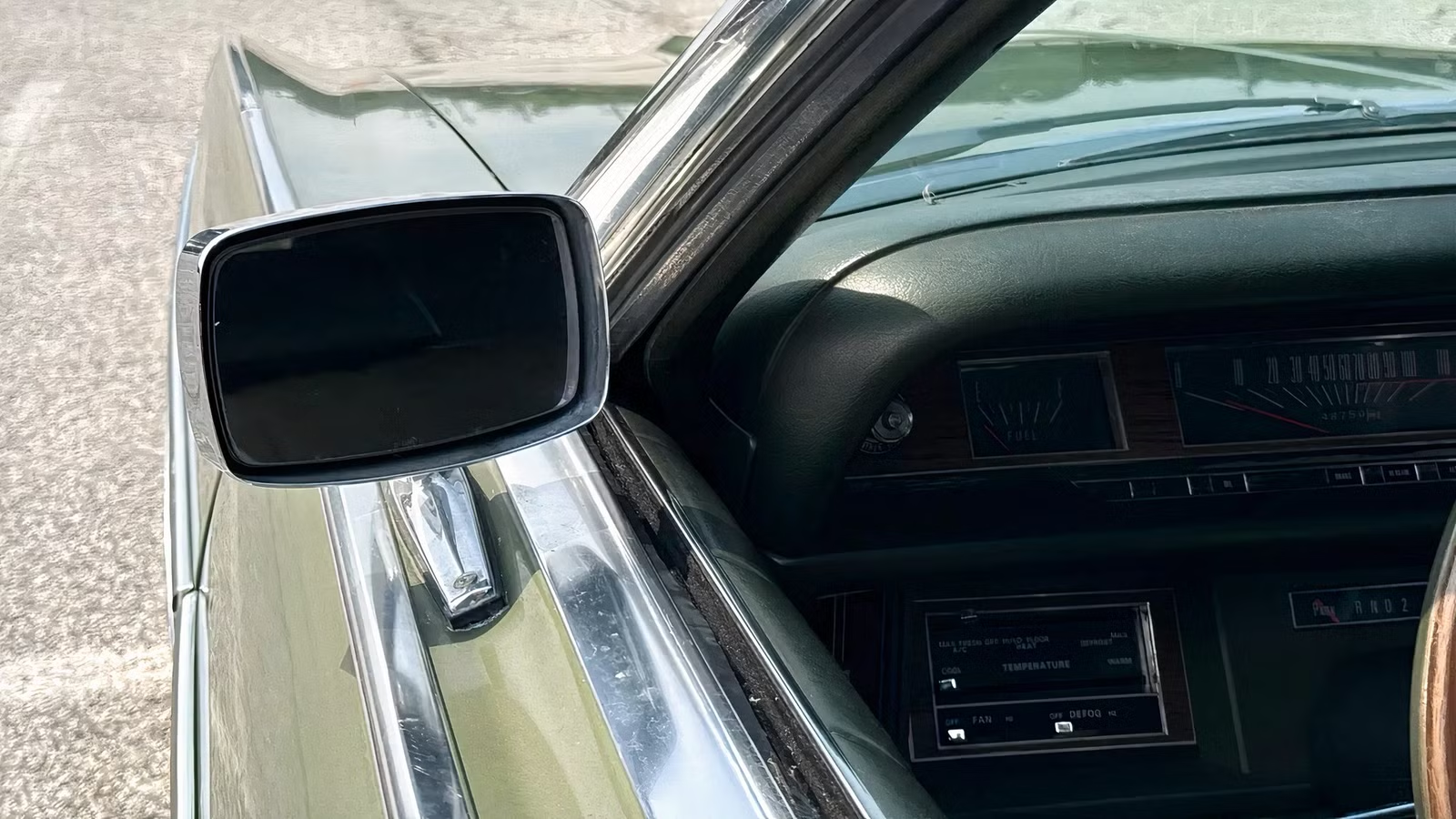
It was a Mercury Marquis. The reveal is almost funny because the car looks so completely wrong for the engine. The Marquis was a full-size luxury coupe, not a performance special. Its job was to carry people in comfort, swallow highway miles, and look suitably expensive while doing it. The two-door body had the long hood, formal roofline, upright proportions, and sheer physical size associated with America’s land-yacht era. Yet the Marquis could carry Ford’s 460 under that enormous hood.
For 1975, the 460 was available in the two-door Marquis, including Brougham and Grand Marquis versions. The Grand Marquis name had become the highest trim level of the Marquis range, positioned below the Lincoln Continental in Ford’s hierarchy. The 460 remained part of the full-size Mercury powertrain mix through 1978, although it became an option rather than the default choice as Ford shifted toward smaller V8s.

The dimensions make the pairing even more ridiculous. A 1975 two-door Marquis measured about 229 inches long, rode on a 124-inch wheelbase, and weighed roughly 4,750 pounds in base form. A Grand Marquis could push closer to 4,900 pounds. And there was almost nothing about the styling to warn anyone that a 7.5-liter V8 was hiding underneath. The Marquis wasn’t covered in stripes or decorated with performance badges. It looked like exactly what it was, a formal American luxury coupe from an era when cars this large were still perfectly normal.
That anonymity is the fun part. Park one next to a group of more obviously sporty cars and the Marquis is unlikely to attract much attention. Nobody at a gas station is walking over to ask about the engine. Open the hood, though, and the visual story changes completely. The engine filling that bay is one of the biggest passenger-car V8s Ford had. Suddenly, that miserable-looking horsepower number needs a little more context.
The C6 Automatic Made The Marquis A Highway Machine

Ford paired the 460 with the C6 three-speed automatic, a transmission built to handle the substantial output of Ford’s larger engines. It wasn’t sophisticated by modern standards, but the Marquis didn’t need sophistication. It needed a drivetrain that could move a huge body smoothly and reliably. Ford reserved the C6 for exactly this kind of duty, since the lighter automatics in the lineup were never built to live behind an engine this heavy for the long haul. It was also used behind the 460 in Ford’s biggest Lincolns, showing that Mercury wasn’t getting a lesser transmission for the big engine.

The rest of the car followed the same philosophy. The long wheelbase and soft suspension favored a comfortable ride over sharp handling, giving the Marquis the floaty character associated with full-size American luxury cars. The steering, body movements, and sheer dimensions all reminded the driver that this thing was designed for cruising, not attacking corners. That makes the engine and transmission surprisingly well matched. The 460’s low-end shove does not ask the C6 to hunt through a pile of ratios chasing revs, and the suspension is not asking for aggressive driving either. Everything points toward settling into the seat and letting the car cover distance.
The braking system is where the sheer size of the package becomes impossible to ignore. A car approaching 5,000 pounds on period braking hardware needs more planning than a modern performance car, especially when slowing from highway speeds. Four-wheel disc brakes were available on some versions, but the basic character remained that of a very large, very heavy machine. There is something appealingly honest about that. The Marquis gives you the big seat, long hood, soft ride, V8 soundtrack, and the feeling that the highway is going to run out before the car does. It never pretends to be anything sportier. The 460’s role isn’t to turn the Marquis into something it isn’t. It is there to make all that mass feel manageable.
A 200-Horsepower Land Yacht Could Still Get Moving

Calling the Marquis slow is fair, but the numbers deserve some context. The 460-powered Marquis could reach 60 mph in roughly 10 seconds, depending on trim and test conditions, a period-appropriate figure for a car built around comfort rather than speed. That is hardly a sports-car number, but it does not make the car a hopeless slug either. The biggest problem is obvious: weight.
The base 1975 car was already around 4,750 pounds, and the Grand Marquis could be heavier. Add a three-speed automatic, conservative emissions-era engine tuning, and a chassis designed around comfort, and there was never going to be a spectacular launch. But once the Marquis gets rolling, that same low-end torque takes over. The engine is not chasing a high-revving horsepower peak to keep the car moving, so the acceleration arrives without the drama you would expect from something this size.

That is why the 460-powered Marquis is more interesting than its horsepower figure suggests. It isn’t a forgotten muscle car waiting to embarrass something at a stoplight. It is a huge luxury coupe carrying an engine that lost much of its peak power but retained the characteristics that made it useful. On the highway, that distinction matters even more. The Marquis can settle into a steady cruise, the big V8 working without sounding frantic, while the long wheelbase and soft suspension do what they were designed to do.
The 1970s may have taken the muscle out of America’s biggest V8s, but they didn’t make those engines irrelevant. They just changed what they were good at. In the Marquis, the 460 found a different job. Instead of powering a car built to chase quarter-mile glory, it was asked to move nearly 5,000 pounds of Mercury with as little fuss as possible. For an anonymous luxury coupe from the malaise era, that is a surprisingly good use of 7.5 liters.
Sources: Bring A Trailer, Mecum, Classic.com

Related posts

Latest Post


No Comments