
The Overlooked V12 Ferrari That’s Now a Blue-Chip Investment
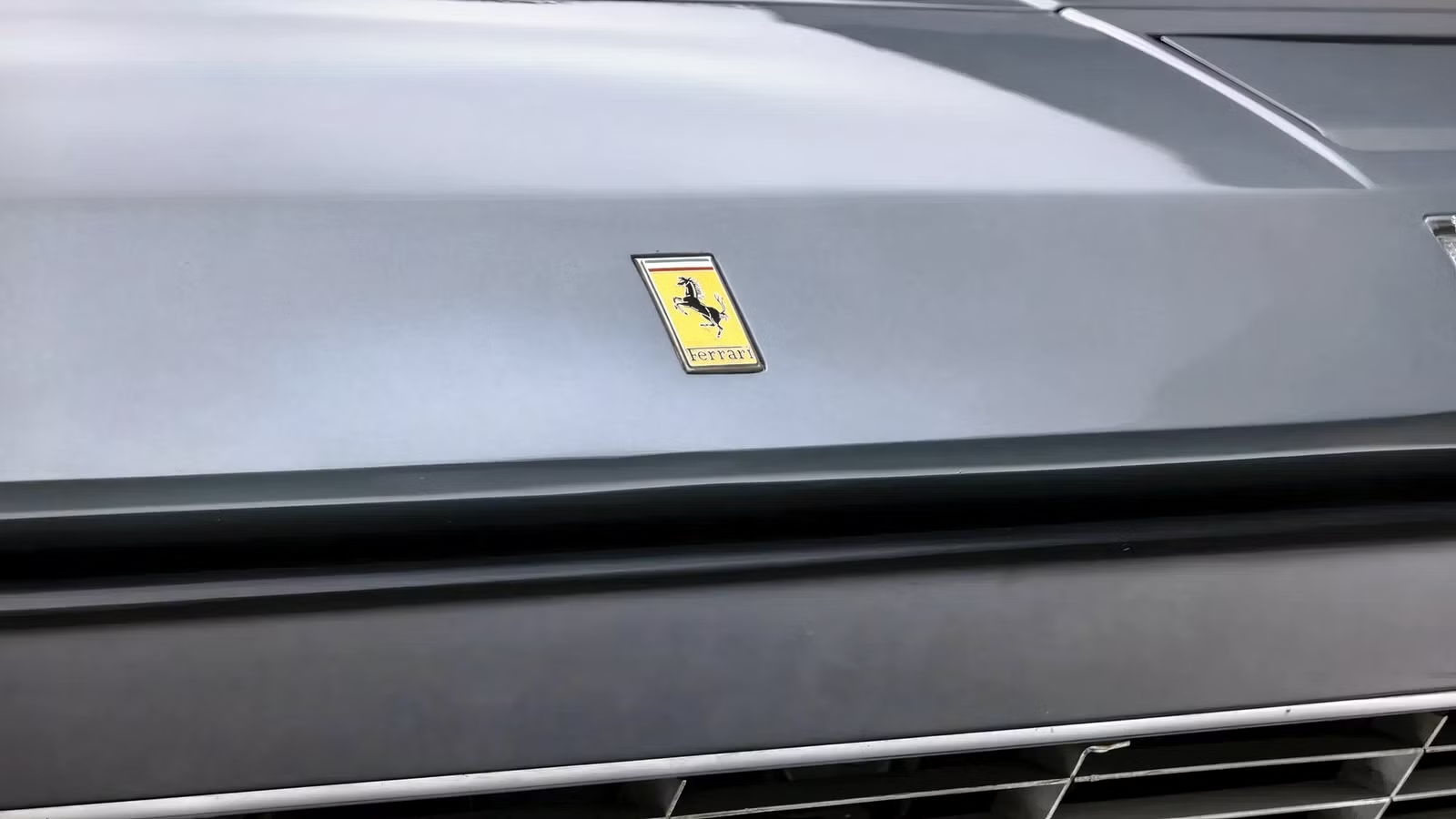
For decades, the most valuable Ferrari collector vehicles were the ones with racetrack DNA. If you wanted a Ferrari purely for investment purposes, you either bought a mid-engine, low-slung sports car built to tear through the Italian countryside, or an aggressive, track-focused special. This blue-chip market was reserved for these poster cars. But recently, collectors have been shifting their focus toward understated, usable, and purely mechanical machines. Because of this pivot, a front-engine V12 Ferrari GT that was once universally dismissed as the “cheap entry point” into the brand is quietly undergoing a remarkable transformation into a blue-chip collectible.
Why Ferrari’s Cheapest V12 Stayed Cheap for So Long

To understand why the Ferrari GT cars have spent years in the shadows, you have to look at the powerful image Maranello spent decades projecting to the world. Ferrari was the house of speed and performance. Think of its historic lineage that captured the public imagination: cars like the Daytona, Berlinetta Boxer, Testarossa, and the carbon-fiber, twin-turbo terror of the Ferrari F40. Even into the 1990s, cars like the F355 cemented Ferrari’s status as a builder of visceral, high-revving sports cars designed to get your heart racing.
A relaxing GT car simply didn’t fit that high-octane narrative. They looked right at home parked outside a corporate building or a high-end casino next to a fleet of executive sedans. But for an audience raised on the myth of Enzo Ferrari’s screaming race cars for the road, a GT car felt too mature, too sanitized, and emotionally disconnected from the image Ferrari was trying to portray.
Collectors Wanted Mid-Engine Drama, Not Executive Grand Tourers

Ultimately, brand perception and visual drama dictated what buyers actually wanted, leaving engineering excellence out of the equation. In the late 20th century, a supercar buyer didn’t just want a fast car; they wanted a theatrical experience. They craved the wide stance, fancy doors, rear windows you could barely see out of, and the two-seat configuration of mid-engine machines.

Ferrari’s GT cars looked like cars for executives, not racing drivers. They lacked the wild wings, pop-up air intakes, wide hips, and wide rear tires that defined the poster cars of the era. Because they lacked that immediate, stop-and-stare factor, the collector market also didn’t pay attention to them. They were viewed as vehicles for the older crowd, which effectively made them very affordable for decades.
Everything Buyers Claimed to Want, Except the Reputation

The great irony is that, on paper, this car had everything you wanted in a high-end classic Italian grand tourer. Tucked neatly beneath its long hood sat a hand-built V12 engine. The exterior was designed by Pininfarina, featuring clean, pronounced bodylines that have aged quite well. Step inside, and you are greeted by a supple, hand-stitched luxury cabin covered in premium Connolly leather, deep-pile carpets, and amenities that could rival any high-end grand tourer of its time. Ferrari even offered it with an automatic transmission to ensure effortless cruising.
But it wasn’t a mid-engine sports car that could stop people in their tracks and still be faster than almost any car on the road. Buyers criticized the three-speed automatic transmission for lacking sports-car urgency and engagement, completely missing the point. It was a car engineered to cross Europe at 150 mph without breaking a sweat.
The Ferrari 400 and 412 Quietly Became Maranello’s Ultimate Gentleman’s Car

The Ferrari 400 and 412 series were the quintessential Ferrari grand tourers. The Ferrari 400 was first unveiled in 1976, introducing the controversial GM three-speed automatic gearbox option alongside the traditional five-speed manual. This was the first Ferrari to have an automatic. By 1979, the updated 400i brought fuel injection into the mix, replacing the carburetors for improved daily reliability and cleaner emissions. The final version arrived in 1985 with the 412, which had a bigger engine, a subtly raised rear decklid for improved luggage space, ABS, and flat-faced alloy wheels. This evolution resulted in Maranello’s ultimate gentleman’s car: a sharp, angular, boxy luxury coupe meant for high-road speeds instead of track performance.
A GT With a Glorious V12 Engine

At the heart of this grand tourer lay the legendary Colombo V12 engine. In the 400, it was a 4.8-liter naturally aspirated V12 with six dual-choke Weber carburetors, producing a glorious, mechanical symphony you wouldn’t expect from a car like that. It made 340 horsepower and 318 lb-ft of torque with the manual. The automatic couldn’t handle the full power of this V12, so it was rated at only 310 hp and 320 lb-ft of torque. The automatic was a serious point of criticism for the car. Purists scoffed at a General Motors automatic inside a Ferrari, but this exact powertrain configuration fulfilled the car’s true purpose.
The updated 400i retained the same engine but replaced the carburetors with fuel injectors, which reduced power overall to 310 hp and 320 lb-ft but allowed the car to comply with emissions regulations. But the 412 used a larger 5.0-liter variant of the Colombo V12 making 340 hp and 333 lb-ft of torque.
Ferrari’s Longest-Running Front-Engine V12 Grand Tourer

When you step back and look at the sheer longevity of this design, the historical significance becomes undeniable. The vehicle line evolved across a remarkable production run spanning from 1972 all the way to 1989. The family tree officially began with the 1972 365 GT4 2+2, which served as the rock-solid foundation for this shape, and its foundational architecture remained in continuous production for 17 years. This incredible lifespan makes it the longest-running production run of any single V12 body style in Ferrari’s entire history. Each car was simply an evolution of the original 1972 model. While other sports car designs came and went with changing fashion trends, this clean, minimalist shape quietly endured, bridging the gap between the raw mechanical era of the early 1970s and the high-tech, digital dawn of the late 1980s.
The Market Has Finally Started Accepting This Car

So, what changed? Why is a car that was once avoided now finding its way onto the lawns of prestigious concours events? The simple answer is that the modern collector market has matured. In a world full of aggressive supercars and highly digitized driving experiences, modern collectors are consciously prioritizing originality, rarity, everyday usability, and an authentic, analog driving experience over outright track times.
The 400 and 412 represent an era when a luxury grand tourer felt completely analog. There are no fancy driving modes, active aerodynamic wings, or complex dual-clutch gearboxes here. Instead, you get a direct hydraulic steering rack, a beautifully balanced front-engine chassis, and the mechanical music of a naturally aspirated V12 engine. Collectors have come to realize that you can actually drive this Ferrari to dinner, fit two adults comfortably in the back seats, pack real luggage in the trunk, and enjoy a vintage driving experience without drawing unwanted attention.
From Bargain Entry Point to Blue-Chip Collectible

The shifting perception of these grand tourers has had a massive, undeniable impact on their actual market values. For decades, you could easily pick up a running, driving 400i for the price of a used hatchback. Those days are gone. According to recent market analysis from classic car valuation experts like Hagerty, values for the 400 and 412 series have exploded by 221% over the past decade. The upward momentum has only accelerated lately, with average prices surging between 30% and 66% since 2020 alone.
The production numbers tell an incredibly clear story about rarity and transmission choice. A total of 502 Ferrari 400s were made: 355 were automatics and 147 were manual GTs. A total of 1,305 Ferrari 400is were made with 883 being automatics and 422 manual GTs. Finally, a total of 576 Ferrari 412s were made with 306 automatic and 270 manual cars. That is 2,383 cars in 13 years, with 1,544 automatic cars and 839 manuals. Fewer than 2,400 cars were produced, with a 64.8/35.2% split between automatics and manuals. Because of this extreme rarity, manual-transmission cars now routinely command a massive 40% to 50% value premium over their automatic siblings.
For comparison, automatic 400is have an average price of $66,824, while the manuals have an average price of $108,732. Furthermore, the collector market is showing a strong willingness to pay huge sums for pristine cars with provenance. A prime example was the 1983 Ferrari 400i bought brand new by Rolling Stones guitarist Keith Richards which sold for a staggering €345,000 (roughly $394,000). This landmark sale proved that top-tier collectors now view these grand tourers as historically significant vehicles worthy of high-profile collections.
Time Has Completely Changed How Enthusiasts See It

Ultimately, time has allowed this Ferrari to step out of the shadows and be properly appreciated. In the 1970s and 1980s, the 400 series was compared to wild mid-engine sports cars and fell well short by that measure. Today, it stands out as a masterclass in elegant, quiet grand touring luxury. One has even received a restomod treatment with the V12 from the 812 Superfast making 800 hp, paired with a five-speed manual from the Ferrari 599.
The market has finally come around to the realization that an understated, razor-sharp V12 grand tourer offers a cool factor that flashy, loud supercars simply cannot replicate. The Ferrari 400 and 412 spent decades hidden away in the shadows of automotive history, but they have finally emerged into the limelight—not as the cheap, unloved options of the past, but as highly sophisticated, investment-grade blue-chip classics.
Sources: Ferrari, Bring a Trailer, Hagerty, Classic.com

Related posts



Latest Post


No Comments