
9 Japanese Motorcycles Engineered To Outlast Their Owners
Reliability out of Japan usually gets credited to kaizen and simplicity, and that’s part of it. But the real trick runs quieter. Engineers tuned these engines to run well under their limit, leaving a cushion between what they can do and what they actually get asked to do. Call it the understress ratio: horsepower divided by displacement, the thread tying this list together. Here are ten Japanese motorcycles built with room to spare, ranked from the most understressed engine on two wheels to the hardest working one.
9
Kawasaki Vulcan 900 Classic
Understress ratio 0.055 hp per cc

We start here, because nothing on this list has more room to breathe. The Vulcan 900 packs a 903cc liquid-cooled V-twin making a claimed 50 horsepower, relaxed enough to barely qualify as work. Kawasaki chose belt final drive over a chain, one less thing to wear out. Owner forums back that up with real numbers. One rider on the Kawasaki Vulcan forums logged roughly 90,000 miles on stock internals with nothing beyond normal wear items and a replacement stator, never once needing the valve shims touched. The only part worth watching is the voltage regulator at higher mileage.
8
Kawasaki KLR650
Understress ratio 0.06 hp per cc

The KLR650 has run the same 652cc single since 1987, and Kawasaki calls it one of its most trusted engines. Fuel injection replaced the carburetor in 2022, the only real shakeup in decades. Kawasaki never published an hp figure, but period press and media dyno testing puts it around 37 hp at the rear wheel. One named rider on the KLR650 forums backs that up directly, reporting 199,000 miles on the original piston, rings, and top end with nothing more than a cooling upgrade and the doohickey fix. A weak tensioner nicknamed the doohickey could fail catastrophically on pre-2008 bikes. Swap the cheap part once and it runs solid from there.

7
Honda Shadow 750
Understress ratio 0.06 hp per cc

The Shadow 750’s 745cc V-twin traces back to the 1983 VT750C’s RC14E architecture, and the layout has barely changed since. Claimed output sits around 45 hp, unremarkable and exactly the point. Hydraulic valve adjusters, shared tech with the Gold Wing, keep the valve train at zero clearance without manual adjustment. Owner forums checks it out with real examples. One named rider reported 351,000 miles on a well cared for bike, and another logged 123,000 miles on a 1998 VT750 ACE with nothing beyond a voltage regulator, a clutch, and the usual tires and chains. When these bikes need work, it’s almost always old hoses or carburetor jets, rarely the engine.
6
Suzuki DR650
Understress ratio 0.07 hp per cc

The DR650 is proof that Suzuki found the formula once and stopped touching it. The 644cc air- and oil-cooled single has run essentially unchanged since 1996. Claimed output lands around 43 hp, nothing to brag about and everything to rely on. Riders Yan and Aga rode two DR650SEs around Australia, 20,000 miles each on nothing but tires and oil. Suzuki runs the same conservative math one size down with the DR-Z400S, a 398cc single that stayed carbureted and largely untouched for a full quarter century before finally being replaced in 2025. Adventure rider Heather Sinclair put 40,000 miles on a DR-Z400S across multiple long-distance trips and singled out the engine as the one part of the bike that never gave her trouble.
5
Honda Gold Wing GL1800
Understress ratio 0.07 hp per cc

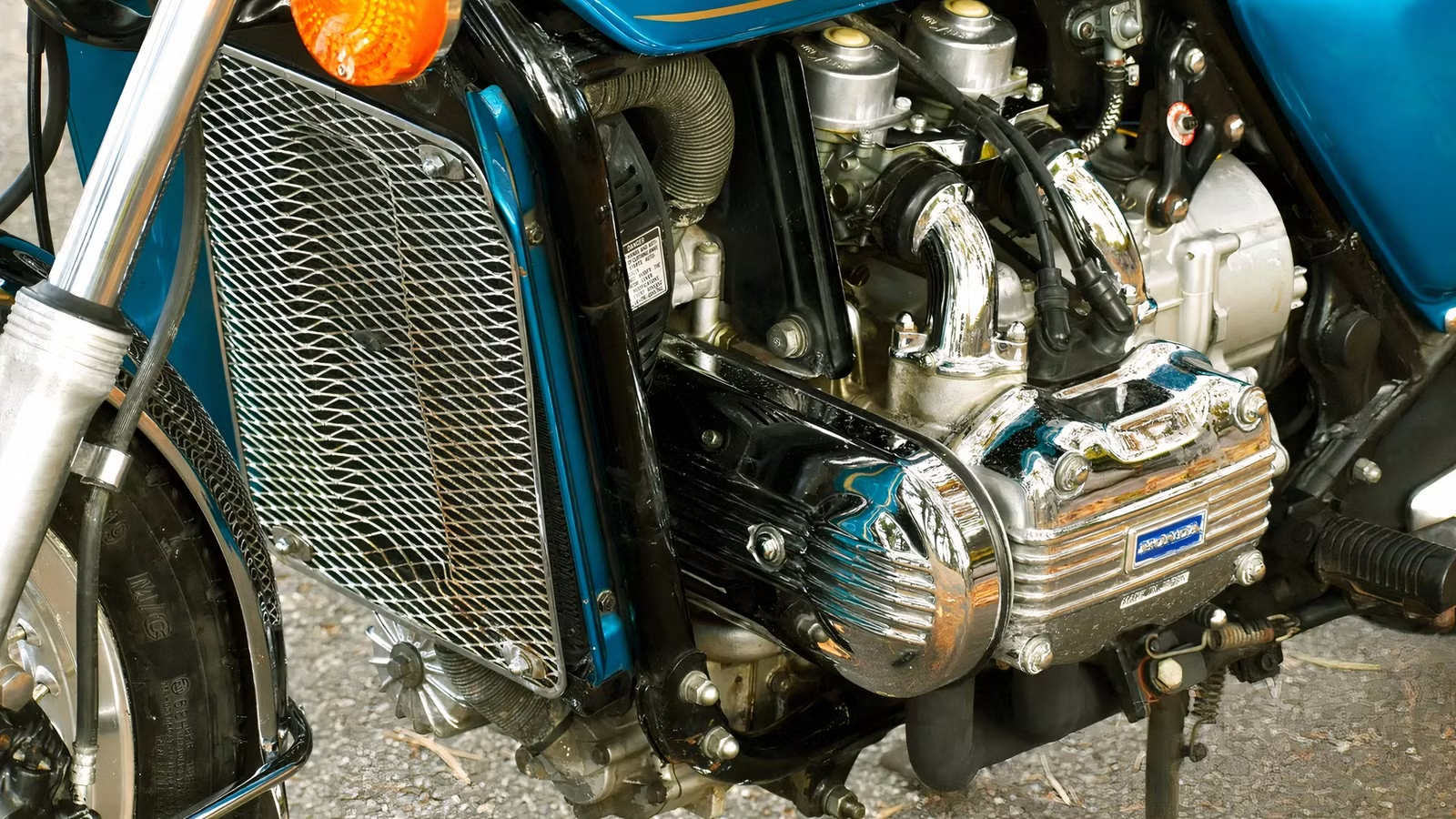
For starters, the Honda Gold Wing GL 1800 is the holy grail of gran tourer motorcycles. Every rider ends up in the Gold Wing as their ultimate destination. Every generation of the Gold Wing gets bigger without asking more of the engine. Displacement grew to 1,833cc, two-valve heads gave way to four valves per cylinder in 2018, and riders now choose a six-speed manual or a seven-speed dual-clutch automatic. Peak output lands at 125 hp, numbers the GL1000’s engineers never dreamed of. Forum regulars routinely report 200,000 to 400,000 miles on stock internals, belts and bearings the only real maintenance.
4
Suzuki Boulevard M109R
Understress ratio 0.07 hp per cc

The M109R looks like it should break every rule here. Its 1,783cc V-twin claims 123 hp, dwarfing anything else on this list. Run the math, though, and the specific output lands at 0.07 hp per cc, basically identical to the Gold Wing one spot above it. Suzuki built this engine with the same restraint as its smaller siblings, with oversized pistons and friction-reducing coatings doing the same job they do on the SV650.
Owners back it up, with reports of 100,000-plus miles on the original bottom end and one forum regular reaching 143,000 with a single clutch basket swap. The honest complication lives in the gearbox, not the engine. A documented oil-flow fault has cost a significant share of M109Rs their second gear between 20,000 and 60,000 miles, appearing across owner forums often enough to take seriously. The engine held up its end. The transmission is this list’s one asterisk.
3
Honda GL1000
Understress ratio 0.08 hp per cc

This is the bike that started the whole conversation, and it earns the spotlight. Honda’s GL1000 broke cover in 1975 as the original Gold Wing, a 999cc flat-four laid on its side and liquid-cooled, revving to 7,000 rpm for a peak of 78 hp. At launch, period press and media tests clocked it second only to the Kawasaki Z1 in the quarter mile. Allan Zahrt of Wisconsin bought his 1975 GL1000 new in 1976 for $2,348.59, tax and title included. On July 29, 2017, his odometer rolled to one million miles. He rebuilt the engine three times along the way, and that matters more than a flawless number would. Understressed engineering still asks for maintenance. It just rewards that maintenance far longer than most bikes ever get the chance to prove.
2
Suzuki V-Strom 650
Understress ratio 0.10 hp per cc

The V-Strom 650 is the SV650’s cousin, built for gravel instead of pavement, sharing that same 645cc V-twin under a different tune. Independent dyno testing puts real world output around 67 hp, enough for dirt roads without overworking the engine. There are records online of riders accumulating all the way up to 104,000 miles without major mechanical work or issues. Suzuki markets this bike explicitly for exactly that kind of high mile use, and the ownership record backs the pitch up.
1
Suzuki SV650
Understress ratio 0.12 hp per cc

Here is where this list has to be honest with itself. The SV650’s 645cc V-twin claims around 75 hp, working out to 0.12 hp per cc, easily the hardest-working engine on this page. Suzuki still built in a margin, resin coated piston skirts engineered to cut friction and stretch engine life, and it shows. There are examples of SV650s that have logged 80,000 hard miles with nothing but consumables replaced, and that is not an outlier, it is the normal story.
The used market treats 30,000 miles on an SV650 as high mileage purely because of how hard these get ridden, not because the engine can’t take it. That is the lesson at the bottom of this ranking. Even the entry with the least room to spare had more than enough to work with, and that is the trick these ten motorcycles share, whether the number is 0.055 or 0.12.
Sources: Mecum, Bring A Trailer, Honda, Suzuki, Kawasaki

Related posts


Latest Post


No Comments