
The Oldsmobile That Pushed The Limits Of FWD Performance
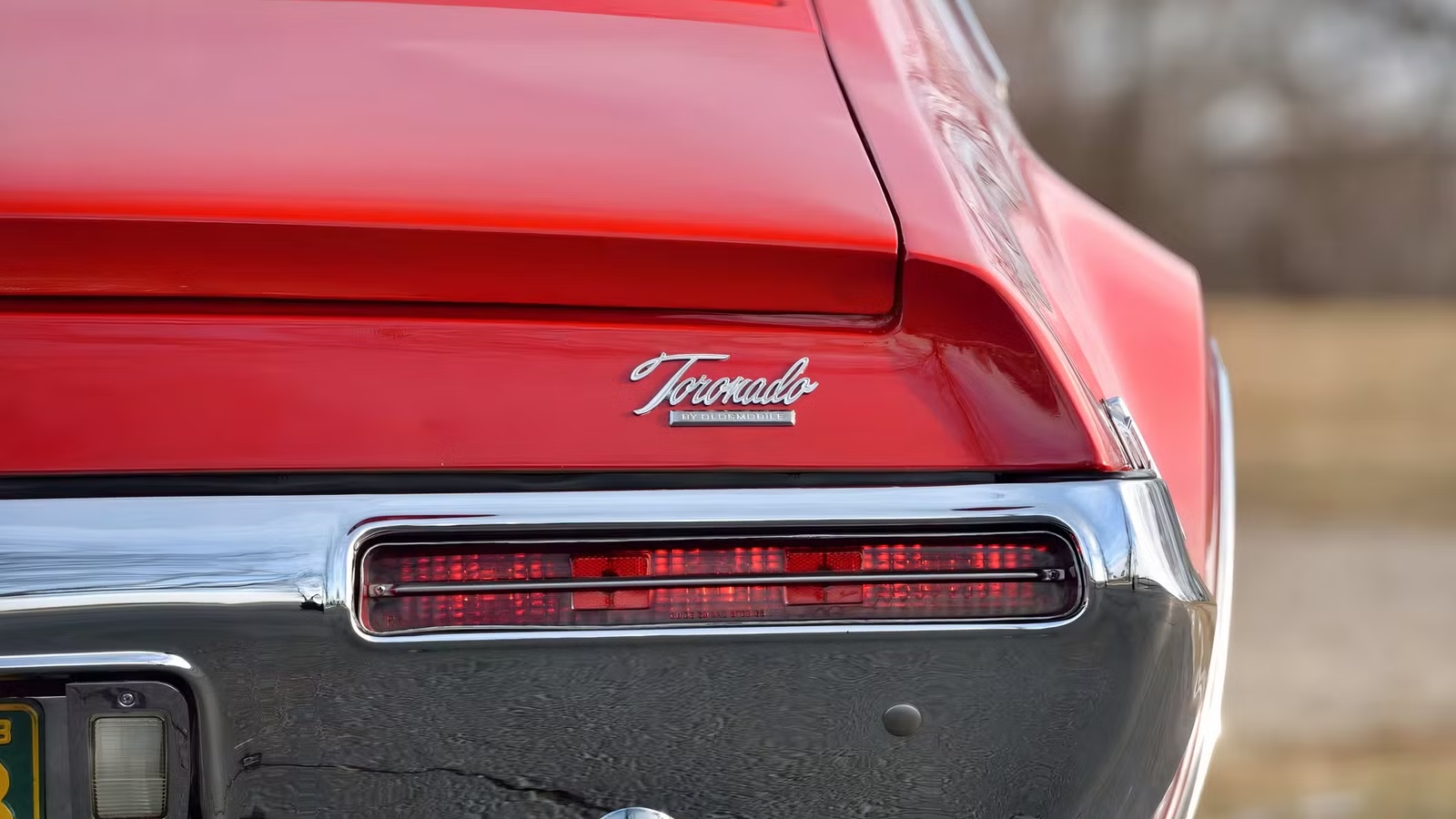
Oldsmobile is now a bit of a forgotten brand in the North American car scene. But, there was a time when it made some of the best cars the American auto industry had to offer. One of the best of those is the car we’re going to talk about now. This car pushed the limits of what could be achieved with old-school American performance. Plus, it unintentionally helped to create one of the quirkiest vehicles General Motors ever made.
During The Golden Age Of American Cars, Some Manufacturers Did Weird Things
The golden age of American Cars (the mid-1960s to early 1970s) was a time when the American automotive industry was riding high. They didn’t have to worry about the effects of the oil crisis and worries about global warming yet. They also didn’t have to worry too much about competition from European and Japanese brands. As a result, they were allowed to run wild and free with what they could do with their cars, and the market absolutely ate it up.
This meant we got some very weird cars out of North America. Plenty of homologation specials for NASCAR and drag racing got built, putting massive engines into otherwise ordinary cars. There were also some bold styling experiments, like the AMC Marlin fastback coupe. One of the wildest ‘dare to be different’ moments, though, was when Oldsmobile decided that it needed a luxury coupe to compete in an emerging niche in the American car market.
Oldsmobile Decided To Do Something Very Unusual For Its Ford Thunderbird Competitor


In the 1950s and 1960s, the Ford Thunderbird made everyone realize that there was money to be made out of the Personal Luxury Car niche. Every big American automotive brand wanted to have a luxury coupe in their lineup to get into this market segment, and compete with the T-bird. Oldsmobile was one of those brands that wanted in. Instead of making a cookie-cutter Personal Luxury Car by numbers, though, it decided to do something a little different. How different did Oldsmobile go? Well, it totally flipped how a big, American luxury car should be on its head.
The 1966-1970 Oldsmobile Toronado Combined Big-Block Power With A Front-Wheel Drive Layout

If you just take a look at the first-generation Oldsmobile Toronado, you can already tell it’s a bit different from everything else from its era. Its quirky styling is only the start of its weirdness, though. Under the skin, it’s one of the oddest big-block luxury cars from the 1960s. That’s for one major reason. This car is front-wheel drive.
This front-wheel drive powertrain was actually very well-engineered. It was able to fit into a hood space that was no smaller than what you’d see on a rear-wheel drive car from the same era.
The first-generation Toronado had two engines throughout its life. They were both versions of Oldsmobile’s Rocket V8. The smaller version was 425 cubic inches in size, and produced 385 horsepower and 475 lb-ft of torque. This was fitted to cars produced from 1966–1967. Cars produced from 1968–1970 got the bigger 455 version, producing 375 hp and 510 lb-ft of torque. If the W-34 option code was specified, that 455 V8 became a performance monster with 400 hp and 500 lb-ft of torque. It’s that W-34 version that pushed the boundaries of American muscle at the time, as it didn’t deviate from the front-wheel drive layout. This made it the most powerful front-wheel drive car ever produced.
Making It Front-Wheel Drive Actually Made Sense

It might seem absolutely crazy to give a car with genuine muscle car levels of performance front-wheel drive. That’s especially true when you take into account that front-wheel drive cars can suffer from torque steer when higher and higher outputs are put through the drivetrain. But, those issues don’t seem to have happened with the first-generation Toronado. In fact, the front-wheel drive layout has been highly praised for how driveable it is. Making the Toronado front-wheel drive gave this big luxury barge excellent traction and high-speed stability. Those two characteristics gave it a noticeable advantage over its more conventional, rear-wheel drive competitors.
The Front-Wheel Drive Layout Was Kept For Later Toronado Generations

As you might have gathered, the front-wheel drive powertrain in the Toronado worked a treat. It worked so well, in fact, that Oldsmobile kept it for all the model’s future generations. Interestingly, early examples of the second-generation Toronado also kept that 455 V8. That made it one of the last proper big-block luxury cars in America.
The Powertrain Was So Solid, It Was Used In Heavy-Duty Motorhomes
This front-wheel drive powertrain wasn’t just good for luxury cars, either. It turned out to be so solid that General Motors poached it to use in one of their most audacious projects ever. That’s the GMC Motorhome, which was produced from 1973–1978. It used the second-generation Toronado’s running gear wholesale, including that 455 V8 from the early examples.The use of the Toronado’s powertrain actually fit in with the ethos of the GMC Motorhome quite well, as it was supposed to be a luxury option for top-end customers.
This big motorhome ended up being one of the quirkiest vehicles General Motors ever made. While it ended up being a flop, it has gained a cult following among enthusiasts who adore it because of its uniqueness.
These Early Toronados Can Be Picked Up For Bargain Prices

Many cars produced during the golden era of the American auto industry have become incredibly valuable collector’s pieces. That’s not the case with the Oldsmobile Toronado, though. Despite being pioneering cars from an engineering standpoint, they’ve been largely passed over in favor of more typical Personal Luxury Cars. As a result, those early Toronados are still bargain buys most of the time. The average used value for the first-generation Toronado at the moment is around $19,486. One 1969 example sold for just $8,800 at Mecum’s 2026 Kissimee auction.
The nicest examples are starting to sell for higher prices, though. A 1966 example in pristine condition sold for $49,000 in 2023, while two 1970 examples sold for $41,000 and $41,500 respectively in 2022. If you’ve ever wanted to own an early Toronado, now might be the time to buy in before prices climb further.
Sources: Bring A Trailer, Classic.com, GMC, Mecum Auctions, Oldsmobile

Related posts



Latest Post


No Comments